Knowth Kerbstone Numbering System
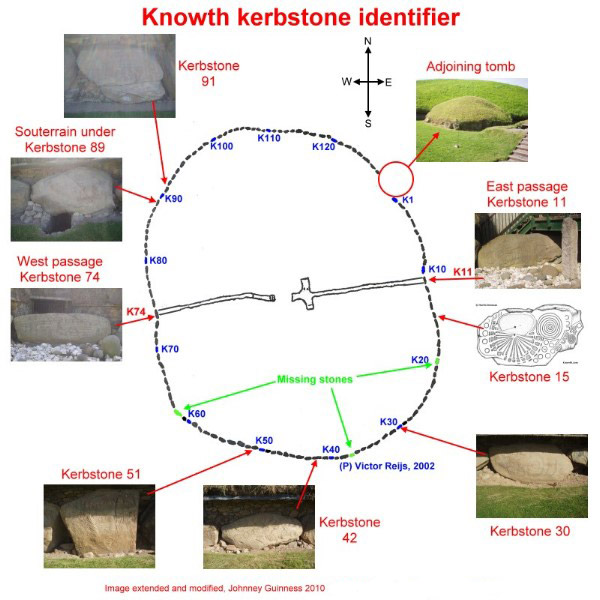
The George Eogan numbering system runs from K1 to K127 around the kerb of the Great Mound at Knowth. Martin Brennan used a different system based on compass directions: North-East, South-East, South, South-West, West and North-West. Victor Reijs compiled the comparison table below (only stones mentioned by Martin Brennan are included). Every entry links to the dedicated kerbstone page on this site; the full gallery is at Knowth kerbstones.
Knowth Kerbstone K5
 Knowth Kerbstone K5 (NE6).
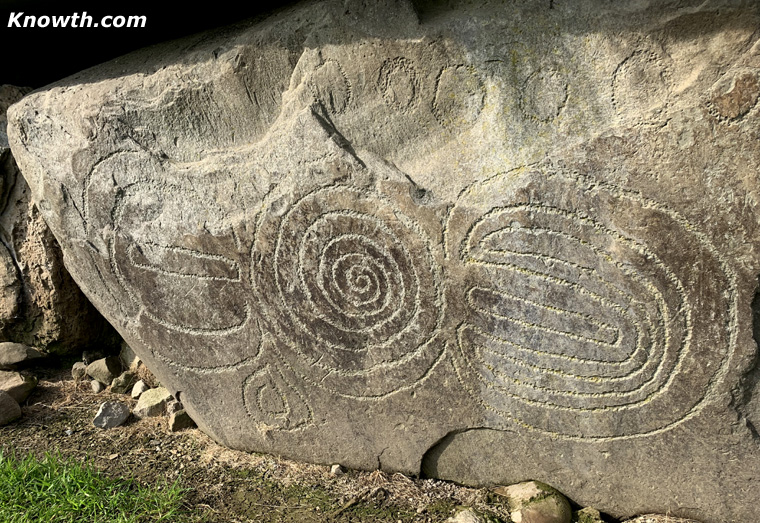
The crescent represents the moon; Kerbstone K5 (NE6) shows how the crescents measure time. A set of six circles (six months of the year?) extend across the right half of the stone from above the centre of a spiral with six turnings. The circle and crescent at the far left also suggest the moon. See The Stones of Time, p. 137.
Knowth Kerbstone K15 - the Sundial Stone
 Knowth Kerbstone K15 - the Sundial Stone (SE4).
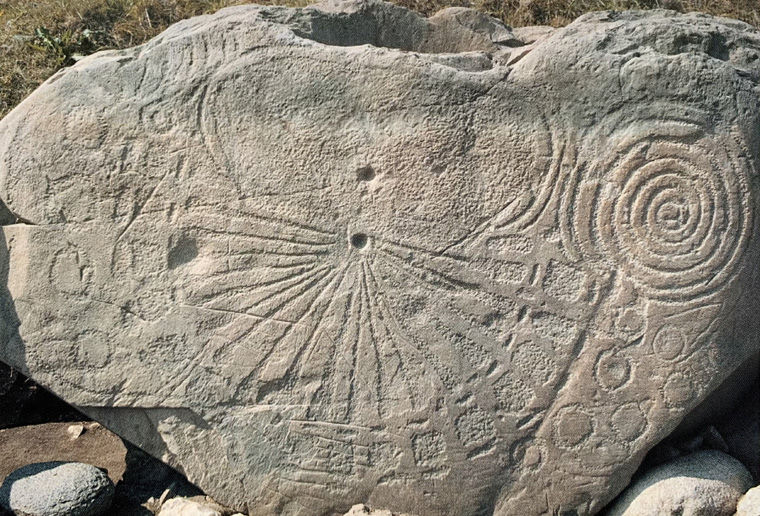
Brennan illustrated and discussed Kerbstone K15 (SE4) as the Sundial Stone. A semi-circle of about twenty picked lines radiates from a central cupmark, widening outward and terminating in small rectangles around an oval motif. Brennan read this fan of rays as a sundial face and argued that such panels on the Knowth kerb formed part of a Neolithic solar calendar, complementing the lunar motifs he identified on stones such as K5. See The Stones of Time and The Boyne Valley Vision.
Knowth Kerbstone K11 - eastern passage entrance
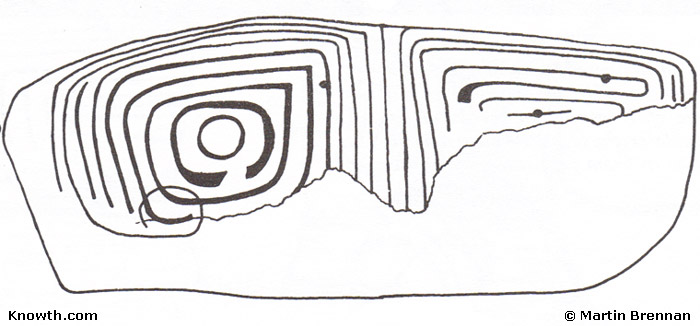
In Brennan's compass notation, Kerbstone K11 is EAST0, the zero point of the eastern arc at the entrance to the eastern passage. The greywacke block is more than three metres long, with a central groove that aligns with the standing stone outside and with the passage within. Chevrons, spirals and deeply picked rectangular panels cover the main face and top surface. Brennan treated this entrance kerbstone as a primary architectural marker in his reading of Knowth as an astronomical observatory. See The Stones of Time.
The Megalithic Art of the Passage Tombs at Knowth, Co. Meath
Excavations at Knowth Volume 7: The Megalithic Art of the Passage Tombs at Knowth, Co. Meath
The complex of passage tombs at Knowth is dated c. 3200-2900 BC, and this volume deals with one of the most significant aspects of the site. It presents a complete catalogue of the 390 recorded carved stones at Knowth, through descriptions, drawings and photographs.
Six main styles of art have been identified and these are discussed, together with the motifs and techniques employed. The Knowth carvings constitute c. 46% of all such art in Ireland, and the volume sets the Knowth art in the context of the other Irish carvings, those in western and northern Britain, and also the somewhat earlier art found on megalithic tombs in Atlantic Europe.
Purchase at Amazon.com or Amazon.co.uk. View or download at Digital Repository of Ireland.