Knowth Kerbstone K56
Kerbstone K56 is one of the 127 kerbstones numbered in Professor George Eogan's record of the Knowth monument. It is located on the south-western side of the great passage tomb mound.
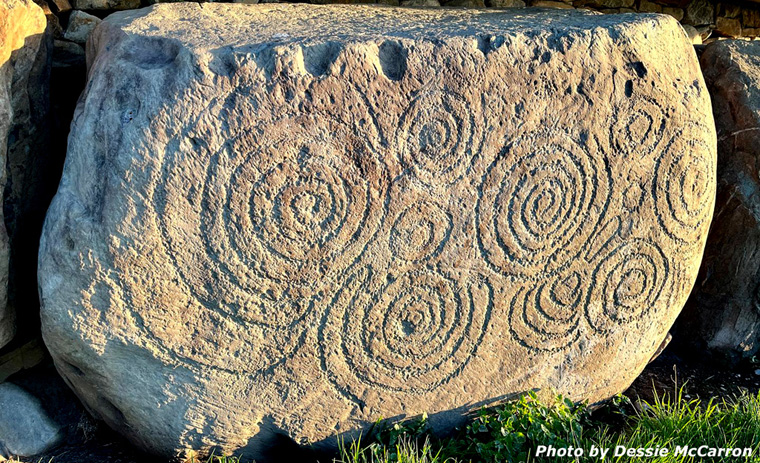 Knowth Kerbstone 56 - K56.
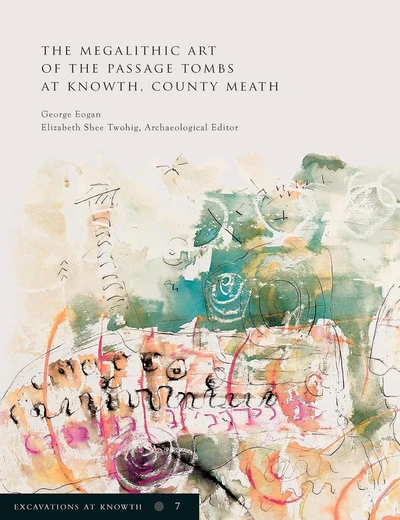
The Megalithic Art of the Passage Tombs at Knowth, Co. Meath
Description of Kerbstone 56
A number of motifs are picked on the main face of the stone, and the overall impression is one of an unusually well-planned and rhythmic whole. A medium-sized or large, rounded point is most commonly used, but the pickmarks near the top of the stone are shallower, probably due to weathering. There are five anti-clockwise spirals, three in a row and two in the spaces beneath them.
From the left, the motifs comprise a large spiral of five turns; the outer end of the spiral then doubles back for two-thirds of the way around the spiral and there is a short outer arc at the lower-left. To the upper-right of this there is a spiral of three-and-a-half turns, with a double circle below it, and lower down a spiral of four-and-a-half turns, which also doubles back on itself for two-thirds of a turn and then doubles back again for about a quarter turn.
In the middle of the stone is a spiral of five-and-a-half turns, and beyond this, to the right, are two spirals of three turns each. The space to the right of the middle spiral has a double circle at the top, with a small circle below, then a wedge shape with rounded corners, and below that a semi-circle facing down towards a set of four concentric arcs. Three chevrons are picked between the two spirals at the right.
Excavations at Knowth Volume 7: The Megalithic Art of the Passage Tombs at Knowth, Co. Meath
Purchase at Amazon.com or Amazon.co.uk. View or Download at Digital Repository of Ireland.
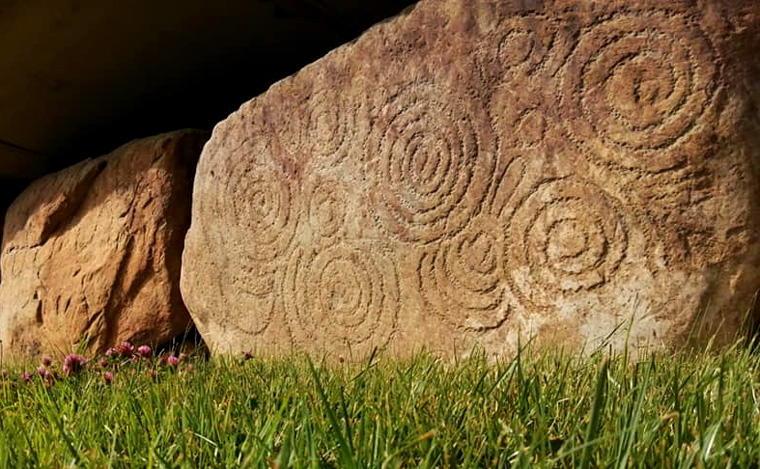 Knowth Kerbstone 56.
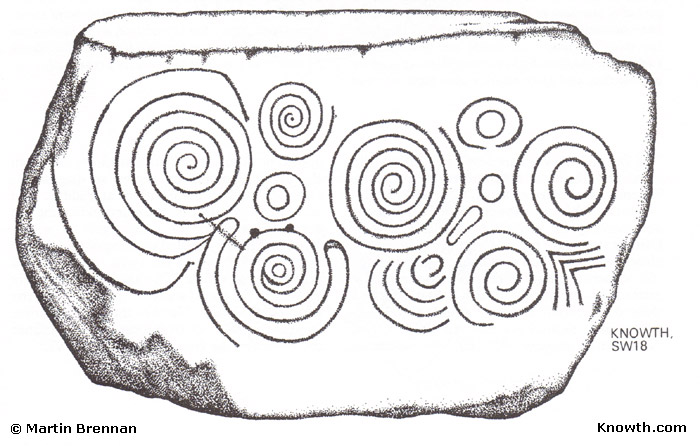 Kerbstone K56 (SW18) by Martin Brennan - Left-handed spirals are organised in a geometric pattern.
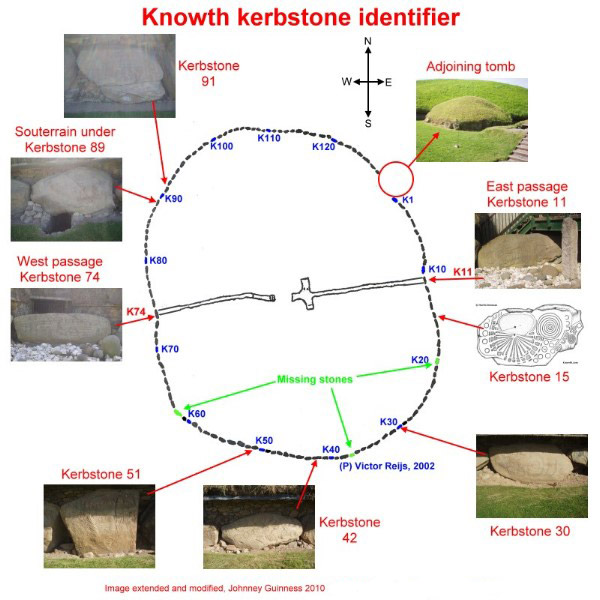
Knowth Stone Age passage tomb
Kerbstone K56 is one of the stones encircling the Great Mound at Knowth, recorded in the numbered kerb sequence from K1 to K127. The mound cannot be visited independently. Access is by guided tour from the Brú na Bóinne Visitor Centre at Donore, on the south bank of the Boyne, with a shuttle bus to the site and interpretation by trained guides.
The first farmers reached the Boyne Valley around six thousand years ago, probably travelling by river. They cleared woodland, cultivated wheat and barley on rich soils, and kept herds of cattle, sheep, pigs and goats before committing enormous communal labour to the great tombs.
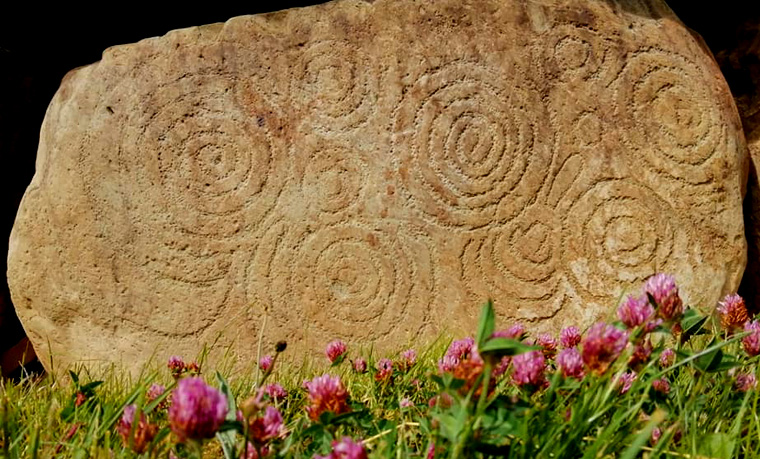 Knowth Kerbstone 56.
The great tombs were laid out as part of a deliberate ceremonial setting above a bend in the River Boyne. Knowth occupies rising ground with wide views across the valley, placing it firmly within a prehistoric landscape that later tradition remembered as Brú na Bóinne, the royal seat of the Boyne.
Carvings on the end stone of the eastern passage have been interpreted as a schematic map of the moon's surface, among the earliest attempts anywhere to record the appearance of the lunar maria. Other motifs on the site may relate to eclipses and to the interplay of sun and moon in Neolithic reckoning.