Knowth Kerbstone K11
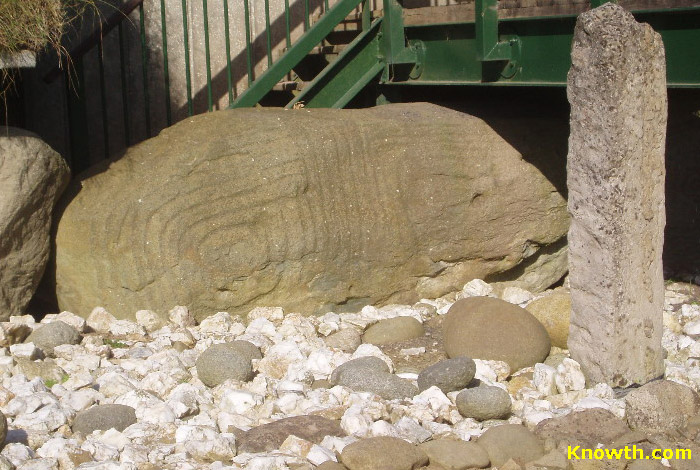
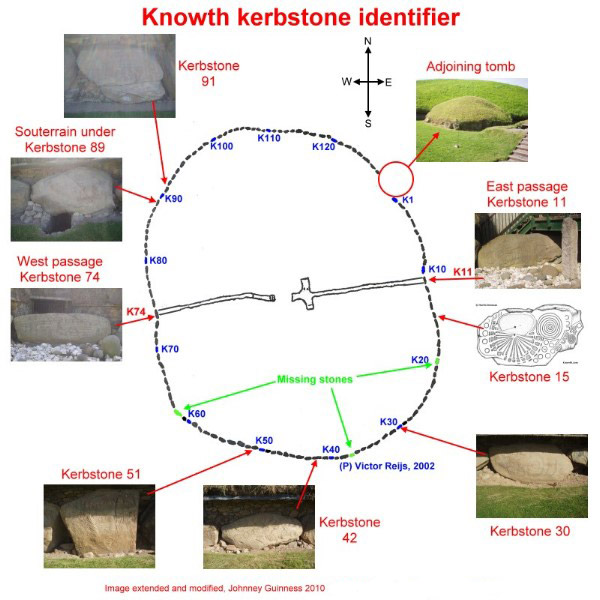
Kerbstone K11 is one of the 127 kerbstones numbered in Professor George Eogan's record of the Knowth monument. It is located at the entrance to the eastern passage of the great passage tomb mound.
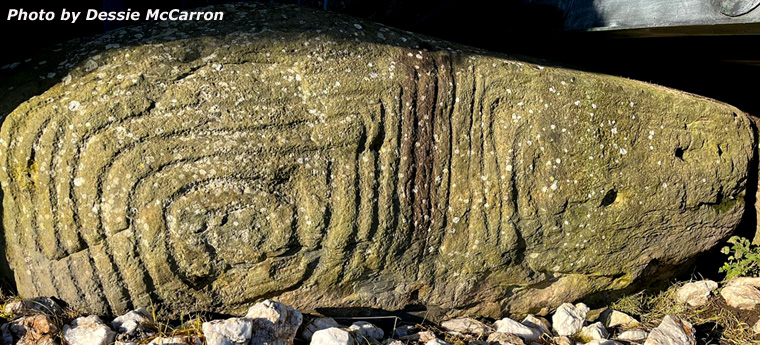 Knowth Kerbstone 11 | Photo by Dessie McCarron.
Knowth Kerbstone K11, the entrance stone of the Eastern Tomb. The greywacke stone is 3 metres (10 foot) long, greywacke is a type of coarse sandstone. The central groove on the stone is directly in line with the standing stone outside as well as the long passage within.
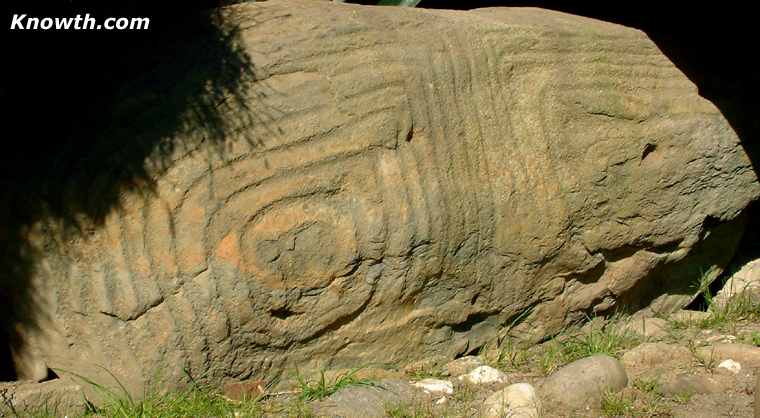 Knowth Kerbstone K11 | Brú na Bóinne UNESCO World Heritage Site.
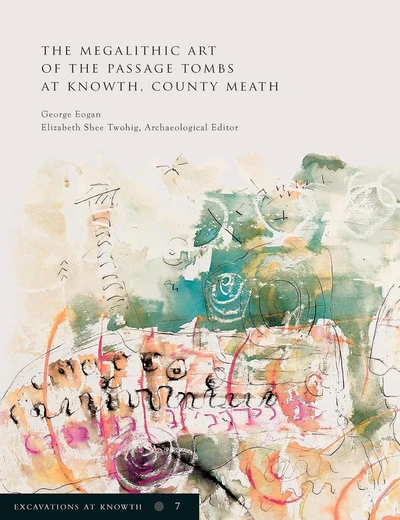
The Megalithic Art of the Passage Tombs at Knowth, Co. Meath
Description of Kerbstone 11
Stage 1 comprises a number of motifs, which underlie the Stage 2 carvings that dominate the stone. They include an incised grid pattern on the left of the main face, with a smaller example just to the right, Low down is a lightly picked two-turn clockwise spiral enclosed in an arc (or possibly a third turn of the spiral). A vertical row of chevrons runs down the centre of the main face of the stone. On the top surface, to the left is a double circle with an arc between the circles and two further arcs outside them.
Stage 2: the carving belonging to this stage occupies both the whole of the stone's main surface and its top, and is arranged around the natural contours of the stone. The picked lines are broad and ribbon-like. A vertical line slightly right of centre is placed in a natural hollow of the stone and continues onto the top surface. A narrower line lies parallel to it on the right, and there is a short, vertical line between the two. Two large motifs occupy the resulting spaces on the stone.
That on the left is more complete, and from the centre outwards consists of a gapped circle, another around this with slightly squared upper corners, and a third, which is distinctly squared on the top-right. Five boxed rectangles, which are open at the bottom, enclose this, again with the top-right corner being more angular than the top-left. An arc runs between the second and third rectangle from the outside. At the bottom-left these clearly overlie the stage 1 spiral. The right half of the stone has a similar motif, but this is incomplete on the lower-right, where the stone is very irregular. All these rectangles are deeply picked (averaging 10mm in depth), and the natural surface stands out as ridges between the picked channels/ribbons.
Excavations at Knowth Volume 7: The Megalithic Art of the Passage Tombs at Knowth, Co. Meath
Purchase at Amazon.com or Amazon.co.uk. View or download at Digital Repository of Ireland.
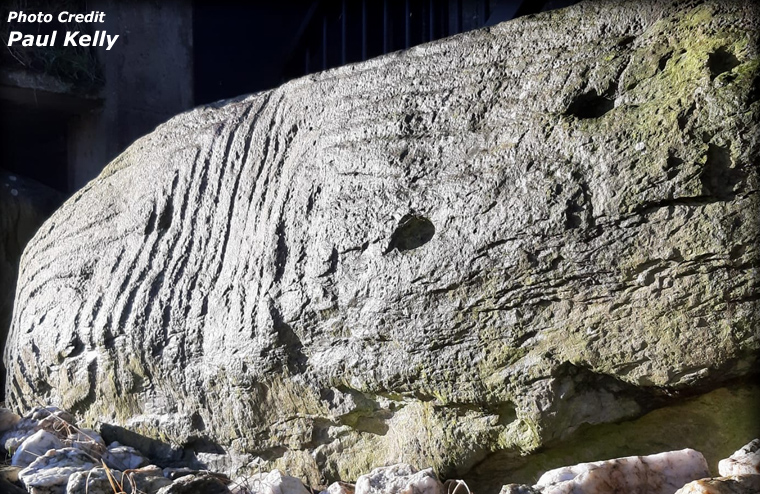 Knowth Kerbstone K11 | Photo by Paul Kelly.
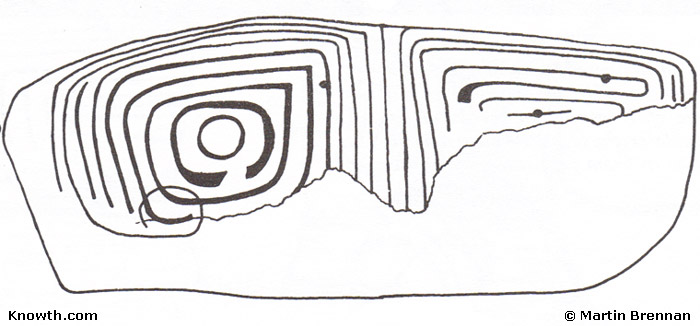 Kerbstone K11 (East0) - Drawing by Martin Brennan.
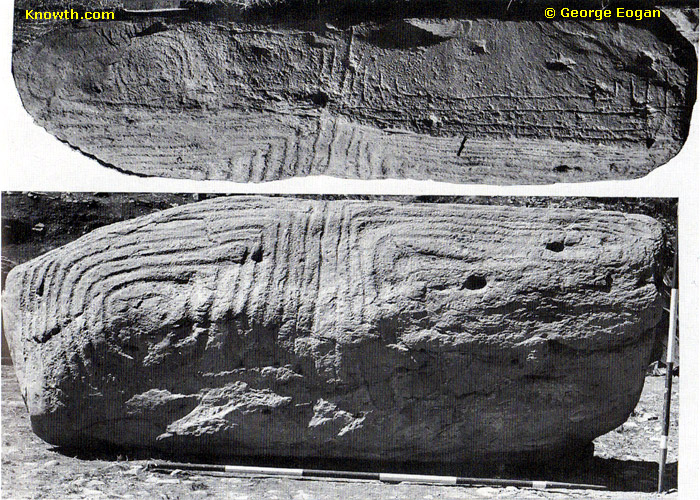 Front and top of Knowth Kerbstone 11 the entrance stone to the Eastern tomb | Photos by George Eogan.
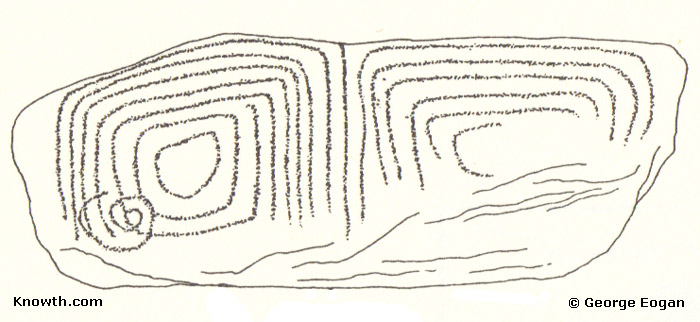 Drawing of Kerbstone K11 by George Eogan from Knowth and the passage-tombs of Ireland.
 Knowth Kerbstone 11 | Brú na Bóinne UNESCO World Heritage Site.
Knowth Stone Age passage tomb
Among the surviving kerbstones at Knowth, K11 contributes to the largest open-air gallery of Neolithic art in western Europe. The stone stands at the entrance to the eastern passage of the Great Mound, where the kerb ring frames the opening of the passage.
Carved in greywacke over three metres long, K11 was worked in at least two stages. A central groove aligns with the standing stone outside and with the passage within, while chevrons, spirals and deeply picked boxed rectangles spread across the main face and top surface in one of the most elaborate entrance panels at Knowth.
Beyond the entrance, the eastern passage and chamber have a combined length of 40 metres (131 feet). The eastern chamber has three recesses and a corbelled roof, a plan comparable to Newgrange. Decorated orthostats line the passage, and the end stone has been interpreted as a schematic lunar map among the richest carvings in the tomb. The western passage and chamber, reached from the opposite side of the mound, measure 34 metres (112 feet) in total.
Few Irish passage tombs combine entrance kerb art with a full decorated kerb ring, and K11 is the principal example on the eastern side of the mound. Visitors on guided tours can view the stone as part of the kerb circuit, while the passages and chambers themselves remain closed for conservation.