Knowth Kerbstone K5
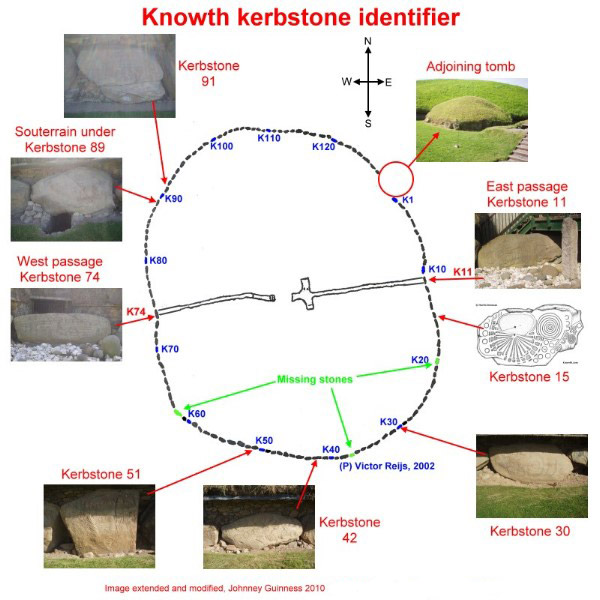
Kerbstone K5 is one of the 127 kerbstones numbered in Professor George Eogan's record of the Knowth monument. It is located on the north-eastern side of the great passage tomb mound.
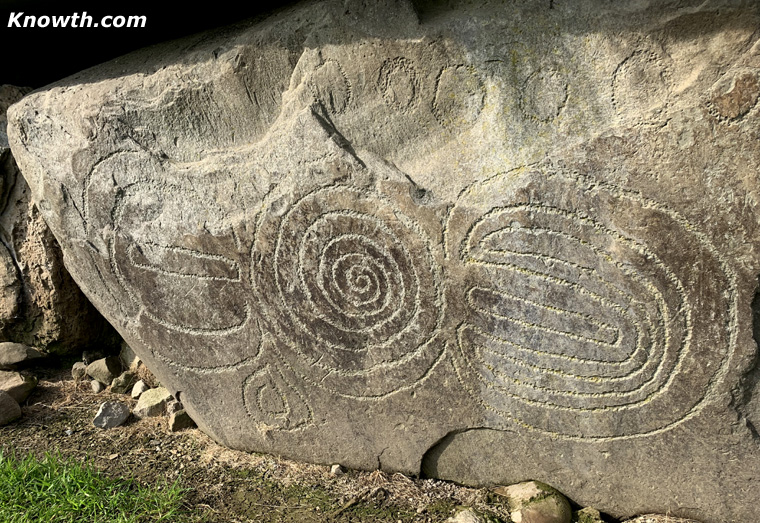 Knowth Kerbstone K5 | Brú na Bóinne UNESCO World Heritage Site.
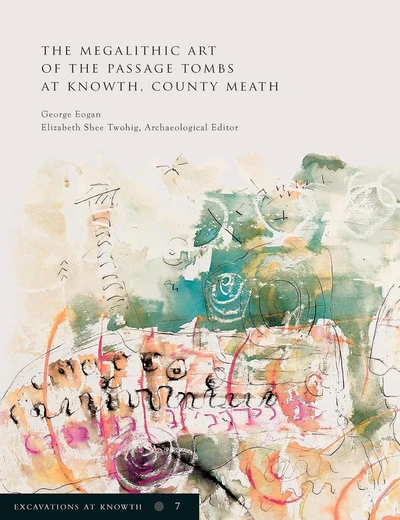
The Megalithic Art of the Passage Tombs at Knowth, Co. Meath
Description of Kerbstone 5
In the centre there is a clockwise spiral of six turns, with an outer arc at the bottom. The spiral is flanked on each side by C-shaped motifs/gapped circles, opening against the spiral. Each encloses a long oval/rectangular motif. The C-motif on the right is the more complex, with an outer C enclosing two sets of double closed Cs. The C-motif on the left is simply doubled. A gapped double circle is squeezed low down between this and the spiral.
At the top-right of the stone there is a row of seven small circles; that on the right is picked on a flaked surface. At the top-left corner of the stone there is a small U and a gapped circle. The main tool used on this face had a small-to medium-sized, rounded point, but in some cases a chisel with a narrow cutting edge was also used. In some cases the pickmarks merge to form a ribbon. Some dispersed marks on the top and the right half of the main face may be natural.
Excavations at Knowth Volume 7: The Megalithic Art of the Passage Tombs at Knowth, Co. Meath
Purchase at Amazon.com or Amazon.co.uk. View or download at Digital Repository of Ireland.
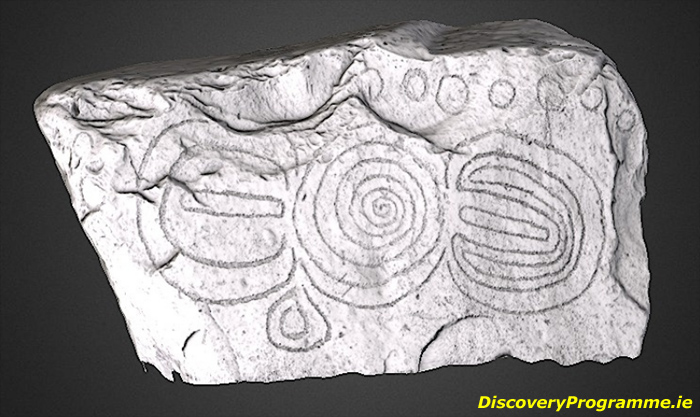 Sketch from scan of Knowth Kerbstone 5 by The Discovery Programme.
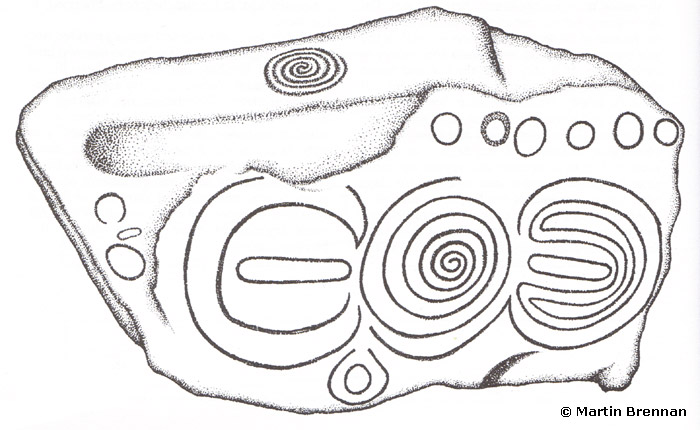 Kerbstone K5 (NE4) - Drawing by Martin Brennan.
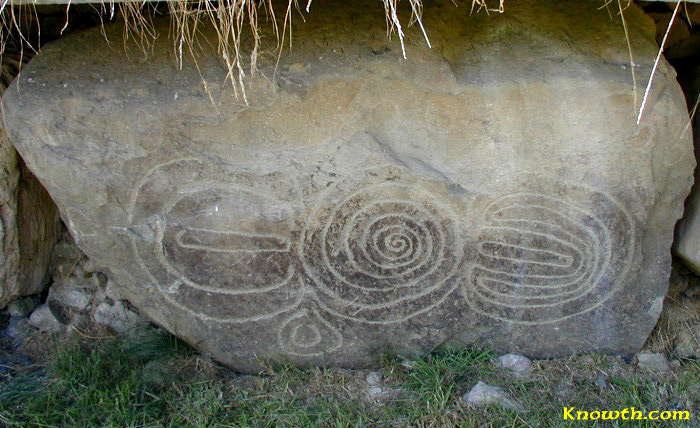 Knowth Kerbstone 5 | Brú na Bóinne UNESCO World Heritage Site.
Knowth Stone Age passage tomb
Stone K5 belongs to the kerb ring that defines the oval footprint of the Knowth passage tomb in the Boyne Valley. Carvings on the end stone of the eastern passage have been interpreted as a schematic map of the moon's surface, among the earliest attempts anywhere to record the appearance of the lunar maria. Other motifs on the site may relate to eclipses and to the interplay of sun and moon in Neolithic reckoning.
Iron Age people buried their dead near the mound and built a substantial ring-fort settlement beside it, reusing a site that already carried great prestige. Later medieval farmers enclosed the summit within a grange, leaving traces still visible from the air.
The eastern passage and chamber together extend 40 metres (131 feet), while the western passage and chamber extend 34 metres (112 feet). The eastern chamber has three recesses and a corbelled stone roof of the kind also seen at Newgrange (eastern tomb at Knowth).
Twin passages at Knowth face broadly east and west. Older ideas that they targeted equinox sunrises and sunsets have given way to wider interpretations that allow both solar and lunar observation, and perhaps calendrical counting, among the motives of the builders.