Articles and Papers - Ancient Ireland
Knowth Articles
- Knowth - A Virtual Tour - Bryn Coldrick.
- Spirals within Spirals: Stones have Stories to Tell - James Nemec.
- Knowth - Secrets from the grave - an article from The Irish Times.
- Knowth by Jeffrey May - an article from Current Archaeology.
- Megalithic Art at Knowth - from Minds or Moons? - Laurie Darcus.
 Knowth Megalithic Passage Tomb in the Boyne Valley.
Newgrange Articles
- Winter Solstice at Newgrange by Lucy Caldwell.
- Incest uncovered at the elite prehistoric Newgrange monument - Alison Sheridan.
- A Passage to the Afterworld - the story of New Grange adapted from an article first published in the The World Of Hibernia magazine.
- Newgrange: Ireland's ancient answer to the pyramids - Laura Harrison McBride
- Prof. Michael J. O'Kelly who excavated and restored Newgrange.
- Newgrange: empowering the salmon of wisdom - Philip Coppens.
- The Bull of Newgrange: a metaphor for Halley's Comet? - Gilbert de Jong.
- Newgrange Excavation Report Critique - Alan Marshall.
- Ireland's burial mounds hold many mysteries - Jim Sajo.
- Computing the Winter Solstice at Newgrange - Rick Doble.
 Newgrange Megalithic Passage Tomb.
Dowth Article
- Dowth: Where Darkness, Stone and Memory Meet - Harry Warren.
Loughcrew Articles
- Reflections on Loughcrew and Newgrange - Tim O'Brien.
- Loughcrew Equinox Reflection - Sally McKenna.
- A taste of the unexpected: subverting mentalités through the motifs and settings of Irish passage tombs.
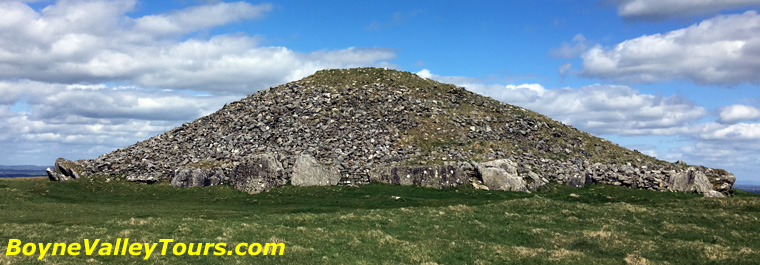 Loughcrew Cairn T.
Fourknocks Articles
- Fourknocks - An interpretation - Martin Dier.
- Magic of Fourknocks - Brendan Matthews.
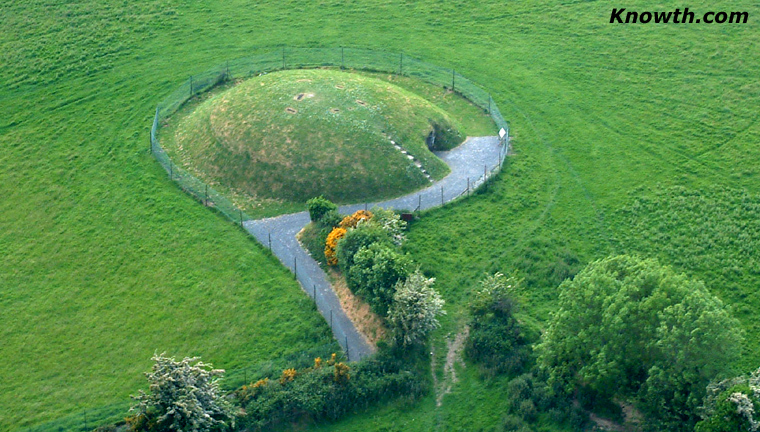 Fourknocks Megalithic Passage Tomb.
General Articles
- Stonelight Archives - Pioneering research of Martin Brennan.
- Ireland in prehistory - A concise account - Desmond Johnston.
- Some Thoughts on the Celts - Origin, Religion and Language - Desmond Johnston.
- Aspects of the Megalithic Era - Desmond Johnston.
- Fourknocks - An interpretation - Martin Dier.
- Messages from the Monuments - How Neolithic Monuments Communicate About Religion and Status - Paul K. Wason.
- We Have Never Been Material - Andrew Cochrane.
- Monuments and Access - The interpretation of Neolithic Monuments - Dr. Liam Kilmurray.
- Cairnpapple Prehistoric Site - Scotland - Jackie Queally.
- The Valley of the Boyne - from 'The Charm of Ireland' by Burton E. Stevenson, published in 1914.
- Vale of the Boyne and Royal Meath - published in 1898 for the Great Northern Railway Company.
Downloadable Papers
- Pigs, pannage and the winter solstice at Newgrange - Eric Guiry and colleagues, 2025. Pig bones outside the sealed tomb belong to a short burst of slaughter around 2600 to 2450 BC. The animals were fattened on autumn nuts and killed in the weeks around midwinter, so gatherings at the entrance continued after the chamber closed.
- The 'King' of Newgrange? A critical analysis - Research Article 2025. The petrous fragment NG10 is from a child of a very close incestuous union, and that finding fed the 2020 headlines. The chamber had been disturbed for centuries, and the human remains are a mix of burnt and unburnt bone from several people.
- Social and Genetic Relations in Neolithic Ireland: Re-evaluating Kinship 2025. People placed in the great passage tombs were usually distant relatives, often no closer than sixth cousins. Kinship here was built through shared labour, seasonal gatherings and the long work of the monuments.
- Winter Solstice Phenomenon at Newgrange: Research Report 2024. High-resolution photographs and video, commissioned by the National Monuments Service, follow sunlight from the roof-box along the passage and into the chamber. The record shows how the tomb was built to catch the midwinter sunrise.
- Megalithic art on the Great Circle at Newgrange - Ken Williams, 2023. Picking on four of the Great Circle stones had been missed for decades, hidden by lichen and flat light. Oblique lighting and photogrammetry pick out the marks, which match techniques already known on the kerb and in the passage.
- Beyond Newgrange: Brú na Bóinne in the later Neolithic. Stephen Davis and Knut Rassmann place later Neolithic monuments on the ground between the passage tombs and the Boyne. Henges, timber circles, palisades and avenues show in LiDAR and in the cropmarks of the dry summer of 2018.
- The 2020 Newgrange DNA study. Lara M. Cassidy and colleagues sequenced genomes from Irish tombs, including a man at Newgrange born of a first-degree incestuous union. They read distant kin links between the great passage tombs as a sign of rank.
- Newgrange from the air, the 2018 interim report by Tom Condit and Mark Keegan. Drought in June and July 2018 turned buried ditches and post-holes into cropmarks on the floodplain below the tomb. The report maps the Geometric Henge, the enclosures beside it and a long palisade running towards the ridge.
- The Ritual Origins of the Roof-Box at Newgrange - Laura E. Freeman Marr. Freeman Marr follows the roof-box from its rediscovery in O'Kelly's excavations to the winter solstice as a public ritual. The thesis sets Neolithic ideas of the opening beside the way tourism now interprets it.
- Facing the Cairn at Newgrange - Robert Hensey and Elizabeth Shee Twohig, 2017. They set the excavation records beside letters about the reconstruction and stone facings at other cairns. A quartz facing above the kerbstones is the reading they find most convincing, though the height and look of the original wall cannot be recovered exactly.
- Brú na Bóinne World Heritage Site Management Plan, 2017. The plan sets out how the Bend of the Boyne is looked after, a core of about 780 hectares and a buffer of 2,500 hectares around Newgrange, Knowth and Dowth. Conservation of the monuments sits alongside farmland, research and the visitors who come to a site inscribed in 1993.
- Knowth passage grave astronomy - Kate Prendergast, 2017. She reads the offset passages, with kerbstones K52 and K15, as a way to keep the sun and the moon in step.
- Knowth Equinox sunrise/sunset alignment? - Frank Prendergast and Tom Ray. Their surveys for the Royal Irish Academy series on Knowth tested the idea that the two passages face equinox sunrise and sunset. The passages are offset from both. Confusion between magnetic north and true north on older plans had kept the idea going.
- Rediscovering the Winter Solstice Alignment at Newgrange - Robert Hensey. Hensey traces how the winter solstice alignment became accepted after 1967 and suggests the roof-box was built when the passage was lengthened. He weighs older reports of midwinter light and how far they shaped the reconstruction of the outer passage.
- An archaeoastronomical assessment of Tomb L - Frank Prendergast. Sunlight enters the passage and chamber of Tomb L on Carnbane West over a run of weeks. He reads that light as symbolic of the tomb's funerary role rather than as a precise calendar.
- Boyne Valley Landscapes Project, Phase III final report, 2010. LiDAR, geophysics and viewsheds at Brú na Bóinne. Megarry marked 127 possible new sites from the LiDAR, and Barton tested several with magnetometry and earth resistance. The viewshed work asks what the three tombs see of one another, of the Boyne and of Tara and Loughcrew.
- Brú na Bóinne World Heritage Site Research Framework, 2009. The Heritage Council prepared this framework for the Department as a set of research questions for the Bend of the Boyne. Passage tombs, megalithic art and the long occupation of the river bend are treated as one landscape.
- Brú na Bóinne Research Framework: the 2008 Consultation Draft. Jessica Smyth's consultation draft for the Heritage Council sets out what was known about the World Heritage Site in 2008, the gaps in that knowledge and 42 questions for future research. The page summarises the draft. It is not an account of later work.
- Irish Passage Tomb Motifs - Andrew Cochrane on water, colour and the carvings at Newgrange. Spirals, lozenges, arcs and cup-marks were added and overwritten over time, so the decorated surfaces stay unfinished. Hardness, colour, texture and the setting of the kerb all take part when someone stands in front of the stone.
- Brú na Bóinne - Heritage Tourism Sustainability - Bettina Graham. Visitor numbers at Brú na Bóinne have to be held against conservation of the monuments and the life of people who live beside them. The essay uses the Brú na Bóinne Development Plan 2000 and the Meath County Development Plan 2007 to 2013.
- Newgrange: A View from the Platform - Gabriel Cooney, 2006. He reads the quartz and granite outside the kerbstones as a platform around the entrance, laid down before much of the cairn slipped. Some of that stone may first have stood on the mound.
- Newgrange - A Womb Not a Tomb - Geraldine Moane. Moane takes Marija Gimbutas as a way back into the Ireland that built Newgrange and reads the spirals, triangles and passage as goddess imagery. The winter solstice beam enters a chamber she understands as a place of birth and return.
- Aspects of Ritual Deposition in the Late Neolithic and Beaker Periods at Newgrange - Charles Mount. The animal bone and objects around the timber circles are treated as ritual deposits of the Late Neolithic and Beaker periods. Pits, post-holes and the large number of pigs point to ceremony focused on the mound.
- Shadow casting phenomena at Newgrange - Frank Prendergast, 1991. The tall stones opposite the entrance cast sunrise shadows onto the triple spiral of Kerbstone 1 at different seasons. GC1 reaches it at winter solstice, GC-1 in February and October and GC-2 around the equinoxes.
- Newgrange, County Meath - R. A. S. Macalister, 1929. The Penny Guide describes the bend of the Boyne and the chamber from what could be seen in 1929. Macalister dates the cemetery to the Bronze Age. The page sets those paragraphs beside later excavation and a Neolithic date of around 3200 BC.
- The Bronze Age in Ireland - George Coffey, 1913. Coffey sets Irish copper, bronze and gold in a European spread of forms, from flat axes and lunulae to swords and shields. He takes the Newgrange spiral as a motif carried from the Aegean along the amber route through Scandinavia.
Boyne and Beyond Conference 2022
Inspired by the legacy of the late Professor George Eogan this international conference examines the Boyne Valley monuments in the context of the wider prehistoric world.
View all conference sessions