Knowth Kerbstone K7
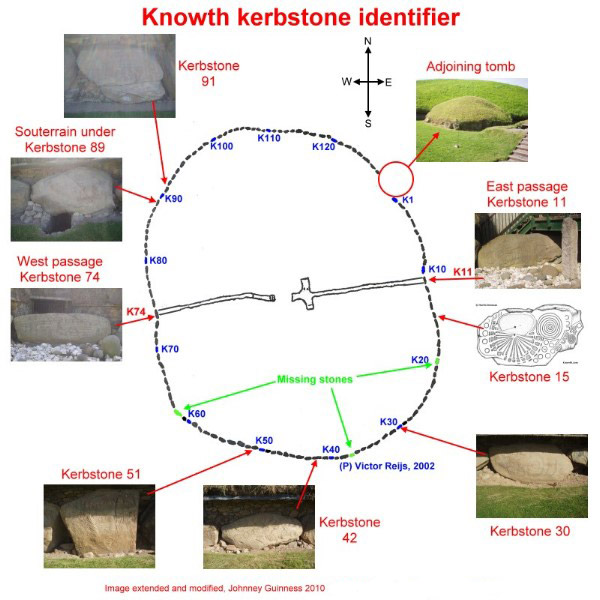
Kerbstone K7 is one of the 127 kerbstones numbered in Professor George Eogan's record of the Knowth monument. It is located on the north-eastern side of the great passage tomb mound.
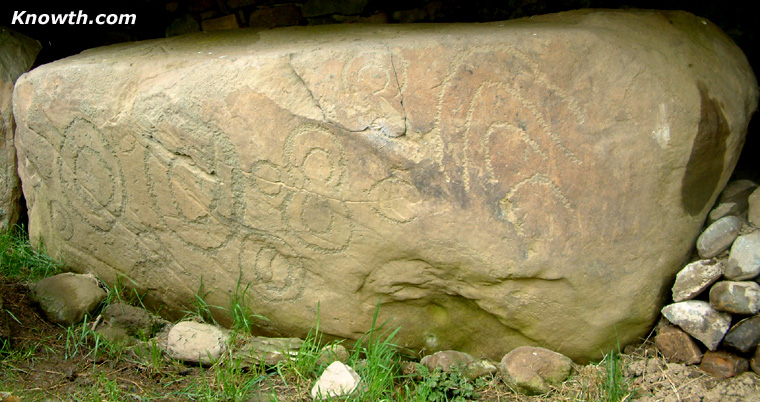
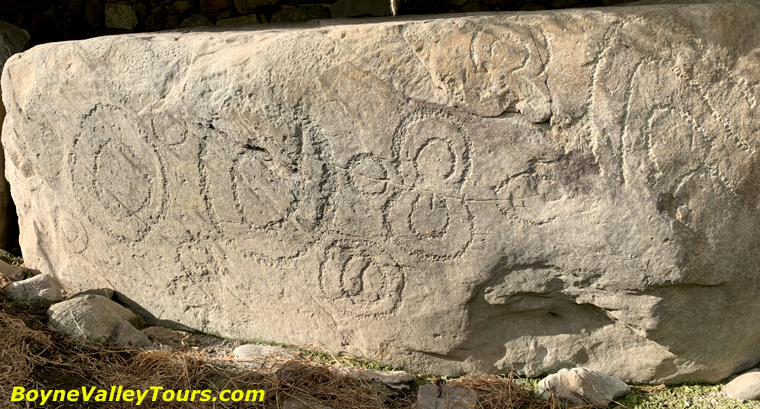 Knowth Kerbstone K7.
The Megalithic Art of the Passage Tombs at Knowth, Co. Meath
Description of Kerbstone 7
A series of circles, arcs and U-shaped motifs are picked on the upper two-thirds of the surface of this stone. The picking is done with both small and broad points, and in places the pickmarks merge together to form a ribbon-like line. Some patches of Close Area-picking occur on the upper part of the stone. From the left, the motifs comprise a double gapped circle and two large, double concentric circles with two smaller circles between them, the upper one being gapped.
To the right is another small single circle, with a double circle beneath. To the right of this, two gapped double circles open towards each other to form a distinctive motif like a figure of eight. Above these is a double semi-circle opening downwards, a gapped circle, and three large, boxed Us opening downwards towards a fourth U. Near the top-right is another small, gapped circle. On the lower-right of the stone there are a number of deep pickmarks.
Excavations at Knowth Volume 7: The Megalithic Art of the Passage Tombs at Knowth, Co. Meath
Purchase at Amazon.com or Amazon.co.uk. View or download at Digital Repository of Ireland.
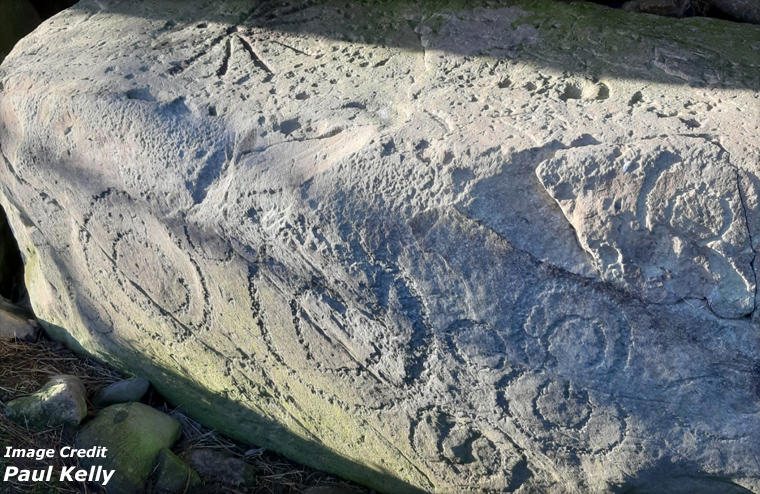 Knowth Kerbstone K7 - Photo Credit: Paul Kelly.
Knowth Stone Age passage tomb
Among the surviving kerbstones at Knowth, K7 contributes to the largest open-air gallery of Neolithic art in western Europe. Knowth was raised more than five thousand years ago in the Neolithic period, around 3200 BC, when established farming communities were shaping the Boyne Valley. Together with Newgrange and Dowth, it forms the heart of the Brú na Bóinne World Heritage landscape.
Originally 127 kerbstones encircled the monument; three are now missing. Most of the survivors bear panels of curvilinear and circular ornament. Some compositions suggest careful observation of lunar rhythms, a theme that runs through much of the art at Knowth.
 Knowth Kerbstone K7.
Medieval texts and local folklore associate Knowth with the royal cemetery of the Boyne and with ancestral powers of the land. The concentration of labour required to build Brú na Bóinne implies strong leadership and shared belief among Neolithic communities.
Later seasons of excavation exposed 19 smaller tombs clustered around the main mound, along with pottery, house foundations and flint tools from an earlier Neolithic phase of settlement in the area, perhaps dating to around 4000 BC.