Knowth Kerbstone K69
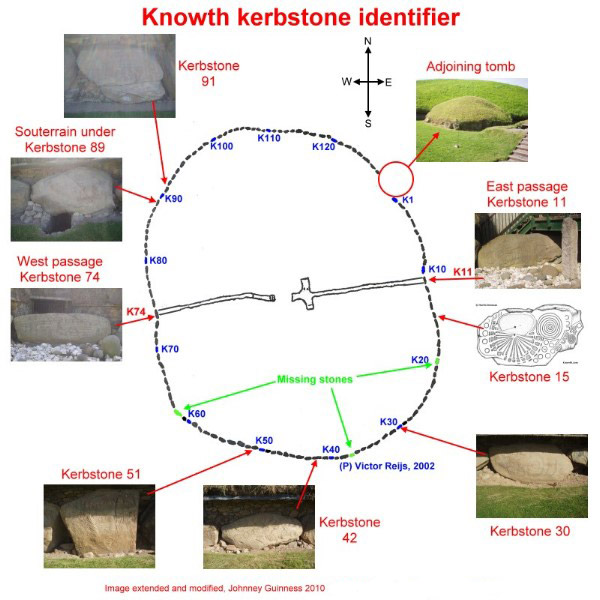
Kerbstone K69 is one of the 127 kerbstones numbered in Professor George Eogan's record of the Knowth monument. It is located on the south-western side of the great passage tomb mound.
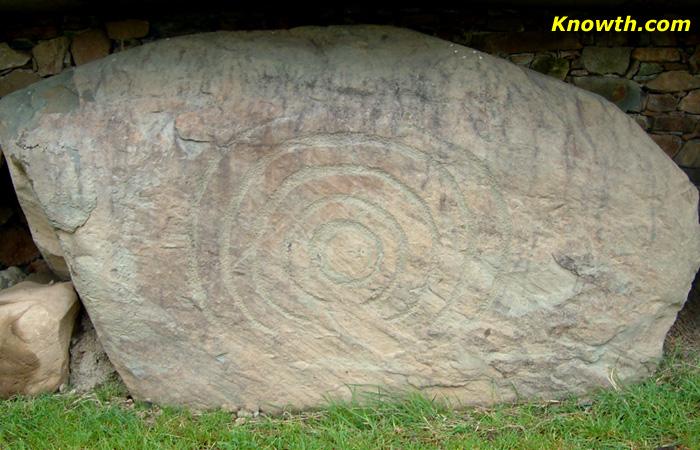 Knowth Kerbstone K69.
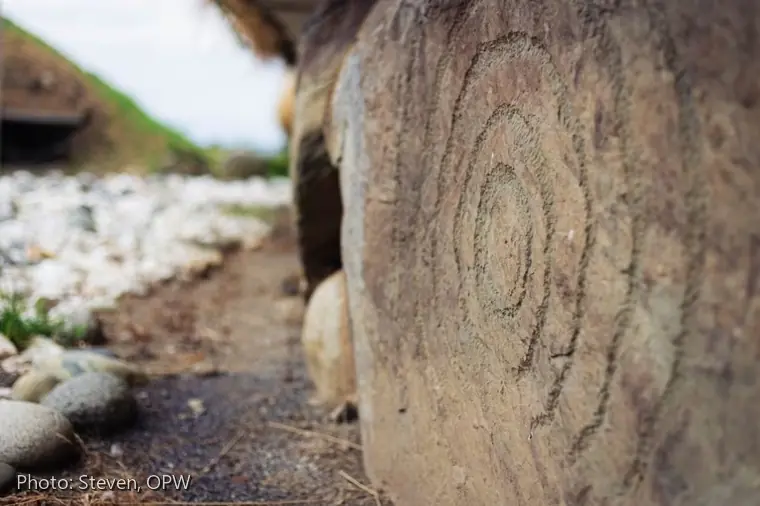 Close-up of the double concentric circle enclosed by four gapped circles on Knowth Kerbstone K69.
The Megalithic Art of the Passage Tombs at Knowth, Co. Meath
Description of Kerbstone 69
At the centre of the main face there is a large motif comprising a double concentric circle enclosed by four gapped circles opening downwards. The distinctive broad lines were created by the use of tools that had edges of different shapes and sizes. A broad-edged chisel was frequently used, but the innermost (gapped) circle is finely picked.
Between the second and third circles from the centre there is a small arc on the upper-left. At the top-right-hand side of the third circle there are two small arcs, which may underlie the large motif, and thus would constitute an earlier stage of carving on the stone, possibly together with the innermost circle and its adjacent arc. There are dispersed pickmarks on the upper surface and on the left, the latter group forming a shallow arc.
Excavations at Knowth Volume 7: The Megalithic Art of the Passage Tombs at Knowth, Co. Meath
Purchase at Amazon.com or Amazon.co.uk. View or download at Digital Repository of Ireland.
Knowth Stone Age passage tomb
Stone K69 belongs to the kerb ring that defines the oval footprint of the Knowth passage tomb in the Boyne Valley. Inside the eastern tomb, the carved granite basin in the right-hand recess is among the finest Neolithic artefacts in Ireland. The block is so massive that the chamber appears to have been constructed around the basin rather than the reverse.
Activity at Knowth did not end with the Neolithic builders. The mound remained important through the Bronze Age and Iron Age, and was reused in medieval times, showing how long the monument kept its place in the life and memory of the Boyne Valley.
Newgrange draws the largest crowds, yet Knowth is unmatched for the quantity and variety of its sculpture, the scale of the mound and the depth of its archaeological record, with occupation traces spanning from the Stone Age into recent centuries at the ancient site of Cnogba.
The kerb carvings are abstract rather than figurative, yet they are far from random. Repeated circles, crescents and flowing lines point to a shared symbolic world among the Boyne Valley builders, one that modern visitors can still sense when walking the numbered stones around the mound.