Knowth FAQ
Knowth is one of the principal monuments of the Brú na Bóinne World Heritage landscape in County Meath, Ireland. Constructed around 3200 BC, it forms part of a complex Neolithic ceremonial landscape that includes Newgrange and Dowth. Knowth is particularly noted for its twin passages and for containing the largest assemblage of megalithic art in Western Europe. All visits are managed through the Brú na Bóinne Visitor Centre operated by the Office of Public Works. The questions below address common points of enquiry regarding its archaeology, excavation history, alignment and access.
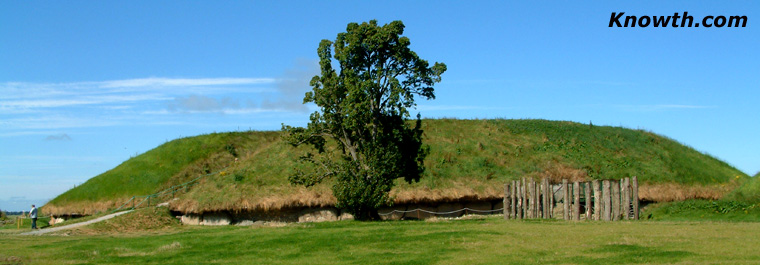 The Great Mound at Knowth.
What is Knowth?
Knowth is a large passage tomb of the Neolithic period. The central mound is about 10 metres (33 feet) high and 95 metres (312 feet) across at its widest point, covering about 0.6 hectares (1.5 acres). It contains two separate passages leading to independent chambers, one opening broadly to the east and the other to the west. The monument is encircled by 127 kerbstones, many of which are decorated with carved motifs.
When was Knowth built?
Radiocarbon evidence places the construction of Knowth around 3200 BC, making it broadly contemporary with Newgrange and older than Stonehenge and the Great Pyramid of Giza.
Who excavated Knowth?
Systematic excavation began in 1962 under Professor George Eogan of University College Dublin. Work continued for several decades and revealed complex structural phases, reused decorated stones, and extensive evidence for later activity around the mound. The results were published in the multi-volume Excavations at Knowth series.
How is Knowth different from Newgrange?
Although similar in date and general form, Knowth differs in several important respects. It has two passages rather than one, and it contains a greater quantity of megalithic art. Newgrange is aligned to the winter solstice sunrise, whereas the passages at Knowth are oriented approximately towards sunrise and sunset around the equinoxes. Knowth also shows substantial evidence of later reuse during the Iron Age and early medieval periods.
What is megalithic art?
Megalithic art refers to the abstract carvings found on large stones within and around passage tombs. At Knowth these include spirals, concentric circles, arcs, lozenges and serpentine motifs. Many decorated stones appear to have been repositioned during construction, indicating that the monument underwent modification during its building phases.
How many decorated stones are at Knowth?
Over 200 decorated stones have been recorded at Knowth, including kerbstones, passage and chamber stones, and stones that were reused and repositioned during construction. This density of carving is one reason Knowth is often described as the greatest concentration of megalithic art in Western Europe.
What has been found inside the passages?
Excavations uncovered cremated human remains, stone basins, decorated orthostats and structural features such as corbelled roofing. The evidence indicates selective burial practices rather than large-scale interment. While it functioned as a burial place, it likely also had ceremonial and symbolic importance linked to seasonal cycles and beliefs about the cosmos.
What are the satellite tombs around Knowth?
Knowth is surrounded by a ring of smaller monuments, often referred to as satellite tombs. At least 19 smaller passage tombs have been identified in the immediate area, creating a wider ceremonial complex around the great mound. These smaller monuments vary in size and form and help show that Knowth was part of a planned Neolithic ritual landscape, not a standalone tomb.
Was Knowth used after the Neolithic?
Yes. Archaeological evidence shows substantial later activity. During the Iron Age and early medieval period, Knowth became the focus of settlement and enclosure activity. Souterrains, burials and structural remains demonstrate that the mound continued to hold social and symbolic significance for millennia.
Is Knowth aligned to astronomical events?
The eastern passage is oriented broadly towards sunrise around the spring and autumn equinoxes, while the western passage aligns towards sunset at the same time of year. The equinox alignment is less precise than the winter solstice alignment at Newgrange and does not produce the same dramatic light beam effect. Even so, the orientation suggests awareness of seasonal cycles and horizon observation.
Can visitors enter the passages?
No. There is currently no public access to either chamber at Knowth. Visitors can walk around the mound and view the decorated kerbstones, but entry to the chambers is not permitted for conservation reasons.
Where is Knowth located?
Knowth is in County Meath, within the Brú na Bóinne landscape. For maps and travel guidance, see Directions. There is no direct access at the monument itself. All visits are managed through the Brú na Bóinne Visitor Centre.
Do I need tickets to visit Knowth?
Yes. Access to Knowth is through the Brú na Bóinne Visitor Centre and there are onsite guides. Purchase tickets Online.
Is Knowth open all year?
No. Knowth is open in the main season, generally from March to early November, and is closed through the winter.
Can I prebook?
Pre-booking is essential as numbers are limited. Tickets can sell out quickly, especially in peak season.
To check availability and book tickets, go to Online Booking.
When do tickets go on sale online?
Online booking opens in advance on a rolling window, depending on the time of year:
March: online booking available 7 days in advance.
1 April to 1 November: online booking available 30 days in advance.
What is the running order of the tours?
All tours begin at Brú na Bóinne Visitor Centre. The time you booked online is the time you are expected in the Visitor Centre.
The first part of the visit is the self-guided exhibition. Approximately 30 minutes has been allocated in the Visitor Centre, then a shuttle bus takes you to the monument or monuments on the ticket you booked. Combined tickets include both Knowth and Newgrange. Limited Knowth or Newgrange tours are also offered, so a Knowth booking does not always include Newgrange.
How long you spend depends on the ticket. A visit to one monument is about 2 hours, and a visit to both monuments is about 3 hours.
Do infants and children need tickets?
Yes. Children aged 11 and under are free, but they still need a ticket and must be included in the online booking.
There is an option during the booking process to include Free under 12s. Failure to include children may result in you not being permitted on tours.
Children aged 12 to 17 are charged at the child rate. Unaccompanied minors (under 18) will not gain admission.
How do bookings work for 14 tickets or fewer?
For 14 tickets or fewer, all visitors must be booked online, including infants and children.
How do bookings work for group sizes of 15 to 30 people?
For bulk group ticketing (15 to 30 people), you must request group booking by email through the Visitor Centre. Groups cannot use the online booking system.
I would like to go on my own. Why do I have to take a tour?
All access to Newgrange and Knowth is through Brú na Bóinne Visitor Centre and is by guided tour only. The primary purpose is to manage the flow and high volume of visitors, as the monuments are old and vulnerable.
The guides help preserve the monuments, create awareness of the importance of Ireland’s ancient heritage, and enhance visitor understanding of Brú na Bóinne.
There is a park-and-ride system in operation from the Visitor Centre to the monuments. Visitor numbers are limited on the shuttle buses and tickets need to be pre-booked online. This rewards visitors with a tranquil, almost unspoilt environment, while protecting the monuments and preserving their setting in the World Heritage landscape.
Is Knowth suitable for visitors with limited mobility?
The Visitor Centre is the starting point for all visits and includes an indoor exhibition. Access to the monument is by shuttle bus. At Knowth, visitors follow gravel and grass paths around the mound and surfaces can be uneven and occasionally wet. If you have specific mobility concerns, it is best to contact the Visitor Centre in advance for the latest practical guidance.
Any final tips before visiting?
Knowth is one of Ireland’s most important prehistoric monuments. Its scale, art and long history of reuse make it central to understanding the Neolithic world of the Boyne Valley. Wear comfortable footwear, arrive early for check-in, and allow extra time if you would like to fully enjoy the exhibition at the Visitor Centre.
This FAQ is intended as a helpful guide for visitors. Ticketing and access arrangements can change, so always confirm details at Heritage Ireland.