Knowth Guide Book
Knowth , a guide book published by the Royal Irish Academy based on material from the archaeological excavations published in their seven-volume Excavations at Knowth series, offers a general overview of what Knowth is all about, outlining why it is of interest and importance. In part, it is intended as a guide that people can use to navigate their way around the site, but it is also a book that anyone can read, use and enjoy without being on site and still get a feel for Knowth and how it came to be what it is.
Knowth, Co. Meath, has been a place of ritual and settlement from the beginning of the Neolithic to the modern era. It is a national monument and part of a UNESCO World Heritage Property: the ancient Brú na Bóinne passage tomb complex that also includes Dowth and Newgrange.
Knowth and the other passage tombs in the Boyne Valley contain the largest collection of megalithic art in Europe. Knowth has the largest collection at any single location.
The number of blue glass beads recovered at Knowth is more than twice the combined total from all other Late Iron Age burial sites in Ireland.
Early medieval 'graffiti' in the form of ogham and insular inscriptions was carved in the passages of the East and West tombs of the Great Mound at Knowth in the eighth century ad.
 Knowth
has produced the richest archaeological assemblage
of material of 10th to 13th century date from any rural site in Ireland, surpassed only by the urban excavations
at Dublin and Waterford.
Knowth
has produced the richest archaeological assemblage
of material of 10th to 13th century date from any rural site in Ireland, surpassed only by the urban excavations
at Dublin and Waterford.
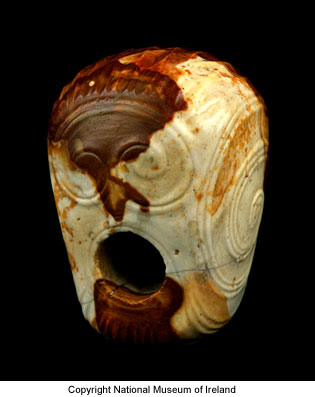
At the time the carved flint macehead was recovered in the East tomb at Knowth in 1982, it was one of only two maceheads to have been found as grave goods in an Irish passage tomb. The other, a partial pestle macehead, had been found in Knowth’s West tomb in July 1967.
Purchase at Amazon.com or Amazon.co.uk
Six millennia of ritual and settlement at Knowth
Knowth, Co. Meath, in the east of Ireland, has had a long, though not continuous, history of ritual and settlement that spans some six millennia, from the beginning of the Neolithic (c. 3700/3600 BC) to the modern era. Since 1993 it has formed part of a UNESCO World Heritage Property, the ancient Brú na Bóinne cemetery complex that also includes Dowth and Newgrange, and since 2023 it has also formed part of what will become the new Brú na Bóinne National Park.
Knowth is home to the Neolithic-era Great Mound (Tomb 1), which unusually contains two passage tombs placed back to back, as well as 19 smaller passage tombs, a Late Neolithic timber circle, and an extraordinary collection of megalithic art throughout the tombs. This alone makes it a fascinating and unique place, but there is even more to Knowth: evidence of Chalcolithic-era settlement and ritual activity; later Iron Age burial activity; a seventh- to eighth-century AD stepped mound; an open settlement in use until perhaps the eleventh century; and an enclosed courtyard farm from the Middle Ages.
In the seventeenth century, a settlement cluster emerged to the east of the Great Mound along the line of the public road. Later, a farmhouse and associated buildings and features developed on the far side of the road. The buildings were acquired by the Irish state in the 1960s from the then owners, the Robinson family, while the farm itself remained in operation for a time afterwards. The site of the Great Mound has been in state care as a national monument since 1939.
Excavations at Knowth Book Series
Volume 1 was published in 1984, it dealt with aspects of prehistoric activity at Knowth.
Volume 2 reported on further aspects of the prehistoric settlement excavated after 1989.
Volume 3 dealt with the animal bone assemblage from Knowth.
Volume 4 explored the historical role of Knowth and wider Brú na Bóinne.
Volume 5 presented the artefacts found at Knowth from the first and second millennia AD.
Volume 6 dealt with the archaeological history of the achievements of the Knowth passage tomb builders who constructed and used the Great Mound (Tomb 1) at Knowth.
Volume 7 dealt with the megalithic art from Knowth.