Labyrinths
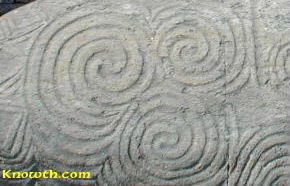 The Greeks were building labyrinths over 3,000 years ago, in a form we now call the Classical seven circuit design. The labyrinth design which brings the walker to the centre through a single path may well have evolved from a basic spiral design, the archetypal symbol known to many ancient cultures.
The spirals carved into the entrance stone at Newgrange over 5,000 years ago have a similar feel to a labyrinth.
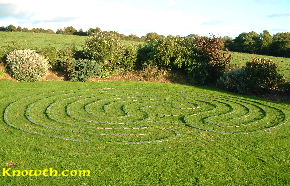 Garden labyrinth near the ancient passage mound at Fourknocks, based on the classical 7 circuit design. The centre of the labyrinth has been modified so that there are no straight lines, like the entrance stone at Newgrange.
Labyrinths have been constructed in churches, hospitals and parks. These are often used for contemplation. Walking among the turnings, one loses track of direction and of the outside world, and thus quiets the mind.
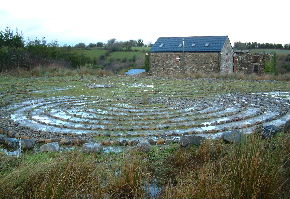
Archetypal Energies Quadruple Labyrinth, at the Labyrinth Centre for Peace & Reconciliation, Glore Mill Follain Art Centre, Kiltimagh, Co. Mayo, Ireland.
Each Archetypal Energy Labyrinth contains 55 Runic Archetypal Energy symbols, a total of 110 symbols for a Double Labyrinth and a total of 220 for a Quadruple Labyrinth.
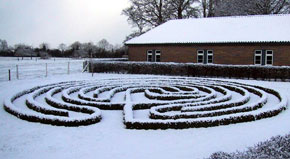 Box hedge and grass labyrinth at An Tobar retreat house in Ardbraccan, Co. Meath.
In 1988 Fr. Michael Kane, director of An Tobar, had taken a training course at Grace Cathedral, San Francisco and on his return, with the help of Martin Dier had created a Cretan labyrinth in the grounds, using box hedges.
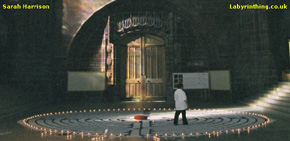 Chartres Labyrinth replica at the Anglican Cathedral Liverpool. The canvas 11 circuit Chartres replica labyrinth was laid out at the Cathedral by Sarah Harrison and Eileen Wiggins.
Labyrinth Links
- The Labyrinth Society - based in the USA, members worldwide.
- Labyrinth Locator - worldwide database of labyrinths.
- Labyrinths from Wikipedia (free encyclopaedia).