Dowth Megalithic Passage Tomb
Dowth, known in Irish as Dubhadh, is one of the three great passage tombs of the Brú na Bóinne complex in County Meath, alongside Newgrange and Knowth. Constructed around 3200 BC, it belongs to the same remarkable phase of Neolithic monument building that transformed the Boyne Valley over five thousand years ago.
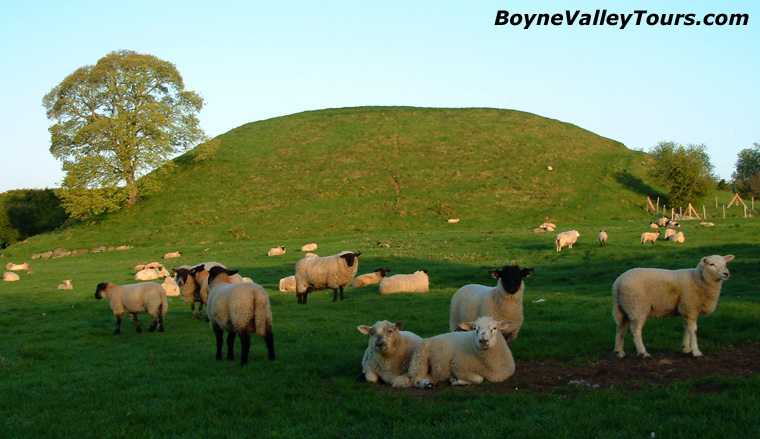 Dowth Mound viewed from the east.
In medieval Irish literature the mound is linked to Bresal Bó-Díbad, who tried to hold the sun in the sky so a great tower could be finished in one day. Night fell before the work was complete, and the place was called Dubhadh, meaning darkness.
The mound measures approximately 85 metres (279 feet) in diameter and rises to about 15 metres (49 feet) in height. Like Newgrange and Knowth, it is encircled by a ring of large kerbstones, many of which are now partially or completely buried.
In 1847 the site was excavated in a poorly documented investigation that involved the use of dynamite. During this work the two passages, now known as Dowth North and Dowth South, were entered and recorded. However, the methods employed caused serious structural damage, and much archaeological evidence relating to the monument’s construction and use was permanently lost.
The Passages and Chambers
Both passages are located on the western side of the mound and are known as Dowth North and Dowth South. Their orientation towards the western horizon is significant, particularly in relation to sunset phenomena around the winter solstice.
Dowth North has a passage approximately 14 metres (46 feet) long leading to a cruciform chamber with three recesses and an annex opening from the right-hand recess. The corbelled roof rises to around 3 metres (10 feet) in height. Although less elaborate than Newgrange, the structure demonstrates the same sophisticated dry stone engineering seen throughout the Boyne Valley monuments.
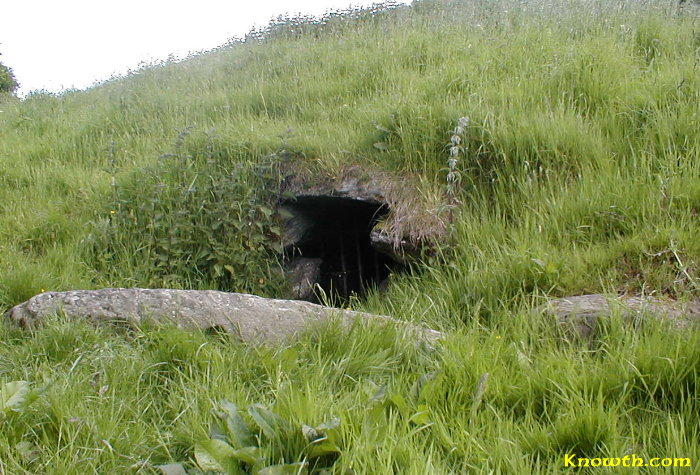 Entrance to Dowth South passage and chamber.
Dowth South has a shorter passage of about 3.5 metres (11 feet) leading to a circular chamber with a single recess to the right. The original corbelled roof collapsed in antiquity and has been replaced with a modern protective covering. Despite its modest scale, this chamber plays a key role in understanding the monument’s astronomical alignment.
Winter Solstice Alignment
Dowth South is aligned on the setting sun at the winter solstice. In the days around 21 December, at approximately 3pm, sunlight enters the passage and reaches into the chamber. As the sun lowers on the horizon, the beam first crosses the sill stone, then illuminates the chamber interior, and finally strikes the rear stones. This sunset phenomenon complements the winter solstice sunrise event at Newgrange.
From early October to late February, sunlight can enter the chamber under favourable conditions. Observations over recent decades have documented the gradual shift of the light beam as the solstice approaches, confirming the builders’ precise awareness of solar movement.
Megalithic Art and Symbolism
Dowth contains a significant collection of megalithic art carved on some kerbstones and passage stones. Spirals, arcs, lozenges and radial motifs appear across the site. One of the most striking carvings is on Kerbstone 51.
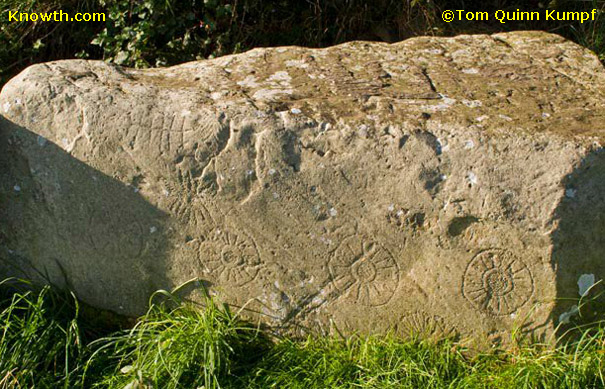 Dowth Kerbstone K51 with seven radiating sun-wheel motifs.
Kerbstone 51 displays seven radiating sun-like symbols. These carvings are often compared with the solar imagery on the backstone of Cairn T at Loughcrew. The repeated circular motifs may represent the sun, seasonal cycles, or calendrical counting. Their presence at a monument aligned to the winter solstice sunset strongly suggests astronomical significance.
Mythology and Later Tradition
Medieval Irish tradition associates Dowth with the figure Bresal Bó-Díbad. According to legend, he attempted to halt the sun in the sky in order to complete a great tower in a single day. Darkness fell prematurely and the project was abandoned. The tale may preserve a distant folk memory of the monument’s solar alignment and its connection with light and darkness.
Archaeological evidence suggests continued activity in the Boyne Valley during the Bronze Age and later periods. Dowth remained part of a landscape that retained ritual and symbolic importance long after its construction.
Setting within the Boyne Valley
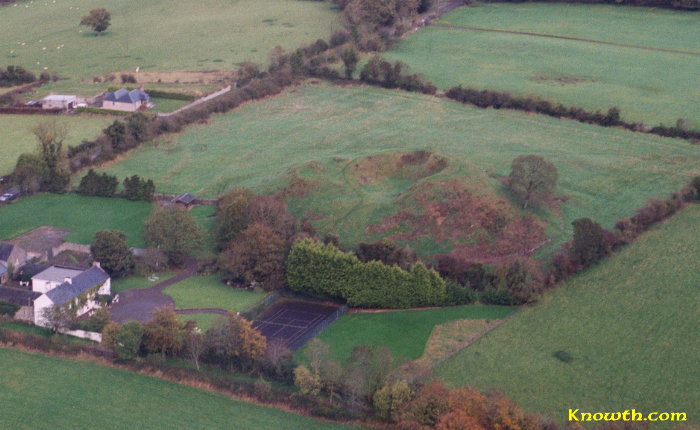 Aerial view of the mound at Dowth.
Dowth stands on elevated ground overlooking a bend in the River Boyne. Together with Newgrange and Knowth, it forms a monumental focus within the wider ceremonial landscape of Brú na Bóinne. The placement of these great mounds appears deliberate, creating visual and symbolic relationships across the valley.
Unlike Newgrange and Knowth, which are accessed through the Brú na Bóinne Visitor Centre, Dowth can be reached directly by road on the north side of the river, a short distance from the Slane to Drogheda road. There is no public access to the internal chambers. Visitors may walk around the mound and examine the kerbstones, often enjoying a quieter and more reflective experience.
Dowth Laser Scan Survey
Recent laser scanning and digital survey work has produced detailed three-dimensional models of Dowth’s passages and chambers. These surveys allow researchers to study structural features, art placement and light penetration with greater precision, helping to refine our understanding of how the monument functioned architecturally and symbolically.
Although often described as the quieter counterpart to Newgrange and Knowth, Dowth is essential to understanding the full story of Brú na Bóinne. Its emphasis on sunset, darkness and the turning of the year adds depth to the solar drama of the Boyne Valley, revealing a monument concerned as much with endings as with beginnings.
- Beltaine Sunrise - images of Dowth K51, the seven suns stone.
- Dowth from The Sacred Island by Martin Byrne an Artist and Tour Guide based in South County Sligo, in north west of Ireland.
- Ireland in prehistory - Early Ireland, Megalithic Ireland, Ancient Ireland - Outside Influences.
- An anthropological lens applied to the early settlers of the Boyne Valley, adapted from a lecture by Dr. Gabriel J.Byrne.
- Messages from the Monuments - How Neolithic Monuments Communicate About Religion and Status by Paul K. Wason.
- Megalithic Attractions of County Meath - Newgrange, Knowth, Dowth, Fourknocks, Loughcrew and Tara.