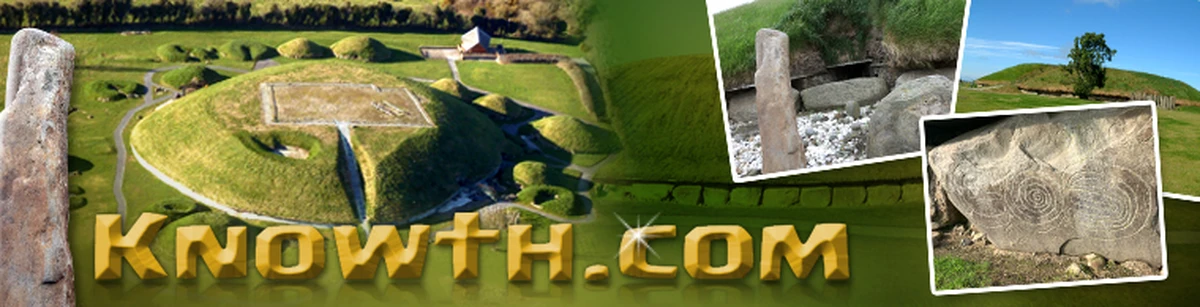
Archaeology and Celtic Myth, An Exploration
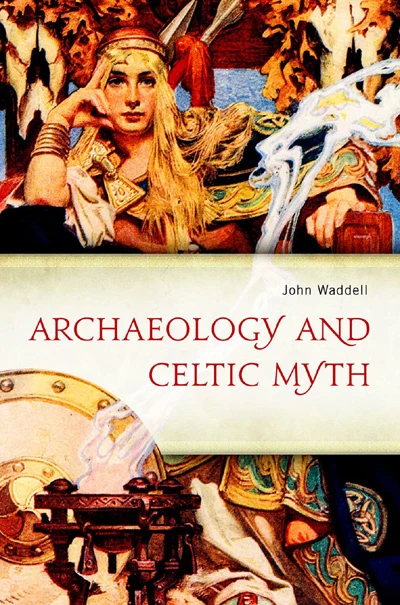
In the book Archaeology and Celtic Myth, An Exploration, John Waddell contends that elements of pre-Christian Celtic myth preserved in medieval Irish literature shed light on older traditions and beliefs not just in Ireland but elsewhere in Europe as well.
He mainly focuses on aspects of the mythology associated with four well-known Irish archaeological landscapes: Newgrange and the Boyne Valley, the royal sites of Rathcroghan in Co. Roscommon, Navan in Co. Armagh, and Tara in Co. Meath.
Their mythological associations permit the pursuit of the archaeological implications of several mythic themes, namely sacral kingship, a sovereignty goddess, solar cosmology and the perception of an Otherworld.
Purchase at Amazon.com or Amazon.co.uk
Book review by Christopher J Lynn
Ulster Journal of Archaeology, Third Series, Vol. 72 (2013/2014)
Before reviewing a book entitled Archaeology and Celtic Myth it seemed appropriate to ask, what would be the criteria or circumstances for identifying links between archaeology and Celtic myth? Until relatively recently some influential authorities in Ireland would allow no possibility of overlap between archaeology and myth. No myths gave rise to archaeological remains and no archaeological remains represented the origins of a myth.
T. F. O’Rahilly cautioned against “archaeologists” who were “predisposed to disturb the bones of the dead” straying into fields where they have little knowledge such as linguistics, early literature and mythology: the shoemaker should stick to his last. According to O’Rahilly, “To look for traces of Finn mac Cumhaill’s dún on the hill of Allen is as vain as to try to discover Dobh Derg’s residence on Slievenamon or Mider’s on Croghan Hill. The Otherworld is impervious to archaeological exploration”.
Despite such strictures, but mindful of them, it could be pointed out that myth and archaeology can, indeed should, overlap in several ways. Firstly, it is possible that at some time in the past an already ancient site was integrated into a myth that had an independent origin. If replicated locally this could lead to the formation of a “mythic landscape” such as exists around Navan Fort, Co. Armagh. This folkloristic identification of monuments that were already old as mythic or historic sites could have taken place over a long period, stretching back perhaps to a fairly remote time because place-names can have durability.
Here Waddell points out that archaeology and myth converge and that millennia-old Indo-European roots emerge. It is, indeed, likely that myths involving astronomical phenomena influenced aspects of the design and construction of Newgrange, but whether they were the same myths that might have survived into the early literature and what was the date of the arrival of the Indo-European speakers in Ireland are relevant questions. Waddell points out that some archetypal subjects, for example the interpretation of calendrical and astronomical phenomena, might have had a long lifetime in pre-literate times.
One interest of the present work is to see if archaeology can bring new insights to bear on concepts that hitherto have mainly been interpreted by experts using primarily literary sources.
Chapter 1
In Chapter 1, ‘Confronting ancient myth’, Waddell introduces the subject of myth and the sites in Ireland where ‘it is impossible to ignore the mythic dimension of these places’. He draws attention to the difficulties of using manuscript sources not older than the 12th century to help understand the prehistoric archaeology of sites such as the Hill of Tara, Navan Fort and Rathcroghan. The academic background to the study is outlined and includes appropriate acknowledgment of the contributions of some earlier scholars such as the Rees brothers’ Celtic Heritage and Proinsias Mac Cana’s Celtic Mythology.
Differing views of the value and appropriateness of the term Celtic in an archaeological context are reviewed and it is concluded that the existence of the language family is sufficient to hold out some hope of shared themes in the archaeological symbols of those who spoke a Celtic language.
Possible mythic themes that might have archaeological relevance include a cosmogony, an account of how the world began, and how it should be maintained. Referring to the birth-tale of Cú Chulainn we are introduced to the possible linkage of solar and seasonal imagery to kingship, a sovereignty goddess identified with the land and well-being and the otherworld, and mythic validation of contractual relationships.
Chapter 2
Chapter 2 deals with ‘The Otherworld hall on the Boyne’ and begins with a summary of the archaeological evidence derived from M. J. O’Kelly’s excavation at Newgrange with some emphasis on the ‘roof-box’, which admitted a shaft of light that remarkably illuminated the internal burial chamber at dawn on midwinter solstice and for a few days on either side of the solstice.
Clearly this orientation was significant for the tomb builders. The monument was sited, designed and built to achieve this phenomenon. The landscape seems to have been regarded as sacred from the beginning of man’s use of the area. Presumably it had mythic dimensions and what these might have been are explored in the next section.
They include a medieval tradition that Brugh na Bóinne was the home of the Tuatha Dé Danann, possibly the deities of prehistoric Ireland, including the Dagda and his son Oengus.
The mnemonic quality of Neolithic monuments is noted. They could have accreted myth and folklore, and stories may have been composed to explain their existence, perhaps the prehistoric equivalent of archaeology. There was a need to explain the origin of impressive man-made features in the landscape and to incorporate them into current origin tales.
It is suggested that in the case of the Newgrange mound, built before 3000 BC, there is ‘some agreement’ between prehistoric archaeology and ancient myth relating to the area. Both appear to tell a similar story about the creation and use of the monument.
It could, however, be observed that an impressive monument like Newgrange once built, for whatever reasons, would have acquired some lore aimed at explaining its original purpose, once that was forgotten. It may also have been assigned a seemingly appropriate place in an unrelated story or myth.
Any apparent similarity between the original purpose of the mound as deduced by archaeology and the myths which refer to the monument or area may owe something to the imagination of later storytellers as well as to pre-existing myths that might have influenced the design of the monument.
The fact that some of the myths associated with Brugh na Bóinne, such as the story of Bóand and Nechtán’s well, appear to have Indo-European origins would indicate to some commentators that these are unlikely to have been associated with the monument at the time of its construction. This is because many authorities believe that the first Indo-European speakers are unlikely to have reached Ireland before the Bronze Age.
Chapter 3
In Chapter 3, ‘The elusive image’, Waddell introduces the literary evidence for solar symbolism, particularly with reference to the kingship of Tara. Waddell states that the combination of the sun disc being carried across the heavens in a boat, found for example on the Petrie Crown, is an expression of a religious cosmology.
Designs on the Petrie Crown, a solar boat with birds’ heads in prow and stern on the right-hand disc, are compared with similar images on, for example, a pair of bronze discs from Monasterevin, Co. Kildare, and the Battersea shield from the River Thames at London.
The difficulty that some observers may have in recognising the solar symbolism on the artefacts is explained by the suggestion that there was a deliberate attempt by the artists ‘to obscure or conceal the solar motif … perhaps a … taboo applied to the overt depiction of the symbol of a solar deity?’ (p. 42).
It is suggested that objects like the Petrie Crown and the Battersea shield were royal paraphernalia. The Otherworldly symbolism would be expected because Sacred kings were mediators between this world and the next. The antiquity of the European bird and solar symbolism, stretching back into the Bronze Age, is underlined by reference to Scandinavian objects such as the famous Trundholm ‘chariot of the sun’ from Denmark. It is also possible, however, that ceremonial headgear, like that of the Roman flamines, was worn in Celtic areas by members of a priestly class, the druids, who officiated at sacrifices and mediated between this world and the otherworld.
Chapter 4
Introducing Chapter 4, ‘In pursuit of the Otherworld’, Waddell quotes T. F. O’Rahilly’s view that ‘the Otherworld is impervious to archaeological exploration’. But he rightly observes that people in the past who believed in the existence of such a place may have left tangible remains of their beliefs. The chapter goes on to describe the monuments at Rathcroghan, Co. Roscommon, and quotes from several medieval tales and that portray ‘the cave of Cruachu’ or Oweynagat as a portal to the otherworld. ‘These tales of monstrous cats, destructive pigs and some of the other bizarre creatures are echoes of the cave’s link with the powers of chaos’.
It is suggested that Oweynagat, an admittedly unimpressive natural fissure entered through a short souterrain, was a focus for cult practices in pre-Christian times that included sensory deprivation and altered states of consciousness associated with divination, oracular activity and warrior initiation. Something similar seems to have occurred in a cave at St Patrick’s Purgatory, Lough Derg, Co. Donegal, in medieval and more recent times.
Archaeological examples of the creation of sacred space by making circular enclosures are examined, as is the likely practice of communicating with the underworld by digging pits, wells and ditches, many of which contain probable ritual deposits. It is suggested that grave goods may relate to the dead person’s presumed role in an afterlife as well as reflecting status in the past life.
The topsy-turvy qualities of the otherworld are exemplified in various ways, for example the inversion of distinctive pots over cremated remains in Bronze Age burials or the switching of shoes onto the ‘wrong’ feet of personages in myth and folklore tales, as seems also to have been the case with the person buried in the Iron Age tomb chamber at Hochdorf (Baden-Württemberg). According to literary sources the peaceful otherworld could be accessed in various ways, for example in lakes or, more commonly, in mounds.
Chapter 5
Chapter 5, ‘The horse goddess’, deals mainly with the monuments and archaeological remains of Navan Fort, Co. Armagh, and its surrounding landscape. Navan Fort was anciently known as Emain Macha (‘the twins of Macha’) and Waddell introduces us to the stories and mythology associated with this site and area.
It is pointed out initially that the belief of medieval storytellers that the Navan enclosure was a royal settlement was erroneous in so far as the results of excavation strongly suggest that the Navan Fort monument was built for ceremonial purposes in the early first century BC. The idea of a royal settlement, however, may have been a misplaced guess by the storytellers based on current experience rather than ‘a literary fiction invented to obscure its association with pagan ceremonial’, as suggested in the book.
There is an extensive discourse on the tales that explore the differing natures of the three Machas, the eponymous goddesses of the site. Macha’s equine attributes are examined by comparison with other Celtic goddesses, for example the Welsh Rhiannon and the Gaulish Epona. ‘Macha’s association with Navan seems to imply that horse rituals were especially important here’.
There is an extended summary and discussion of the results of D. M. Waterman’s excavations on the mound in Navan Fort and how those results might be interpreted. It is concluded that the enclosure and mound were built for kingly inauguration and became ‘an emblem of immemorial royal authority’). The site achieved a ‘mythic status of another sort as a royal residence and the epicentre of heroic exploits’.
On the one hand ancient myth may have influenced the siting and design of the monuments at Navan; on the other hand the site became the locus for the activities, personages and events in medieval tales. A difficulty we have with interpreting medieval texts is deciding which parts might be a very ancient residue (if any) and which parts are relatively new, but cast in archaic terms.
Chapter 6
Chapter 6 deals with ‘The goddess of sovereignty’, in particular Medb of Cruachain who, as consort, bestows rightful sovereignty on the succession of true candidates for kingship. The bestowing of sovereignty could also be represented by a female figure giving a cup of drink to the rightful candidate.
The recurrence of rich drinking equipment in the graves of females in Continental Iron Age burials is discussed, notably at sites like Vix, Châtillon-sur-Seine, Mitterkirchen, Upper Austria, and Kleinasperegle, Baden-Württemberg. Further, the connection of a female figure, sometimes also Medb, with the land and its sovereignty is a feature of Irish tradition.
Finds of Bronze Age gold ornaments are noted and it is suggested that two exceptionally large torcs from near the Rath of the Synods at Tara ‘were deposited in a context associated with Medb Letherd’ the goddess of the sovereignty and land at Tara’. This is an interesting juxtaposition, but its potential significance depends on whether the spot was associated with Medb (or a predecessor with similar characteristics) at that early date, something which we cannot know.
The disposal of bronze rapiers on wet lands at this time is contrasted with the dry-land contexts of finds of contemporary goldwork.
Chapter 7
Chapter 7, ‘Sacral kingship’, opens with a description of the site and monuments of the Hill of Tara, Co. Meath. There is a lengthy quote from the interesting Dindgnai Temrach, written about AD 1000 and translated by George Petrie in 1839. This is the text that sets out the standard names for the separate monuments used in descriptions of the site to this day, for example Mound of the Hostages, Rath of the Synods and House of Cormaic.
These names in themselves suggest that they are not of great antiquity as they reflect contemporary early medieval history, epic and polity. For the particular interest perhaps of Ulster readers it could be pointed out that, according to the Dindgnai Temrach, several of the now-destroyed monuments on the north of the site had names commemorating Ulster heroes and historic personages, for example the Triple Mound of Ness (mother of Conchobar mac Nessa), the Rath of Conchobar mac Nessa and the Shield of Cuchulainn; perhaps the latter was a circular elevated platform with a smaller mound at the centre.
This northerly grouping of sites with Ulster names reminds us that the kingship of Tara was regarded as a microcosm of the organisation of the whole island, perhaps reflected in the north/south naming of the monuments along the hill.
There is discussion of the archaeological evidence, including excavated evidence, for the nature of the individual monuments, which vary from a Neolithic passage tomb at the core of the Mound of the Hostages to an Iron Age enclosure (Ráith na Ríg) and, perhaps, an early medieval enclosure (Rath of the Synods). The chapter moves on to a discussion of the nature of early medieval kingship in Ireland and elsewhere.
The essential aspects of sacral kingship are usefully summarised. There follows a section of quotes from early medieval Irish texts that appear to have relevance to understanding the nature of sacral kingship in Ireland, including a bull sacrifice reported in Togail Bruidne Dá Derga, the inauguration of an Ó Conchobair at Carnfree (Annals of Connacht) and some of the tests faced by a candidate for kingship (De Shíl Chonairi Móir).
The ring-barrow type monuments unusually sited on a steep slope at Tara, the Claonfhearta or ‘Sloping Trenches’, are there because of a false judgement by King Lugaid mac Con as recounted in the 9th-century Cath Maige Mucrama.
A section on ‘kingly monuments’ begins with the apposite reminder that ‘archaeological evidence for sacral kingship is difficult to identify’. It is suggested that the ‘Banqueting Hall’ at Tara had a role in rituals of inauguration: ‘Emerging from the processional way ten centuries ago, the royal party would have moved around the ramparts of Ráith na Rí ... The climax of the inauguration ceremony then took place when the King placed his foot on the Lia Fáil’.
Features at other excavated Iron Age sites are suggested to have potential relevance, including the approach avenues flanked by parallel or slightly splaying palisade slots leading to the circular enclosures at Navan Fort and Knockaulin. It is suggested that sites with mounds within earthwork enclosures such as Sessamagall, Co. Tyrone, could also have been built for kingship purposes.
There is a review of the evidence, literary and archaeological, for ‘sacral kingship’ among the British and Continental Celts, including the hillfort of the Glauberg north of Frankfurt and Hirschlanden (Baden-Württemberg), where stone statues interpreted as possibly representations of sacral kings were found.
The richly furnished burial of a man at Hochdorf, north of Stuttgart, in a mound dating from the 6th century BC is discussed. The sacred character of the Hochdorf person is evident from the number, style and quality of the grave goods. Other sites drawn into discussion include the burial of a warrior found at Mill Hill, Kent, and the fortress of Dún Ailinne, which may have been ‘chosen as an inauguration site by the kings of Dál Riata’ because it had commanding views and may have been considered to be a great cairn mimicking smaller sites in the vicinity (p. 164).
This book is not an attempt to comprehensively explore the beliefs of Celtic religion or cosmology; rather it sets the archaeology of key sites in Ireland beside the early medieval myths and lore that refer specifically to each site in the hope that a deeper understanding may emerge.
Sometimes there is a considerable distance in space and time between the date of the archaeology and the texts that contain the myths and lore. The hope is that there might be a relationship between the archaeological remains and the myths, one in some way having influenced the development of the other. Sometimes the similarities between myth and archaeology that can be adduced seem to be universal realities common to several cosmologies, having reference to the underground, the surface that we walk on, the sky above and the water around.
The mythical material or lore, telling us what someone thought about the sites, could have accrued to the places at many times in the past, but probably date from the time of the writing down of the text in the early middle ages or shortly before it.
The monuments at Tara, for example, seem to be interpreted largely in terms of the early medieval culture of the time (Mound of the Hostages, Ráith Lóegaire, Rath of the Synods), including the association of Christian saints with older monuments. Archaeological evidence, on the other hand, be it deduced from a surface inspection of the monuments or from excavation, tells us what people actually did at that place at a specific time.
It is worth noting, however, at a general level that prehistoric sites which are celebrated in early medieval lore as having had importance in the heroic age often turn out to be among those rare sites in Ireland that have a phase of activity or construction in the Iron Age. The book is an impressive assemblage, well referenced, dealing with some of the most significant archaeological sites in Ireland and incorporating data from recent excavations, surveys and commentaries.
It is an authoritative study which quickly brings the reader to the heart of a complex and challenging subject. In some cases readers will have their own views on the interpretation of various questions put forward. This arises from the elusive or universal nature of some of the myth material, the paucity of rules governing the process of interpretation and the lack of direct archaeological evidence from excavation for some of the sites, for example Rathcroghan, Co. Roscommon.