Guide to the Passage Tombs at Brú na Bóinne
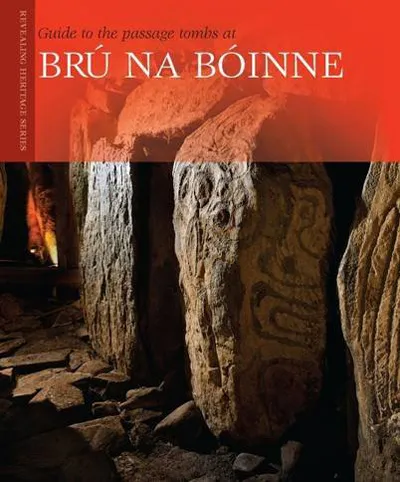
This concise, 32 page illustrated Guide to the Passage Tombs at Brú na Bóinne brings together all the essential information in an accessible format. The magnificent stone monuments of Brú na Bóinne were constructed during an extraordinary burst of religious and artistic expression between 3300 and 2800 BC. The great mound at Newgrange, completed around 3200 BC, predates both the pyramids at Giza in Egypt and Stonehenge in England.
Over the centuries this remarkable complex, comprising almost 40 tombs and associated monuments, experienced periods of neglect and obscurity. Today, however, the landscape and heritage of Brú na Bóinne are widely recognised and carefully protected. In 1993 the site was inscribed as a UNESCO World Heritage Site.
This guide explores what is currently understood about the people who built Brú na Bóinne, how they lived, and what inspired them to create such enduring monuments. It also traces the story of the tombs themselves, examining their construction, their evolving role in ceremonial life, and the changing ways in which they were used over time.
Purchase at Amazon.com or Amazon.co.uk.
Introduction
Brú na Bóinne, where the great Stone Age tombs of Knowth, Newgrange and Dowth are situated, is a roughly U-shaped area formed by a bend in the River Boyne. Here, on a shale ridge that rises above the low-lying countryside, in the centuries before and after 3000 BC, people built the three majestic funerary monuments, as well as many other smaller tombs and related sites.
Brú na Bóinne’s monuments are among the finest examples of stone-built tombs in Europe, with a very rich collection of megalithic art. They provide evidence for a remarkable concentration of ritual activity, involving the construction of monumental works that entailed a substantial investment in labour. As a result, for some centuries Brú na Bóinne was a place of action and activity.
The Bend of the Boyne was formed in ancient times when the river, just east of Slane, was blocked by a ridge of Carboniferous shale rock through which it could not flow. This forced it to make a right-hand turn to the south, where it flowed east, parallel to the ridge, for about three miles. It then swung northwards again, forming a loop. From here the river flows east and finally empties into the sea downstream from Drogheda.
The region formed by the Boyne and its northern tributaries extends for approximately five square kilometres. The land is low-lying and suitable for farming, covered by boulder clay deposited by Ice Age glaciers.
The people who built this huge cemetery were not the first settlers in Ireland, nor were they the first to have lived in the fertile Boyne Valley. Ireland itself had been settled from around 8000 BC in the Middle Stone Age, or Mesolithic period. It is believed that these first settlers sailed here from northern and western Britain. They were hunter-gatherers, living off what the land and sea provided: wild animals, fish, berries and plants. The early people made simple tools from stone and bone, such as scrapers for preparing animal skins, stone blades and bone spears for fishing. Rivers were an important source of food. Forests too provided food and materials for early Neolithic people.
Farming had first developed in the Near East about 12,000 years ago, around the time when the Ice Age was coming to an end in Ireland. As a result, people gradually learned how to select and grow types of grasses and cereals, and to breed and keep pigs, oxen and goats, which gave them a stable food supply. With a reliable supply of food throughout the year, agricultural communities developed and eventually replaced the older hunter-gatherer way of life.
Society and economic activity became more complex and specialised. Long-distance trade in goods developed. This new way of life spread throughout western Asia and Europe, and eventually to Ireland. New methods and attitudes were introduced from abroad. As a result of the introduction of farming around 4000 BC, fundamental changes in everyday life took place.
People no longer had to depend solely on what nature could provide but now cooperated with it. Forest clearance began.
Around 3900 BC, at the beginning of the Late Stone Age, or Neolithic period, the first settlements appeared at Brú na Bóinne, and by 3500 BC considerable areas would have been open, farmed landscape.
As agriculture was adopted in Ireland, so too was the practice of building funerary monuments for the dead, using large stones. Such structures are called megalithic tombs and were used for the communal burial of cremated remains. Deposited with the remains were personal items such as beads and pendants made of bone, antler pins and, very occasionally, pottery.
Though Knowth, Newgrange and Dowth, stretching from west to east, dominate the landscape of Brú na Bóinne, they are just the core of a much larger cemetery, which holds 37 tombs and at least eight other individual sites of uncertain date. It is likely that additional sites have been destroyed over the millennia. As well as the three great mounds and their satellite tombs, there is a fourth cluster of tombs at Ballincrad townland between Newgrange and Dowth. Two mounds lie south of the main cemetery on the floodplain of the river, and two sit to the north of the cemetery at Monknewtown and Townleyhall. There are also embanked circular enclosures of later date called henges, timber circles, a ceremonial procession route known as a cursus, and a ritual pond. There is evidence of other sites that have not yet been excavated.
A notable feature of the Newgrange mound is that it is oriented and built so as to allow the rays of the rising sun at the winter solstice, the days around 21 December, to enter the tomb and travel down the passage to shine directly onto the back chamber and flood it with dawn light.
It is not known whether this was intended to be witnessed by anyone other than the remains of the dead, as the entrance to the tomb was closed by a large upright stone. Nor do we know how the ancient people conducted their rituals inside and outside the tombs.
Building each of the three great tombs probably involved hundreds of people working for many decades. It shows that a stable, organised community lived in the region, that they understood the movements of the sun, and that they could express their fundamental beliefs about death and the afterlife through elaborate architecture and symbolic art. They had the engineering skills to lift and move enormous stones over long distances, and the tools to cut wood, dig trenches, cut sod and carry out other construction work. They could organise large groups for complex projects over many years, and they could visualise the transforming effect of a beam of sunlight travelling along a dark passageway in a sealed tomb in the depths of winter.
Purchase at Amazon.com or Amazon.co.uk.