Knowth Kerbstone K78
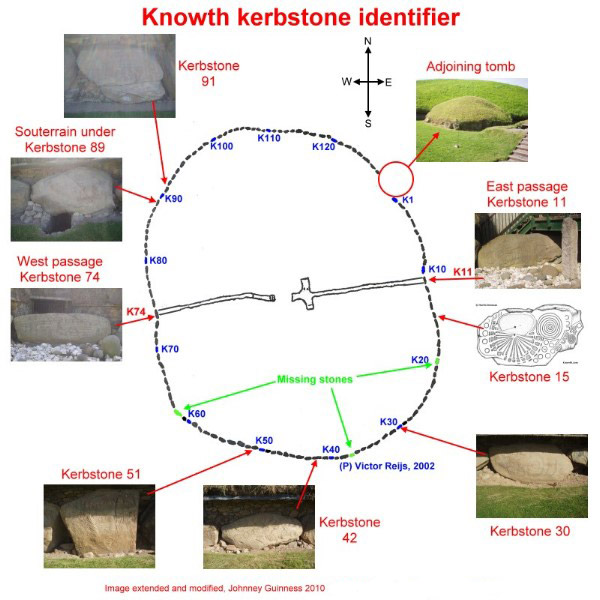
Kerbstone K78 is one of the 127 kerbstones numbered in Professor George Eogan's record of the Knowth monument. It is located on the north-western side of the great passage tomb mound.
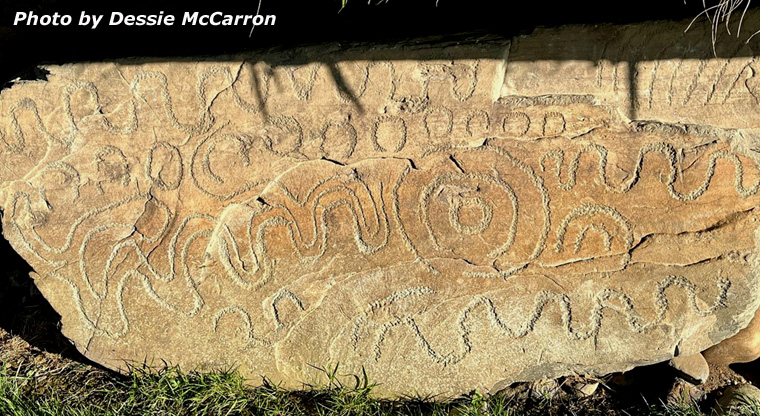 Knowth Kerbstone 78 - photo by Dessie McCarron.
The Megalithic Art of the Passage Tombs at Knowth, Co. Meath
Description of Kerbstone 78
A serpentiform is picked with fine, dense pickmarks parallel with most of the top edge of the stone. In the top-right corner, on lower plane of the stone, is a double U-motif opening downwards, with six curving lines on the left opening towards the Us. Below the long serpentiform there is a row of circular motifs, comprising seven single U-motifs all opening downwards, and three single circles.
To the lower-right, a short serpentiform motif runs to the right edge of the stone. On the left is a double serpentiform motif running from the left edge to the middle of the stone. Each end of the upper serpentiform doubles back and meanders; the one on the right curving around one of the Us in the row above, while on the left the end of the serpentiform doubles back on itself in a loop and then loops up and down the left edge of the stone. A circle enclosed in two gapped circles separates the two serpentiform motifs, and a double semi-circle is picked lower down to the right.
Below these is a serpentiform whose left end doubles back over itself, and to the left is another short serpentiform. The lower-right angle is pick-dressed, as is the base of the recessed area in the top-right corner. Most of the carving is done with a medium-sized, rounded point. There are some dispersed pickmarks in the middle of the stone.
Excavations at Knowth Volume 7: The Megalithic Art of the Passage Tombs at Knowth, Co. Meath
Purchase at Amazon.com or Amazon.co.uk. View or download at Digital Repository of Ireland.
Knowth Stone Age passage tomb
K78 forms part of the ceremonial kerb documented during decades of excavation at Brú na Bóinne by Professor George Eogan and his team. Activity at Knowth did not end with the Neolithic builders. The mound remained important through the Bronze Age and Iron Age, and was reused in medieval times, showing how long the monument kept its place in the life and memory of the Boyne Valley.
Newgrange draws the largest crowds, yet Knowth is unmatched for the quantity and variety of its sculpture, the scale of the mound and the depth of its archaeological record, with occupation traces spanning from the Stone Age into recent centuries at the ancient site of Cnogba.
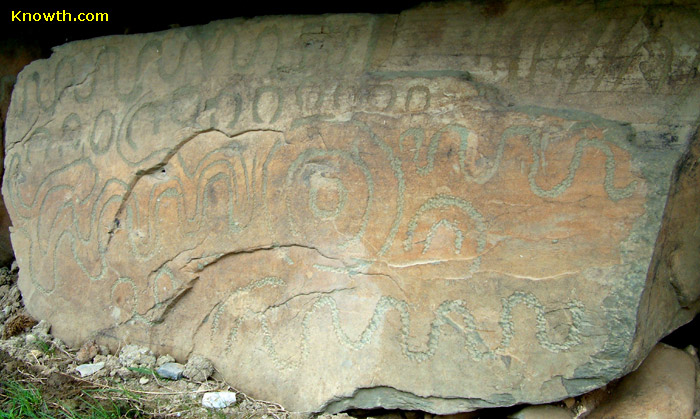 Knowth Kerbstone K78.
The kerb carvings are abstract rather than figurative, yet they are far from random. Repeated circles, crescents and flowing lines point to a shared symbolic world among the Boyne Valley builders, one that modern visitors can still sense when walking the numbered stones around the mound.
No other site preserves so much carved Neolithic stonework in one place. After conservation of the mound, visitors on guided tours can walk the full kerb circuit and see one of the greatest open-air collections of prehistoric art in Ireland.