Knowth Equinox sunrise/sunset alignment?
For many years it has been suggested that Knowth’s two main passages were deliberately aligned to the equinox sunrise and sunset. A detailed set of professional surveys by Frank Prendergast and Tom Ray, carried out as part of the Royal Irish Academy publication series on Knowth, tested that idea using precise measurement and astronomical calculations.
Their conclusion is clear. The eastern and western passages of Knowth are not aligned on the equinox sunrise or equinox sunset.
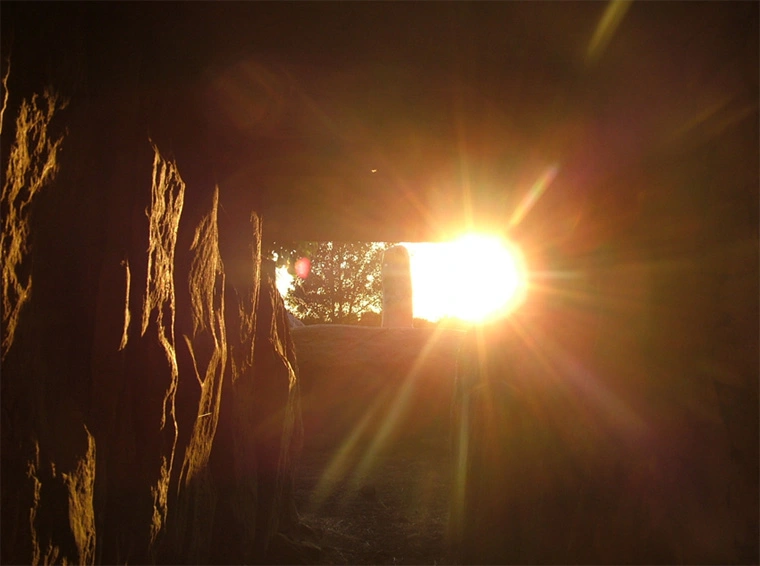 Elevated sun viewed from close to the entrance of the western passage at the equinox.
Why the Equinox Idea Became Popular
The equinox hypothesis gained traction because Knowth has two passages, one broadly to the east and one broadly to the west, and because Newgrange has a famous solar event at the winter solstice. Early discussion in the literature also contributed to the public expectation of an equinox pairing at Knowth. However, Prendergast and Ray point out that confusion between different “norths” on plans, especially magnetic north versus true north, helped reinforce a belief that did not stand up to accurate surveying. Magnetic declination in Ireland changes over time, so old plans can mislead if their reference north is not stated and dated.
What the Researchers Measured
The work summarises two surveys focused on the orientation of the passages and the realistic visibility of sky and horizon from within them. For the western passage, they surveyed the outer passage axis and also the inner passage axis beyond the bend, and measured the deflection between the two. For the eastern passage, an earlier gyro theodolite survey (1985) recorded the passage axis, and the report evaluates what that means astronomically, taking the local horizon into account.
Key Findings
At the equinox, the sun rises close to due east and sets close to due west, but at Knowth the measured orientations do not match those positions. The western outer passage points to an azimuth of about 258° 34' (looking out), which is well south of due west at the equinox, and the western inner passage points to about 278° 14', which is north of equinox sunset.
The eastern passage points to about 85° 08' (looking out), which is north of due east and still further from the true equinox sunrise direction once the raised eastern horizon is considered.
The report also explains a well known observation from 1997 when light was seen in the western passage close to the autumn equinox during conservation works. The authors show that, with the capstones in place, direct sunlight at that time and date could not have penetrated deep into the passage because the sun was too high above the small visible sky aperture. They suggest the 1997 effect was most likely reflected light, and that the temporary removal of capstones during conservation may have allowed unusual lighting conditions.
So When Does Light Line Up
Rather than aligning with the equinox, the calculations suggest that the western outer passage may receive direct light from the setting sun in early March and early October. This effect would occur only briefly, on one or two days, when the sun’s position happens to match the passage axis. In the survey’s computed examples, the western outer passage corresponds to around March 4 and October 9, while the western inner passage aligns more closely with dates around April 3 and September 8. These dates are approximate, but they demonstrate the key point: if a solar relationship exists, it is not equinoctial.
Why “Equinox Alignment” Is Tricky
Prendergast and Ray also make a wider interpretive point. Unlike the solstices, the equinox is not marked by a unique, easily recognisable horizon extreme. The sun’s rising and setting position changes rapidly around the equinox, by about one solar diameter per day, so a true equinox alignment would need extremely high precision to be convincing. Their conclusion fits broader research which finds little evidence that Neolithic builders targeted the equinox as a precise calendrical event.
Quick Summary
The surveys show that neither passage at Knowth is precisely aligned to equinox sunrise or sunset. Some limited light effects can occur on other dates, but the popular equinox explanation does not match the measured orientations once true north and local horizon height are correctly accounted for.
Original Paper
Read the original paper Alignment of the Western and Eastern Passage Tombs at Knowth Tomb 1 by Frank Prendergast and Tom Ray.
Archaeoastronomy presentation by Dr Frank Prendergast to Space Oddities Live.