Knowth passage grave astronomy
Kate Prendergast argues that Knowth was built to keep the sun and the moon in step. The passages are not aimed at equinox sunrise and sunset. She treats that offset as deliberate, and she reads kerbstones K52 and K15 as counts of the same two cycles.
 Knowth in the Boyne Valley.
One complex, three mounds
Newgrange, Knowth and Dowth stand within about 1.6 km (1 mile) of each other in the bend of the Boyne. They share a plan, a set of finds and a building period of about 3200 to 3000 BC. Each is a large cairn, about 10 metres (33 feet) high, raised over a passage and chamber, with a kerb of massive slabs and a great quantity of carved stone. Prendergast treats the three mounds as one complex. The astronomy at each mound, she argues, has to be read with the other two.
Newgrange is the case that has been watched and measured. Michael O'Kelly's team saw the winter solstice sunrise enter the chamber on 21st December 1972. Jon Patrick showed that the orientation was already there when the tomb was built. Tim O'Brien argued that the roof-box framed the beam tightly enough to mark the day of the solstice itself. Prendergast sets Knowth beside that result and asks whether its passages were made for a calculation of a different kind.
Passages off the equinox
Tomb 1 has two passages, one running roughly east and one roughly west. Prendergast gives the eastern passage as 40.4 metres (133 feet) long, ending in a cruciform chamber, and the western as 34.2 metres (112 feet). An east and west pair invited the idea of equinox sunrise and sunset. George Eogan suggested it, and Martin Brennan's team photographed the setting sun in the western passage in September 1980. On 13th September, about nine days before the autumn equinox, direct sunlight reached into the passage. On 16th September the beam had moved further in, and the shadow of the standing stone outside had drawn closer to the vertical line on the entrance stone.
Frank Prendergast and Tom Ray then surveyed both passages. The eastern passage and the western passage, inner and outer, are not aligned on sunrise and sunset at the spring and autumn equinoxes. At Knowth West the sun reaches furthest into the passage a little over two weeks after the autumn equinox, and the same interval before the spring equinox. At Knowth East the rising sun enters about six days before the autumn equinox and about six days after the spring equinox. Brennan was watching the light close on the entrance stone. On the survey, the full run of light comes after the equinox has passed.
Near the equinox the place where the sun rises and sets shifts by nearly a solar diameter a day, so a passage can time that movement more sharply than a count of days out from the solstice. Anthony Murphy and Richard Moore, in Island of the Setting Sun, argue that the two offsets were a way to set the lunar month against the solar year, much as Passover and Easter do. A lunar month, from new moon to new moon, is just over 29 days. Twelve of them come to just over 354 days, and a solar year to just over 365, so a calendar kept by the moon alone drifts against the seasons.
Gillies MacBain has offered one count that would use the offsets. Knowth East, six days after the spring equinox, would fall three lunar months before the summer solstice, six before the autumn equinox and nine before the winter solstice. Knowth West would fall thirteen lunar months before the next spring equinox. Prendergast leaves that scheme unproven. Terence Meaden adds a separate marker. Even if sunlight does not run the full length of either passage on the equinox, the shadow of the outer standing stone meets the vertical line on the entrance kerbstone when the day is found by counting.
The Calendar Stone
 Kerbstone K52, the Calendar Stone.
Brennan called K52 the Calendar Stone. Twenty-nine circles and crescents run around the long wavy line across the middle of the stone. Counted clockwise, a crescent leaves the spiral as the new moon, the shapes fill out to a circle at the top for full moon, and they thin again as the moon wanes. Three crescents in the spiral stand for the dark nights when the moon cannot be seen. The count then starts again.
The same carving has been asked to hold a longer count. Five solar years contain 62 lunar months rather than 60, because of the gap between 354 days and 365. Brennan read the central wavy line as a count to 31, turned back on itself to reach 62. The turn at 31 marks the extra lunar month every two and a half years, which brings the lunar count back into line with the equinoxes. Murphy and Moore find the Metonic cycle in the short wavy line at the lower right. That line counts seven. Seven times 31, the count of the central line, is 217. Halfway along it, two small crescents mark 18. Add 18 to 217 and the total is 235 lunar months, the number in 19 solar years. The cycle is named for the Athenian astronomer Meton.
The Sundial Stone
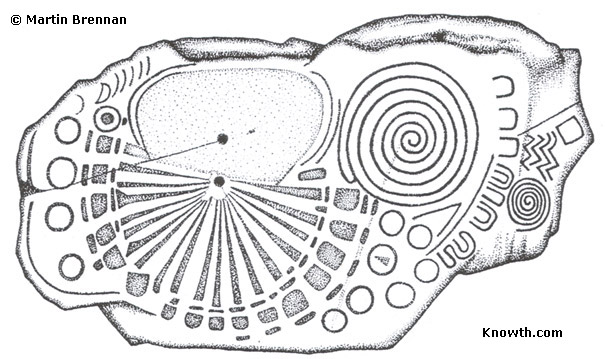 Kerbstone K15, the Sundial Stone. Drawing by Martin Brennan.
Brennan read the fan of lines as a sundial. The outer spokes mark where the sun stands at the summer and winter solstices, and the middle of the fan marks the equinox, halfway between those extremes. Crescents and circles to either side bring the moon into the same design. Euan Mackie later described the stone as a carving of the sixteen month solar calendar proposed by Alexander Thom.
The passage survey and the two stones point the same way. Knowth, on Prendergast's reading, shows the same care for a precise observation that Newgrange shows at midwinter, aimed at a different target. Newgrange measures a fixed day, the winter solstice. Knowth measures the moon against the sun near the equinoxes. She reads the two mounds as parts of one system.
The paper
Kate Prendergast, "Knowth passage-grave in Ireland: An instrument of precision astronomy?", Journal of Lithic Studies, vol. 4, no. 4 (2017), pages 67 to 76.
Read the paper Knowth passage-grave in Ireland: An instrument of precision astronomy?