Hill of Tara Images
From the air, the Hill of Tara is revealed as a complex ceremonial landscape that developed over many centuries. Dominating the summit is Ráth na Ríogh, the Fort of the Kings, a large oval enclosure surrounding several of Tara's principal monuments.
Ráth na Ríogh was constructed during the Iron Age, probably in the later centuries BC. Its enclosing ditch lies inside the bank, unlike the usual arrangement found in defensive ringforts. This suggests that the earthwork served primarily as a ceremonial or symbolic boundary enclosing the royal and ritual centre of Tara.
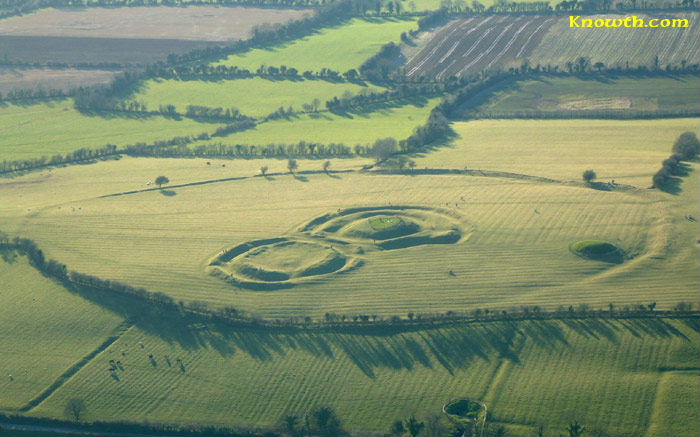 The summit of the Hill of Tara is enclosed by the Iron Age earthwork known as Ráth na Ríogh,
the Fort of the Kings. Within the enclosure are the interlinked earthworks of Teach Chormaic
and An Forradh.
The summit of the Hill of Tara is enclosed by the Iron Age earthwork known as Ráth na Ríogh,
the Fort of the Kings. Within the enclosure are the interlinked earthworks of Teach Chormaic
and An Forradh.
Within Ráth na Ríogh are two adjoining circular earthworks that form a distinctive figure-of-eight shape. These monuments are known as Teach Chormaic, Cormac's House, and An Forradh, the King's Seat or Royal Seat.
Medieval Irish tradition associated Tara with the High Kings of Ireland and connected Teach Chormaic with Cormac mac Airt, a celebrated king in early Irish literature. Archaeological evidence indicates that the monuments formed part of a ceremonial complex constructed within an older prehistoric landscape.
Nearby is the Mound of the Hostages, a Neolithic passage tomb dating from around 3000 BC. It was therefore already ancient when many of Tara's later royal and ceremonial monuments were constructed.
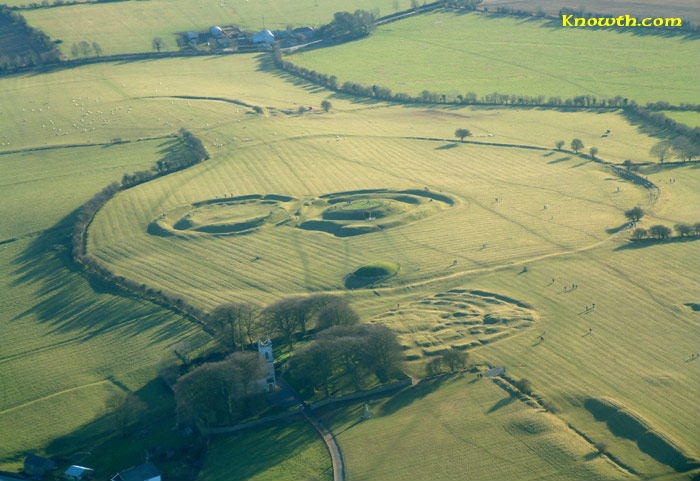 St Patrick's Church beside the ancient earthworks on the Hill of Tara.
St Patrick's Church and its graveyard stand close to the principal earthworks on the summit. The present church was built in the nineteenth century on the site of an earlier church.
According to medieval tradition, Saint Patrick came to Tara after lighting the Paschal Fire on the Hill of Slane. The story describes a confrontation between Patrick and King Lóegaire, who is represented in Christian accounts as the pagan High King of Ireland.
Although the historical details of the story cannot be independently confirmed, the presence of successive churches at Tara demonstrates the continued importance of the hill during the Christian period.
The summit commands extensive views across the surrounding countryside. On a clear day, the landscape of the Boyne Valley and the distant hills of counties Meath, Louth, Dublin, Kildare and Cavan can be seen from Tara.
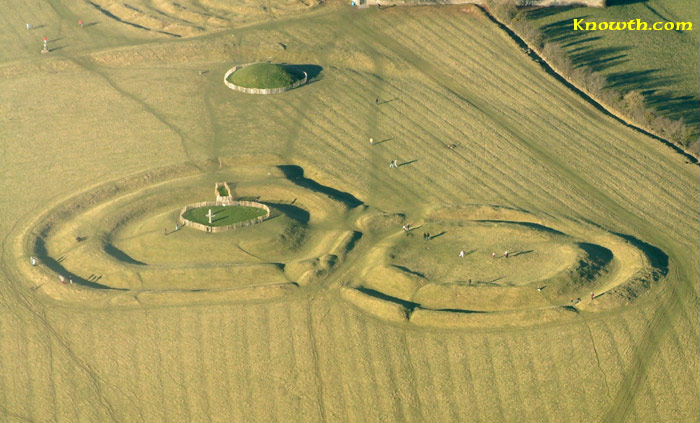 An Forradh, the King's Seat, and Teach Chormaic, Cormac's House.
The aerial view clearly shows the banks and ditches of An Forradh and Teach Chormaic. Visitors walking across the monuments provide a useful indication of their scale.
The Lia Fáil, traditionally known as the Stone of Destiny, now stands on the summit of An Forradh. According to Irish tradition, the stone cried out beneath the feet of the rightful king during the inauguration ceremony.
Its present position is not believed to be its original location. The stone was moved to An Forradh during the nineteenth century, where it remains one of the most recognisable monuments on the Hill of Tara.