Knowth Eastern Passage
The eastern tomb at Knowth has a passage approximately 35 metres (115 feet) (115 feet) long leading into a cruciform chamber, like Newgrange. Together, the passage and chamber extend over 40 metres (131 feet). Inside the chamber a decorated basin stone sits in a side recess, and carved lintels and orthostats show the density of megalithic art that makes Knowth exceptional within Brú na Bóinne.
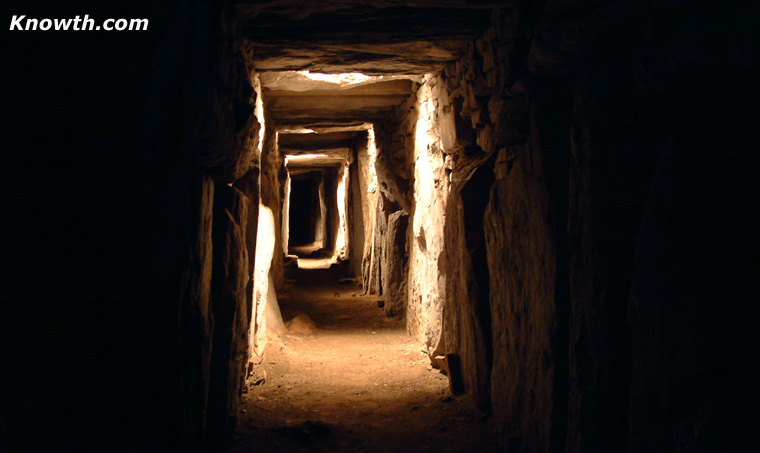 Knowth Eastern Passage leads to a cruciform chamber with a magnificent corbelled roof.
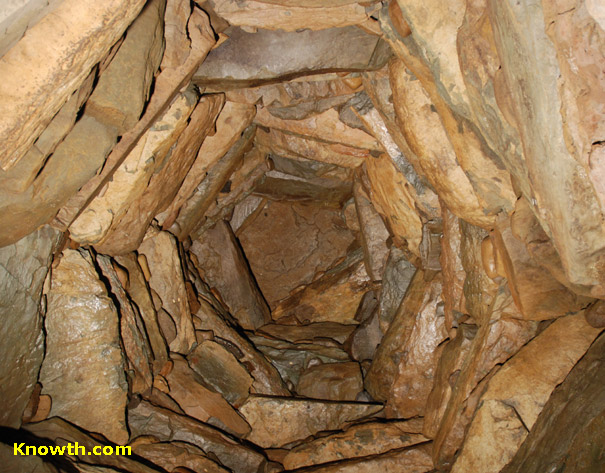 Corbelled roof of the eastern chamber at Knowth.
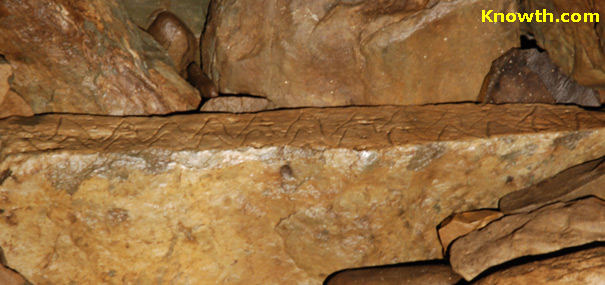 Megalithic art inside the eastern chamber at Knowth.
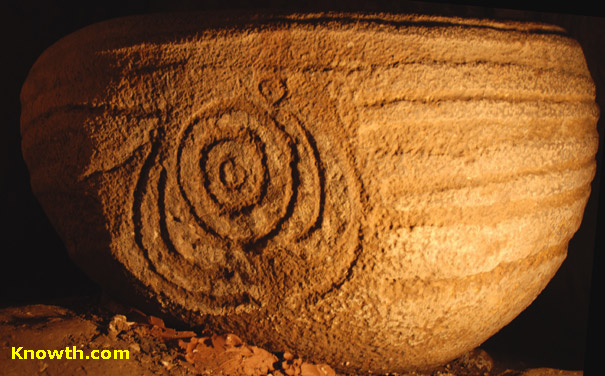 Basin stone inside the eastern chamber at Knowth.
Laser scan of Knowth passage tomb
Inside Knowth’s Eastern Chamber
Three recesses open off the central chamber, giving it its cross-shaped layout. Above them rises a corbelled roof, built from overlapping layers of stone that project progressively inwards until they close the opening. This construction technique also appears in the chamber at Newgrange.
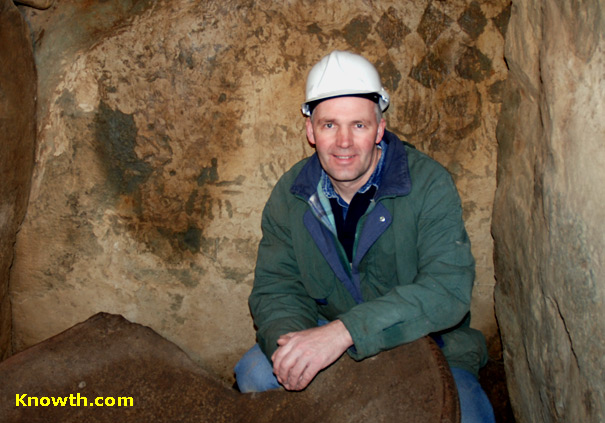 Tour guide Michael Fox inside Knowth’s eastern chamber.
The right-hand (northern) recess contains a decorated stone basin. Behind it stands Orthostat 54, the upright stone forming the back of the recess. Horizontal incised lines cross its surface, with some forming the bases of triangles outlined by fine cuts and filled with picked marks. Near the centre are two groups of nested arcs opening upwards, short lines and two small dot-and-circle motifs with radiating lines. Scattered pickmarks cover the lower part of the stone, while a densely picked area lies on the left. These designs combine fine incisions with marks made by repeatedly striking the stone surface.
Archaeologist George Eogan and his team rediscovered the eastern passage and chamber in 1968, a year after finding the western tomb. His account describes the excitement of entering the chamber and seeing its roof, carved stones and basin. Read more about the rediscovery of Knowth’s eastern tomb.