Winter Solstice sunrise at Newgrange - December 2001
 Article from the Irish Independent December 2001 by Aideen Sheehan.
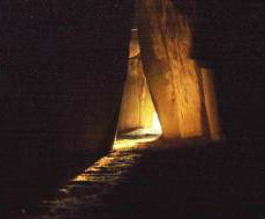
The Solstice sunrise lets the lucky few gaze through a window to an ancient world. Light at the end of the tunnel: the sun makes its way into the main chamber at Newgrange during the winter solstice yesterday.
There was brief light at the end of the tunnel yesterday as visitors to Newgrange got a tantalising glimpse of the splendour of the winter solstice. A narrow beam of light briefly illuminated the 5000 year old burial site, but cloud on the horizon meant the sun failed to thoroughly penetrate the passage grave for the annual 17-minute window into the ancient world.
Around 24 people crowded into the chamber at dawn yesterday, headed by Arts, Heritage, Gaeltacht and the Islands Minister, Síle de Valera, and her Northern Ireland counterpart, Michael McGimpsey. The small group shuffled in the near-total darkness of the inner sanctum, the cold seeping from the ancient stone slabs of the monument which predates the pyramids of Egypt by 500 years. "Now we know what Bin Laden feels like," one wit ventured as we peered through the cave-like darkness waiting to see what fate had in store.
At 8.58am the sun peeped out over the rolling fields of County Meath but low-lying cloud meant its rays could not reach into the 25-cm roof box over the door to the tomb. However by 9.06am stones on the 19m-long passage began to gleam in the winter sun, and shortly afterwards a razor-sharp narrow beam of light lit up as far as the middle of the cross-shaped chamber. Faces that had moments before been almost totally obscured by the dark became dimly visible in the solstice light for a few awe-inspiring minutes.
The chosen few inside included the first members of the public to be randomly selected to attend after administrators Dúchas abandoned the years-long waiting list in favour of a lucky pick for anyone who applied. Outside the passage tomb a crowd of over 80 people including Americans and Spanish watched a beautiful sunrise glow off the entrance, which the ancients faced with Wicklow quartzite for maximum shine factor. Archaeologists are currently attempting to locate the origins of the large structural stones, with early speculation that they may have come from Clogher Head, begging the question of how our distant ancestors transported them upriver, said UCD archaeologist George Eogan.
Winter Solstice Dates
Solstice literally means 'Sun Stands Still', for a few days around the time of the winter solstice the sun appears to stand still in the sky in that its elevation at noon does not seem to change. See winter solstice dates.
Newgrange Winter Solstice Archive
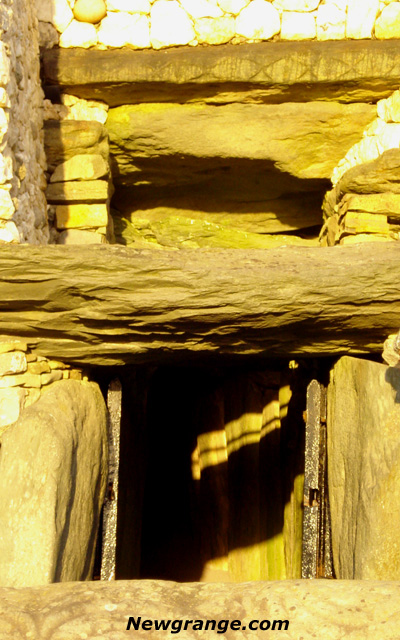 The entrance and roof-box at Newgrange.
- 21st December 2025 Winter Solstice.
- 19th December 2024 Winter Solstice.
- 19th December 2023 Winter Solstice.
- 20th December 2022 Winter Solstice.
- 20th December 2020 Winter Solstice.
- 18th December 2016 Winter Solstice.
- 20th December 2015 Winter Solstice.
- 19th December 2014 Winter Solstice.
- 21st December 2013 Winter Solstice.
- 18th December 2011 Winter Solstice.
- 22nd December 2010 Winter Solstice.
- 19th December 2010 Winter Solstice.
- 22nd December 2009 Winter Solstice.
- 21st December 2009 Winter Solstice.
- 21st December 2008 Winter Solstice.
- 21st December 2007 Winter Solstice.
- 22nd December 2006 Winter Solstice.
- 21st December 2006 Winter Solstice.
- 21st December 2005 Winter Solstice.
- 20th December 2005 Winter Solstice.
- 21st December 2004 Winter Solstice.
- 19th December 2004 Winter Solstice.
- 21st December 2003 Winter Solstice.
- 22nd December 2002 Winter Solstice.
- 21st December 2001 Winter Solstice.
Winter Solstice 1999
Prof Gabriel Cooney lectures in archaeology at UCD - The Irish Times - Jan 2000
As one of the guests on RTE's broadcast from Newgrange on the morning of the winter solstice, it might be felt that I have already had too much opportunity to talk about the phenomenon itself. But, apart from the mystery of what happened inside the monument during the broadcast, there are many other aspects that deserve some comment.
As an archaeologist, one of the most heartening aspects is to see and hear the amount of public discussion and interest the programme has created. I never thought I would hear people discussing solar alignments and the design of megalithic tombs. It is fantastic that this aspect of the prehistoric past has excited so much interest.
However, in all the spins that have been put on the symbolism and meaning of the sunlight entering Newgrange at sunrise on the winter solstice, it has perhaps not been emphasised strongly enough that recognition of this event is due to archaeological research. It was 30 years ago that the late Prof Michael J. O'Kelly, the excavator of New grange, first recorded his description of the solstice event. There had been a local tradition that the rising sun used to light up the tomb, but without the discovery of the roof-box and the recognition of its purpose by Prof O'Kelly there would have been no public awareness of the solstice event.
In some of the coverage and comments there is an impression created that we do not know very much about how people lived in the Boyne Valley when Newgrange was being built. This ignores the painstaking research of archaeologists like Prof George Eogan at Knowth and M.J. and Claire O'Kelly and David Sweetman at Newgrange. Through their work, we have a detailed view of life in the period between 4,000 to 2500 BC, when early farming communities transformed the landscape.
The late Prof Frank Mitchell in a number of important contributions identified the special environmental character of the Bend of the Boyne area and the materials from which the monuments were constructed.
Now this is not meant to be a dry recitation of archaeological endeavour, but to make the point that these and other archaeologists have created the knowledge base for our interpretation of the prehistoric past of the Boyne Valley. There is a lot more that further research will tell us, such as about the land between the monuments where there may not be much trace of prehistoric activity above ground but where new information can be revealed by various survey techniques.
From this work we know that people had been visiting and living on the ridge on which Newgrange stands for several hundred years before the monument was built. Smaller monuments that had features anticipating those of Newgrange itself were constructed. When the monument was built it changed the shape of the hill and became the focus for activity that has continued on and off until the present day.
A few hundred years after its construction, access to the monument was blocked off and the ceremonial focus shifted to activity in large open-air enclosures.
What is being emphasised in the current presentation of the solstice event, however, is not so much what we can interpret about the people who built and used Newgrange in the past, but what it means for us.
The exactitude of the alignment of the monument fits in with an image of a scientific, technologically advanced, modern Ireland. The timeless, spiritual dimension of the sun light lighting the dark fulfils part of the craving for a new sense of spirituality and a connection with the past at a time when religious certitudes are being seen by many to have failed.
We have taken Newgrange out of its context of time and place to serve modern needs, to the extent that the winter solstice media photographic image has become an expected prelude to the late (very late) 20th century Christmas in Ireland. There is nothing wrong with this. After all, how we interpret the past is inevitably influenced by the present.
However, the danger is that in creating a Newgrange for the present we may fail to appreciate the importance of the past and how different the people and society who made Newgrange were to ourselves.
We know from the exchange of objects that people were in contact with other adjacent lands where similar monuments were built. But this was not some kind of prehistoric Euroland, but a world in which local and regional values held sway. Science and spirituality were not separate concerns, but both formed part of the traditions and practice of how life was lived. Time was tied to the seasons and the cycle of life and death.
The land would have been viewed as alive and permeated with the spirits of the dead and the ancestors. Our obsession with demarcating and measuring linear time and the future is precisely that, an obsession characteristic of modern industrial societies where people are at a remove from the rhythm of nature.
So we need to be aware of the need to separate present-day needs from prehistoric past realities. This is not to say that archaeologists agree on the interpretation of the past. For example, there are varying views of the social context in which Newgrange was constructed.
Anyone who wants to connect with the past does not have to go to Newgrange or see it on television to have a real sense of Ireland's historic or prehistoric past. Not just in the Boyne Valley but across the island there are a great variety of archaeological sites dating to different periods in the past.
At a time of great change in the landscape, we need to manage and conserve this resource for the future. The National Monuments Service, Duchas, is under great pressure, because of inadequate resources, to fulfil its role in monitoring and regulating the impact of development on the archaeological resource. If we are really serious about wanting to be connected to our past, then perhaps we should shift our focus from what happens at one monument for a few days each year to a better understanding of what is happening to the past around us every day.
Death in Irish Prehistory by Gabriel Cooney

Death in Irish Prehistory by Gabriel Cooney is a book about life and death over 8,500 years in Ireland. It explores the richness of the mortuary record that we have for Irish prehistory (8000 BC to AD 500) as a highlight of the archaeological record for that long period of time.
Because we are dealing with how people coped with death, this rich and diverse record of mortuary practice is also relevant to understanding how we deal with death today, which is just as central a social issue as it always was.
Purchase at Amazon.com or Amazon.co.uk