Winter Solstice sunrise at Newgrange, 21st December 2004
There was a perfect sunrise on the 19th December and again on the 21st December, the actual morning of the winter solstice mid-point in 2004. About 200 people were present to welcome the sunrise on a bright frosty morning.
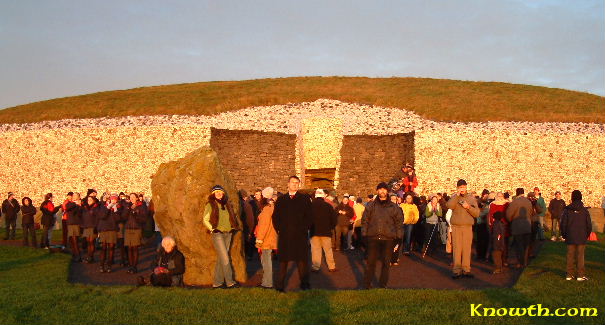 Newgrange winter solstice sunrise, 21st December 2004.
Slow farewell to Winter after a dazzling Solstice
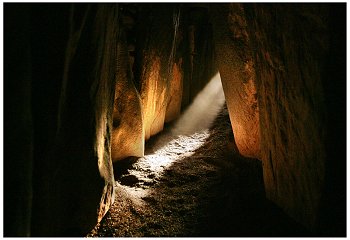 Winter solstice sunbeam in the passage at Newgrange.
Article by Eileen Battersby printed in The Irish Times newspaper on the 22nd December 2004.
Winter solstice sunbeam in the passage at Newgrange.
Article by Eileen Battersby printed in The Irish Times newspaper on the 22nd December 2004.
Fingers of pink began to disperse the stars as the longest night of the year slowly surrendered to dawn. Honouring a late 20th-century practice, created by ancient man long before modern archaeologists had studied the calculated alignment of science and nature, Newgrange watchers gathered at the majestic Late Stone Age monument in Co Meath yesterday. Drawn by the hope of watching the rising sun herald the decline of winter, both the ticket-holding elite and the onlookers standing outside were magnificently rewarded.
For many pilgrims, attendance at Brú na Bóinne is part of an annual ritual marking the start of Christmas. For others, arriving with expressions of anticipation, and some uncertainty, it was a new experience. "Will Santa be here?" asked one little boy, who quickly answered his own question, "I know, he's still really busy at the North Pole." Other watchers looked to the sky and smiled knowingly. Multi-coloured woollen hats and other seasonal headwear did suggest the morning was far colder than it was. Despite the icy roads, the temperature was no sharper than brisk. There was no wind. A filigree of cloud maintained a respectful distance. So clear had the brightening sky become by 8.30 that the large crowd collectively relaxed, confident of sharing a glory devised by nature and brilliantly recognised by early man.
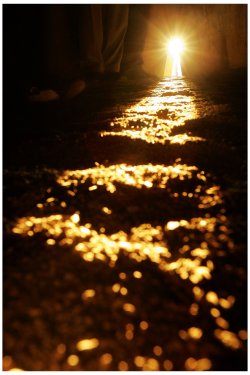 Winter solstice sunbeam along the passage floor at Newgrange.
A young woman draped in a rainbow muffler arrived solemn faced and carrying a
yellow lantern. She stood at the outside wall of the monument, looking east. A
small white dog pattered about, sat and prepared to groom herself as if in
preparation for the coming spectacle. Two men in business suits surveyed the
scene. "There's no druids," said one of them. His companion took
another look before announcing: "I think they tend to be based at
Tara." Below the local horizon, topped by its tree-lined ridge, the River
Boyne emerging from the light mist was a motionless silver ribbon. Outside the
monument, a triumph of science and spirituality, there was no tension, no
anxious whispers. No black clouds arrived to threaten the outcome. Sunrise,
during the five mornings of the mid-winter solstice, enjoys a far greater
significance than throughout the rest of the year. On no other morning, bar
Easter Day, is the sun as symbolic.
Winter solstice sunbeam along the passage floor at Newgrange.
A young woman draped in a rainbow muffler arrived solemn faced and carrying a
yellow lantern. She stood at the outside wall of the monument, looking east. A
small white dog pattered about, sat and prepared to groom herself as if in
preparation for the coming spectacle. Two men in business suits surveyed the
scene. "There's no druids," said one of them. His companion took
another look before announcing: "I think they tend to be based at
Tara." Below the local horizon, topped by its tree-lined ridge, the River
Boyne emerging from the light mist was a motionless silver ribbon. Outside the
monument, a triumph of science and spirituality, there was no tension, no
anxious whispers. No black clouds arrived to threaten the outcome. Sunrise,
during the five mornings of the mid-winter solstice, enjoys a far greater
significance than throughout the rest of the year. On no other morning, bar
Easter Day, is the sun as symbolic.
Across the valley, a yellow light began to rise as if from behind the ridge. The crowd chatted on. The light became brighter, even more yellow. At 8.52, a slim golden blister appeared. On cue, the onlookers cheered. As the glow increased, the hillside retreated into shadow. By 8.55 the sun was moving faster, climbing higher. Its powerful beam had found its heart, the roof-box of the monument built by the ancients in honour of their dead.
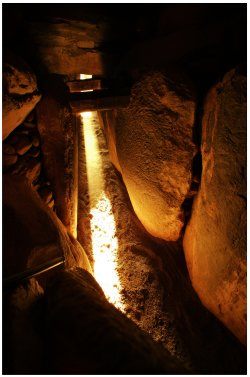 Golden sunbeam advancing along the sanded floor of the Newgrange passage.
Meanwhile, the great boulder-like standing stones that seem to guard the
entrance, basked in the light. Ironically, the pilgrims, having turned their
backs to the sun, now looked towards the long, narrow passageway about to be
illuminated. Cameras were hoisted. Members of the gardaí smiled benignly.
Inside the chamber, darkness began to yield to the golden beam that proceeded up
the sanded floor of the passage. On dull mornings the party inside the chamber
discuss other solstices, years in which the sun made a triumphant appearance.
Yesterday was perfection. In the flood of warm honey light mere words became
redundant. Tom Parlon, Minister of State for the Office of Public Works exited
the passageway as if he had seen a vision, a rare experience for any politician.
The emerging photographers looked so smug, those standing outside could only
squeeze their camera in silent frustration.
Golden sunbeam advancing along the sanded floor of the Newgrange passage.
Meanwhile, the great boulder-like standing stones that seem to guard the
entrance, basked in the light. Ironically, the pilgrims, having turned their
backs to the sun, now looked towards the long, narrow passageway about to be
illuminated. Cameras were hoisted. Members of the gardaí smiled benignly.
Inside the chamber, darkness began to yield to the golden beam that proceeded up
the sanded floor of the passage. On dull mornings the party inside the chamber
discuss other solstices, years in which the sun made a triumphant appearance.
Yesterday was perfection. In the flood of warm honey light mere words became
redundant. Tom Parlon, Minister of State for the Office of Public Works exited
the passageway as if he had seen a vision, a rare experience for any politician.
The emerging photographers looked so smug, those standing outside could only
squeeze their camera in silent frustration.
The same little dog who had groomed herself now dashed towards the passageway in search of fame, or at least a photo. She was apprehended by her embarrassed owner. "I didn't want her to spoil the sacred moment." She didn't. No one could have.
Later a much smaller group of solstice pilgrims gathered at Dowth, another of the Boyne Valley ceremonial mounds. After a day of beautiful skies, a fine sunset was expected. The clouds decided otherwise. A startled bat fluttered about the chamber. Light faded. Even so, Winter had now begun its slow farewell.
Eileen Battersby, The Irish Times
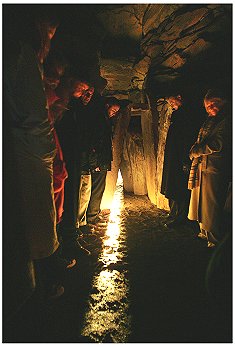 The fortunate few inside the chamber at Newgrange viewing the winter solstice golden sunbeam.
A lottery system is used to allocate places in the chamber for the mornings around the winter solstice, however on the 21st of December they are joined by invited dignitaries. This year the dignitaries included Tom Parlon, Minister of State, Sean Benton, Chairman of the Office of Public Works, and Stuart Eldon the British Ambassador.
Newgrange casts spell on the press
Article by Liam Fay printed in The Sunday Times, 26 December 2004.
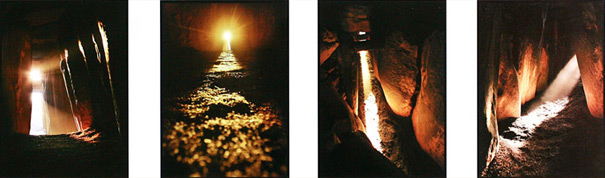 Winter Solstice photographs by Alan Betson.
Newgrange Winter Solstice Archive
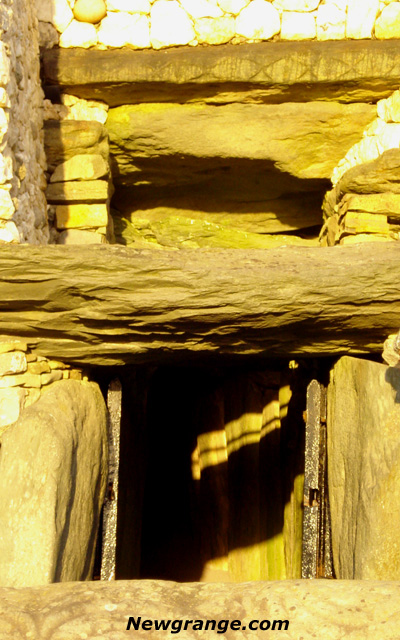 The entrance and roof-box at Newgrange.
- 21st December 2025 Winter Solstice.
- 19th December 2024 Winter Solstice.
- 19th December 2023 Winter Solstice.
- 20th December 2022 Winter Solstice.
- 20th December 2020 Winter Solstice.
- 18th December 2016 Winter Solstice.
- 20th December 2015 Winter Solstice.
- 19th December 2014 Winter Solstice.
- 21st December 2013 Winter Solstice.
- 18th December 2011 Winter Solstice.
- 22nd December 2010 Winter Solstice.
- 19th December 2010 Winter Solstice.
- 22nd December 2009 Winter Solstice.
- 21st December 2009 Winter Solstice.
- 21st December 2008 Winter Solstice.
- 21st December 2007 Winter Solstice.
- 22nd December 2006 Winter Solstice.
- 21st December 2006 Winter Solstice.
- 21st December 2005 Winter Solstice.
- 20th December 2005 Winter Solstice.
- 21st December 2004 Winter Solstice.
- 19th December 2004 Winter Solstice.
- 21st December 2003 Winter Solstice.
- 22nd December 2002 Winter Solstice.
- 21st December 2001 Winter Solstice.