Loughcrew Cairn L - Sunrise Alignment
The Cairn T sunrise alignment at the Equinoxes on Carnbane East is well known, while the seasonal sunrise alignment in Cairn L on Carnbane West is less widely recognised. Cairn T on Carnbane East is open to the public, but Cairn L on Carnbane West is on private land and is not accessible.
At certain times of the year, at Samhain in early November and Imbolc in early February, the rising sun penetrates the passage and chamber of Cairn L, illuminating a limestone standing stone within the cairn.
Archaeoastronomical research, particularly by Frank Prendergast, suggests a more nuanced interpretation. Rather than a precise alignment to specific calendar dates, sunlight enters the chamber over a broader seasonal window in autumn and spring. The deepest penetration of light occurs around early November and early February, with the illumination lasting for approximately 15 to 20 minutes after sunrise.
A careful interpretation is that Cairn L was designed to capture powerful seasonal sunrise light at key transitional points in the year, rather than to mark exact festival dates. Even so, the effect remains one of the most compelling examples in Ireland of how passage tomb architecture interacts with the rising sun, creating a dramatic and likely meaningful experience within the chamber.
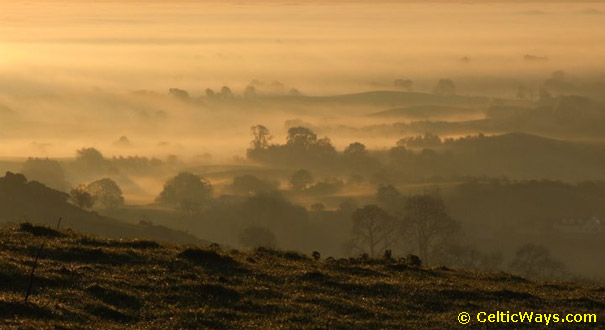 Before sunrise at Loughcrew on November 6th 2005, photo by John Willmott.
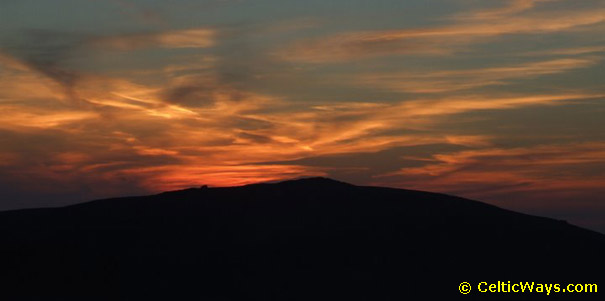 Sun rising over the neighbouring Carrigbrack hill, photo by John Willmott.
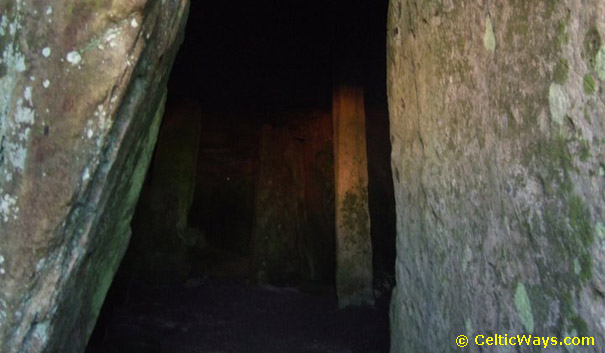 First sunbeam inside Loughcrew Cairn L, photo by John Willmott.
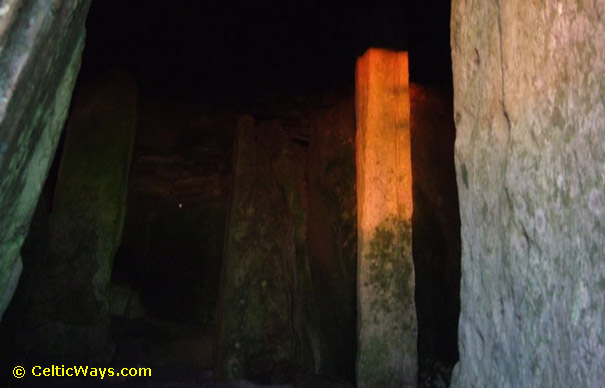 Sunbeam on the Limestone Standing Stone inside Loughcrew Cairn L, photo by John Willmott.
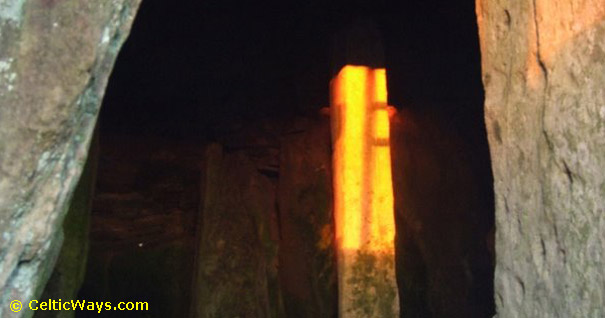 Full Sunbeam on the Limestone Standing Stone inside Loughcrew Cairn L, photo by John Willmott.
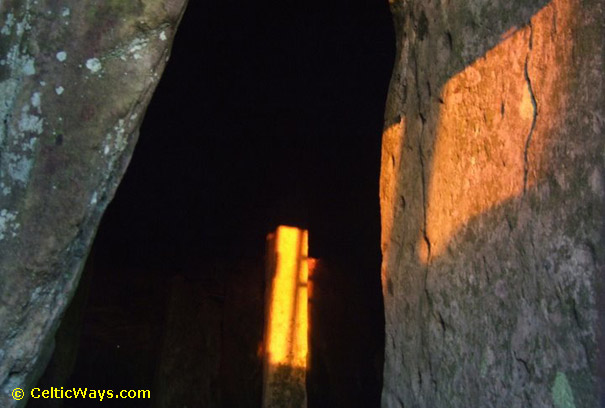 Full Sunbeam on the Limestone Standing Stone inside Loughcrew Cairn L, photo by John Willmott.
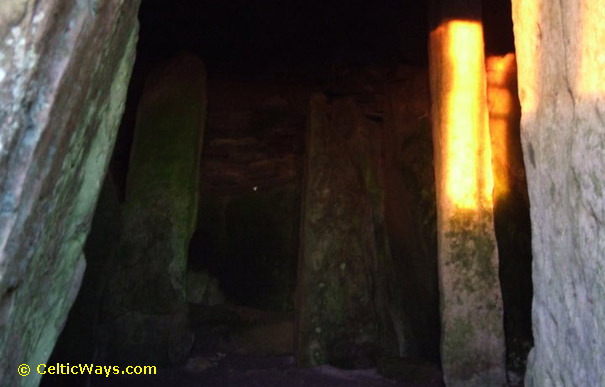 Full Sunbeam on the Limestone Standing Stone, photo by John Willmott.
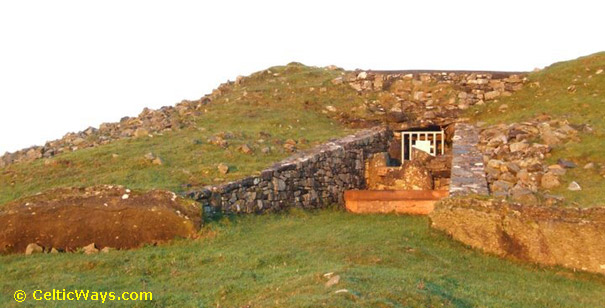 Entrance to Loughcrew Cairn L, bathed in Samhain sunlight, photo by John Willmott.
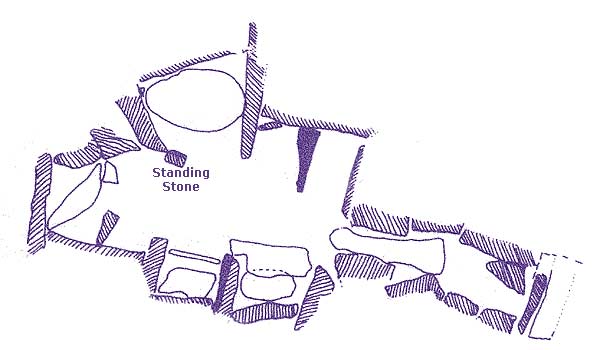 Plan of Cairn L showing the Standing Stone - Adapted from Loughcrew The Cairns a Guide.
Loughcrew Carnbane West
Loughcrew Carnbane West is one of the two principal hilltops within the Loughcrew complex in County Meath, the other being Carnbane East. Together they form one of the most important concentrations of passage tombs in Ireland, set within a dramatic upland landscape that offers wide views across the surrounding countryside.
Carnbane West is less visited than Carnbane East and retains a quieter, more remote atmosphere. The land is privately owned and access is not permitted by the landowner, which means the monuments on this hill cannot be visited by the public. As a result, the cairns on Carnbane West are generally less well known, despite being an integral part of the wider Loughcrew complex.
The hill is crowned by a series of cairns and archaeological features that reflect long-term prehistoric activity in the area. These monuments form part of a broader Neolithic landscape, where tombs were carefully positioned on elevated ground, often with clear sightlines to neighbouring hills and important solar positions on the horizon.
The setting of Carnbane West is particularly striking. Its elevated position provides extensive views across Meath and into neighbouring counties, reinforcing the sense that these monuments were placed in locations of both visual and symbolic importance. The relationship between Carnbane West and Carnbane East also suggests a connected ceremonial landscape, rather than isolated tombs.
Although not accessible, Carnbane West remains a key element of the Loughcrew passage tomb cemetery. It contributes to our understanding of how Neolithic communities organised their monuments within the landscape, combining natural topography with carefully chosen locations to create places of enduring significance.
Read An archaeoastronomical assessment of Tomb L on Carnbane West by Dr Frank Prendergast.