Loughcrew The Cairns
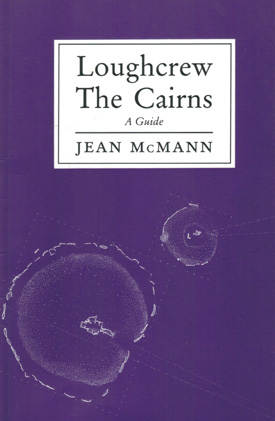
Loughcrew: The Cairns, a guide to an ancient Irish landscape, by Jean McMann. The first in a series of books of local interest, its subject is also one of international archaeological and cultural importance: the 5,000 year old passage tombs on Sliabh na Caillí in the north midlands of Ireland.
This guide is the first publication in more than a hundred years devoted exclusively to one of Ireland's largest Neolithic cemeteries. It includes history and folklore (notably the legend of the cailleach, or hag) as well as archaeological details, and it concludes with interpretations of the uses and significance of these monuments. Also featured are maps, aerial photographs, drawings of finds, illustrations of the exquisite carvings, and, for the first time, complete plans of the site's major cairns.
For local resident or specialist visitor, this much-needed publication constructs and offers the 'biography' of a remarkable landscape at Loughcrew.
Jean McMann holds a PhD in Architectural History from the University of California in Berkeley, where she teaches. In 1980 she published Riddles of the Stone Age: Rock Carvings of Ancient Europe.
Purchase at Amazon.com or Amazon.co.uk.
Preface to Loughcrew The Cairns: A Guide
This guide is intended as an introduction to a little known yet uniquely important landmark, the Neolithic cairns at Loughcrew in County Meath, Ireland. The site is a key monument not only in the history of Ireland, but in the world's history of architecture. It lies about 3 km (2 miles) east of the north midlands town of Oldcastle, 84 km (52 miles) north-west of Dublin.
To walk the hills of this place is to be surrounded by traces of at least five thousand years of the past. The visitor can explore the extensive, unrestored ruins of one of Ireland's four largest passage tomb cemeteries, and at the same time view a 360 degree panorama of the Irish countryside. Loughcrew is also rich in the architectural remains of later periods: Iron Age ring forts, medieval crosses and castles, and the sacred and secular buildings of later centuries. This guide is the first twentieth-century publication devoted exclusively to Loughcrew, and includes the first complete plans of the major cairns.
The historical and architectural information in the book provides the reader with factual evidence; I have also included ideas about the use and significance of the site. Spellings are standardised to modern conventions, except when quoting directly. Most important are the maps and plans, designed to help the reader find and identify details of the monuments. I hope that visitors will think of the cairns not only as beautiful stones in the landscape, but as revolutionary works of art.
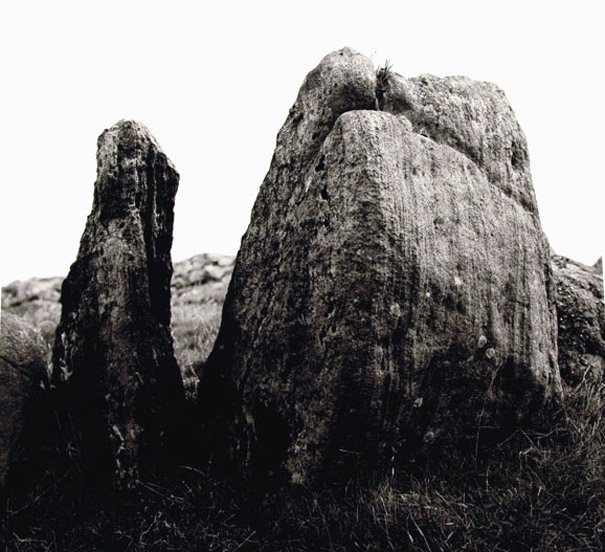 Seven Stones at the Hill of the Witch: photographs by Jean McMann.
Edition of 100, published in 2005 by Jungle Garden Press.
Seven Stones at the Hill of the Witch: photographs by Jean McMann.
Edition of 100, published in 2005 by Jungle Garden Press.
Seven Stones at the Hill of the Witch: photographs
9.5 x 9.5" with 11 sheets including title and colophon laid in a clamshell box. Box covered in green raw silk made by John Demerritt and Kris Langan. Letterpress text printed by Marie Dern. The 9 x 9" carbon-based pigment prints were made by Urban Digital Design in San Francisco.
This series of seven portraits of Irish kerbstones were photographed by Jean McMann. Kerbstones are part of a prehistoric ceremonial centre about 80 km (50 miles) north-west of Dublin at a place called Loughcrew or Sliabh na Caillí (the hill of the witch or hag). Along the crest of this hilly ridge are ruins of at least 35 stone structures now called cairns or passage chambers built around 5,500 years ago during the Neolithic Period.
These cairns and the symbols carved in stone by their makers have been the primary subject of Jean McMann's work as a photographer and scholar ever since she first visited Loughcrew in 1976. Her dissertation for her PhD in History of Architecture from the University of California at Berkeley focused on the plans and history of the site. But her most powerful means of connection has always been the camera.
Jean McMann: "I photographed these kerbstones again and again from 1989 to 1992, lying behind my splayed tripod in the wet grass of Irish summer mornings. They stand on the crest of a hilly ridge now mostly called Loughcrew, about fifty miles north-west of Dublin in County Meath, Ireland. For centuries the place was known as Slieve na Callighe or Sliabh na Caillí (the hill of the witch or hag). The stones are part of a Neolithic ceremonial centre, a site of veneration and pilgrimage built sometime around 5,500 years ago to house and honour the dead. It also may have served as a tribute or means of connection to the sun, moon, stars, as well as to the earth and its seasons. Together with sacred architecture worldwide, the many stone monuments in ruins at Loughcrew speak to us of the purpose and meaning of human existence: our births and deaths, the deeds and events of our lives over time. Deep-rooted and comforting, these stones represent the power of human imagination and our connection to the cosmos."
More about the monuments on the main Loughcrew page, including equinox illumination at Cairn T.