
Sheela-na-gigs - Unravelling an Enigma
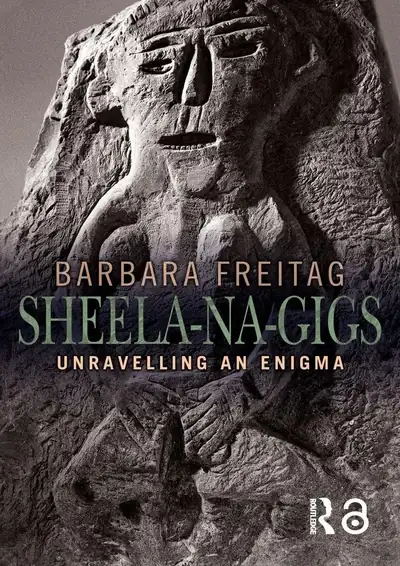
Sheela-na-gigs - Unravelling an Enigma by Barbara Freitag.
Few carvings in Ireland provoke as much curiosity, debate and quiet astonishment as the Sheela-na-gigs. Carved in stone, often weathered by centuries of wind and rain, these stark female figures confront the viewer with an uncompromising directness. Their exaggerated forms, skeletal bodies and emphatic gestures challenge modern expectations of medieval art. Yet they survive, embedded in church walls, perched above doorways and incorporated into castles across Ireland, as enduring witnesses to a complex and layered past.
The book Sheela-na-gigs - Unravelling an Enigma sets out to examine these carvings in a careful and methodical way. Rather than offering a single sweeping theory, it explores their architectural settings, historical context, distribution and the long history of interpretation that surrounds them. In doing so, it treats the Sheela-na-gig not as a curiosity, but as a serious subject within the study of medieval Ireland.
Purchase from Amazon.com or Amazon.co.uk, or you can download the PDF here.
Defining the Sheela-na-gig
A typical Sheela-na-gig depicts a female figure shown frontally, frequently with an enlarged head, prominent ribs and sharply defined limbs. Most striking of all is the deliberate display of the genital area, often emphasised by the figure’s hands. The style is rarely naturalistic. Many figures appear gaunt or skeletal, with wide staring eyes and grim expressions. Others are more rounded, yet still stylised.
They are usually carved in relief, sometimes as independent blocks inserted into walls, and sometimes as part of a larger decorative scheme. Their scale varies considerably. Some are modest in size and easily overlooked. Others are boldly positioned above entrances, where their presence could not have gone unnoticed by those entering the building.
Geographical Distribution
Ireland has the greatest concentration of Sheela-na-gigs in Europe. They are found from Ulster to Munster, with significant clusters in Leinster, particularly in counties such as Meath, Kildare and Tipperary. Comparable figures occur in Britain and parts of continental Europe, yet the Irish examples are more numerous and often more dramatic in form.
This concentration raises important questions. Why did this motif flourish so prominently in Ireland? Was it imported through Anglo-Norman influence, or did it develop in response to local traditions and beliefs? The book examines patterns of distribution and architectural context to address these issues with care and balance.
Medieval Context and Dating
Most Irish Sheela-na-gigs are associated with buildings dating from the twelfth to the sixteenth centuries. This was a transformative period in Irish history. Church reform, the arrival of Anglo-Norman lords and the construction of stone churches and castles reshaped the physical and social landscape.
Placed within this context, the Sheela-na-gig becomes part of a broader architectural language. Medieval churches were not plain structures. They were adorned with carvings, corbels and symbolic figures. Castles too incorporated sculptural elements. The Sheela-na-gig must therefore be considered alongside other medieval motifs rather than in isolation.
Theories of Interpretation
Few subjects in Irish art history have generated as many competing interpretations. Early antiquarians proposed that Sheela-na-gigs were survivals of a pre-Christian fertility goddess. In this view, they represented a distant echo of pagan belief that survived into the medieval period. This theory proved attractive, particularly in the nineteenth and early twentieth centuries, when scholars often sought ancient origins for unusual imagery.
Later interpretations shifted towards moral and didactic explanations. Some scholars argued that the carvings functioned as warnings against lust. Placed on churches, they may have served as visual reminders of the dangers of sinful behaviour. In this reading, the exaggerated display becomes a cautionary symbol rather than a celebration of fertility.
Another strand of interpretation considers an apotropaic function. In medieval Europe, grotesque or startling imagery was sometimes used to ward off evil. Positioned above entrances or at vulnerable points in a structure, a Sheela-na-gig may have been intended as a protective device. The shock value of the image itself may have been thought to repel malign forces.
Unravelling an Enigma does not force the reader to accept one explanation at the expense of others. Instead, it evaluates the evidence for each theory and acknowledges the limitations of certainty. The absence of contemporary written records referring directly to Sheela-na-gigs means that interpretation must rely on context, comparison and careful analysis.
Architecture and Placement
The physical location of a Sheela-na-gig often provides important clues. Many are placed near doorways or windows. Others appear high on gables or incorporated into defensive structures. In some cases, carvings have been relocated, reused or repositioned during later rebuilding, complicating attempts to understand their original setting.
By examining masonry, tooling marks and construction phases, the book attempts to identify which carvings are original to their structures and which may have been moved. This architectural approach grounds interpretation in physical evidence rather than speculation alone.
Folklore and Later Traditions
Over time, communities developed their own explanations for the presence of these enigmatic figures. In some areas, Sheela-na-gigs were believed to offer protection during childbirth. In others, they were thought to guard buildings from misfortune. There are accounts of people touching or interacting with the carvings in ritualised ways.
Such traditions reveal that meanings can evolve. Even if the original medieval intention is no longer fully recoverable, later folklore forms part of the story. The Sheela-na-gig became woven into local memory and practice, acquiring new layers of significance.
Sheela-na-gigs and the Boyne Valley
The Boyne Valley is rightly celebrated for its prehistoric monuments, from the great passage tomb at Knowth to the winter solstice alignment at Newgrange. Yet the region’s medieval heritage is equally rich. Churches, monastic sites and fortified structures dot the landscape, and among them are examples of Sheela-na-gigs.
Seen in this wider context, the Sheela-na-gig connects the deep prehistory of Brú na Bóinne with the medieval world that followed. While separated by thousands of years, both periods demonstrate a powerful engagement with symbolism, belief and the human form. The medieval carvers were heirs to a landscape already layered with meaning.
Challenging Modern Assumptions
Modern viewers often respond to Sheela-na-gigs with surprise or discomfort. It can be difficult to reconcile their explicit imagery with the setting of a medieval church. Yet this reaction may tell us more about modern sensibilities than medieval ones. The Middle Ages were not culturally uniform or prudish in the way they are sometimes imagined.
By situating the carvings within their historical context, the book encourages readers to move beyond initial shock and to consider the intellectual and spiritual frameworks of the time. Medieval art could be didactic, symbolic, protective and even humorous. The Sheela-na-gig may have encompassed several of these functions at once.
An Ongoing Enigma
Despite decades of scholarship, the Sheela-na-gig remains an enigma. New discoveries, improved archaeological recording and fresh perspectives continue to shape debate. Each carving is individual, shaped by its maker and its setting. There is no single template that explains them all.
Sheela-na-gigs - Unravelling an Enigma offers a thoughtful and measured contribution to this ongoing discussion. It brings together architectural study, historical research and folklore to illuminate one of Ireland’s most intriguing artistic traditions. For readers of Knowth.com and for anyone interested in Ireland’s medieval heritage, the Sheela-na-gig stands as a reminder that the past is rarely straightforward. It invites us to look closely, to question assumptions and to embrace the complexity that defines our shared history.
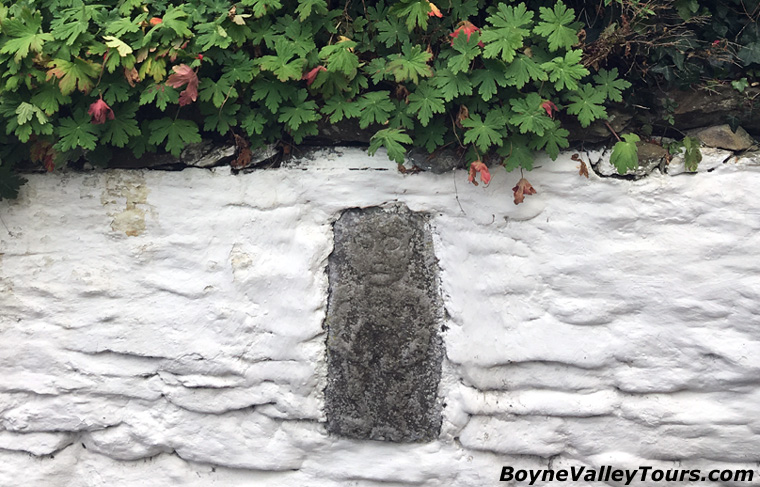 Sheela-na-gig.
Museums kept them locked away safely from public scrutiny
Only in the less puritanical atmosphere of the past few decades did academics as well as artists turn their interest to these carvings. Divergent views emerged as regards the origin and function of the Sheela-na-gigs. Some see them as ancient goddesses, some as vestiges of a pagan cult, others as protective talismans or good luck charms, to name but a few interpretations.
The most favoured critical opinion, however, claims that they are copies of French sculptures put on Romanesque churches as warnings against lust, portraying evil in the battle against moral corruption. Although the reasons advanced for this view are rather unconvincing and, what is more, even contradicted by folk tradition, it has been widely accepted and found its way into dictionaries of art, museum guides and generally into all academic literature on the subject.
The definition of the name, Sheela-na-gig, took an equally surprising course. None of the constituents of the name is an unambiguously identifiable word. Yet a Gaelic pedigree was fabricated which, ironically, strangely contradicts the characteristic features of the sculpture. The problem with both interpretations is twofold. First, their justification is primarily based on a fortuitous resemblance: of form, in the case of the carving, of sound, in the case of the name. Second, they are assumptions imposed from the present on to the past, and from a biased academic on to a rural peasant background.
Sheela-na-gigs are not an urban phenomenon. The vast majority of the figures are found in simple country churches, predominantly in remote agricultural areas where, apart from obvious Christian iconography, they often represent the only form of artistic imagery. Judging by their crude realism and poor workmanship they appear to be produced by local amateur carvers rather than by skilled stonemasons. This suggests that the sculptures belong to folk art and a tradition, too important and too intimately bound up with the welfare of the common people to be disregarded by the Christian Church. Incorporated in a Christian context, but divorced from her roots in pre-Christian tradition, the Sheela-na-gig needs to be seen as some powerful manifestation of continuity with the past. The key to an understanding of her real meaning can thus only be found in a sympathetic appreciation of her medieval social context.
More specifically, in the following chapters I shall argue that the Sheela-na-gig belongs to the realm of folk deities and as such is associated with life-giving powers, birth and death and the renewal of life. Folk deities are found in peasant societies where they preside over certain 'departments' of life. Knowledge of the special power they exercise is transmitted orally and forms part of the folk tradition. Central to the survival of any rural society is the biological reproduction of its members, a close relationship with nature and a reverence for traditional custom. Placed in a cyclical agricultural pattern, the Sheela generally, it seems, was regarded as the guarantor of crops, animals and humans. But in particular, she was the divine assistant at childbirth who, at the same time, formed a link with the realm of the dead.
It will emerge from my investigation that the Sheela-na-gig was in great demand in medieval times, and that she had many sisters in other countries, who, while operating under different names and manifesting themselves in numerous other ways, fulfilled the very same role.
Purchase from Amazon.com or Amazon.co.uk, or you can download the PDF here.