Treasures of the Boyne Valley
Treasures of the Boyne Valley, the archaeologist and historian Peter Harbison traces the River Boyne from source to sea, covering human habitation from prehistory to the present day. The River Boyne flows through the rich limestone land of Co. Meath. Its combination of fertile soil and navigable access to the sea has ensured that it has been inhabited continuously from the end of the Ice Age.
Peter Harbison's book discusses the history of the Boyne Valley, the landscape, the peoples who have left their imprint on the region since prehistory, the houses and monuments, the battle sites and all the other aspects that make it such a rich source of interest.
Purchase at Amazon.com or Amazon.co.uk.
Events and people are featured such as the Battle of the Boyne in 1690 and important figures from the area including the writers Mary Lavin and Francis Ledwidge.
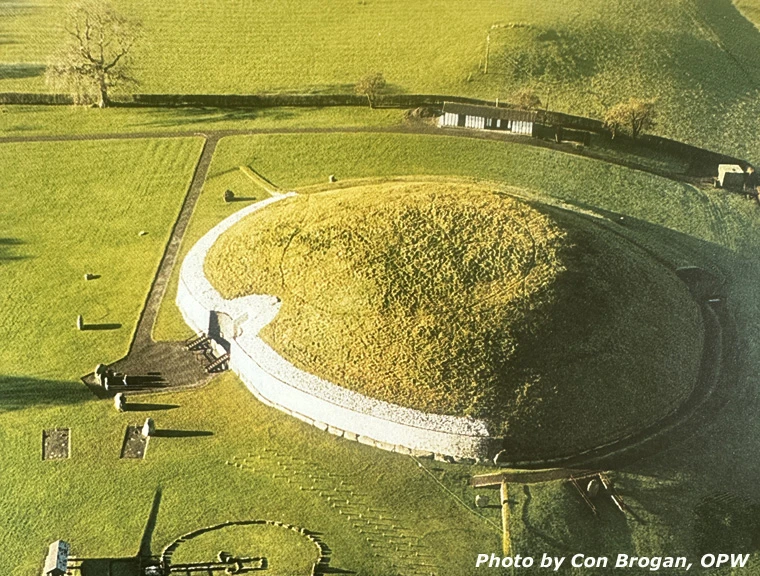 Early morning aerial view of Newgrange from Treasures of the Boyne Valley.
The highlight of the book is of course the three great Stone Age burial sites at Newgrange, Knowth and Dowth. The book also covers the history and archaeology of the Hill of Tara, Trim Castle and Mellifont Abbey.
There are a total of 122 photographs and prints in Treasures of the Boyne Valley, many of the photographs are by Tom Kelly, especially commissioned for the book. Tom Kelly is a resident of the Boyne Valley and knows the area well.
Knowth
The 1960s were the decade when the archaeology of the Boyne Valley really began to buzz. With encouragement from P.J. Hartnett, archaeologist to the Irish Tourist Board, which wanted the Passage Grave at Newgrange made more accessible, Professor M.J. O'Kelly started his excavations in 1962. During the previous two years, George Eogan and George Francis Mitchell had excavated a small but highly interesting Passage Grave on the Louth side of the Boyne at Townley Hall, where Professor Mitchell lived.
This grave has a series of almost concentric circular settings enclosing, near their centre, a rectangular burial chamber which did not differentiate between entrance passage and tomb. It was this excavation and its results that led Professor Eogan to focus his sights on the great mound at Knowth, where he started excavating the same year that O'Kelly began at Newgrange. Forty years on, in what must be one of Europe's longest-standing excavations, he has revealed many surprising, and at times highly exciting, secrets of this great Boyne Valley tumulus.
Satellite Tombs Around the Mound
Where many would have rushed in to seek Knowth's version of the long-known tomb at Newgrange, George Eogan prepared the ground carefully by examining first what lay around the foot of the mound. He knew it was likely that there was more there than met the eye, for R.A.S. Macalister, the first professor of archaeology in University College Dublin, had conducted a small excavation on the site in 1941 and revealed a box-shaped tomb with a passage which he had described as a 'minor grave monument'.
Little could Eogan have suspected how many more such monuments of various kinds he was to bring to light around the mound. Including Macalister's original one, the total amounted to a staggering 19. When first built, they must have looked like a clutch of chickens randomly spread around the base of the mother-hen mound.
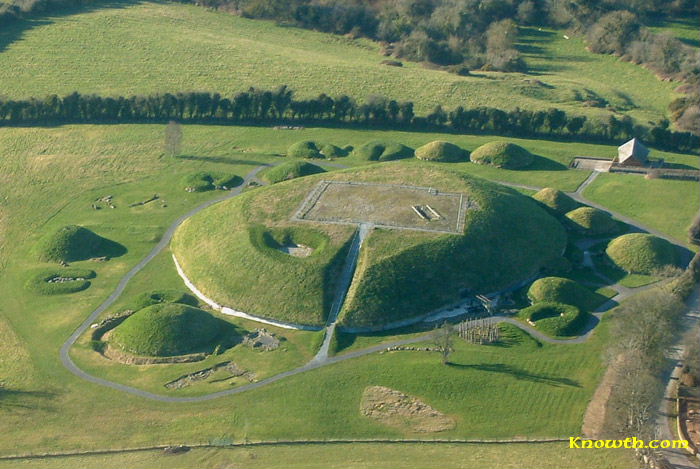 The large mound at Knowth surrounded by smaller satellite mounds.
Most of these satellite tombs were contained within a usually circular setting of kerbstones, though some had a straightened façade on either side of the tomb entrance. Of those which survived sufficiently well to provide Eogan with plans, the layout varied from Macalister's box-like chamber to others where the passage gradually expanded along its length and height to become the tomb, and yet a further group which resembled the classic cruciform plan encountered at Dowth North. None of these was preserved to anything like its full original height and many had been severely damaged, but a number have now been reconstructed and covered with a grassy top to allow visitors to enter and experience for themselves what it must have been like for the original builders some five thousand years ago. One of the tombs had a stone basin of the kind already encountered at Dowth North.
Finds included rather coarsely jabbed pottery bowls dubbed 'Carrowkeel ware', typical of Passage Graves but in their crudeness creating a strong contrast to the refined decoration found on some of the tomb stones. Other items which accompanied the burials, sometimes inhumed, other times cremated, include further material typical of Passage Graves such as chalk balls and a decorated bone pin.
Development of the Site
The rather higgledy-piggledy nature of the layout and spread of these satellite tombs suggests there was no predetermined planning, that they were all built just wherever there was space. The varying tomb plans would also argue for their not having all been built at the same time, but rather that the site just 'growed and growed' as necessity arose over a number of centuries. One of them is certainly older than the main tomb, because the latter's kerb makes a detour in order to avoid it, and it is quite possible that a number of the other satellites are likewise older than the 'mother mound'. Without excavating the whole large tomb down to ground level and below, which is not envisaged, it is impossible to know whether there were originally a whole lot of other examples of the smaller tomb variety beneath it.
Knowth Before Knowth
One of the more recent 'discoveries' George Eogan has surprised us with is, as he so pertinently put it in the title of an article published in Antiquity in 1998, that there was a Knowth before Knowth. In other words, there must have been another important tomb built on or near the site before the present mound was constructed. He came to this startling conclusion through studying stones within the present mound which had had their decoration hidden away and which, he believes, must have been re-used after serving initially in some earlier large and ornamented tomb. He makes the same intriguing, if as yet unproven, suggestion that some of the stones in Newgrange which likewise had their decoration hidden from view when used in the construction may also have belonged to the same hypothetical pre-Knowth tomb, located somewhere, we know not where, in the vicinity of one or other of the great tombs we see today.
The Large Mound
It was only after a few years' work around the periphery that Eogan finally began to tackle the large mound, which is about 9m high and covers an area of an acre and a half.
It was built like a layer cake, with alternating strata of stones and sods. While the mound gives the impression of being round, the line of the kerbstones shows that it was rounded only on the northern and southern portions. Elsewhere the curvature is flattened, almost forming a straight line in some places. The mound's diameter across the curved parts is marginally larger than Dowth's, but from one flattened side to the other it is slightly narrower than Dowth.
The Western Tomb
Macalister and Eogan had not been the first to excavate here since the Stone Age. Locals dug away inside the kerb during the first millennium AD to make a souterrain, just as they had done at Dowth, and the same kind of dry-stone walling used in it also appears to line a passage leading in at right angles towards the centre of the mound. On the afternoon of 11 July 1967 Eogan began to remove earth from this passage when a cavity appeared ahead. The smallest member of the excavating team was given a torch so that he could squeeze through and find out what was inside. When he returned and said that he saw a passage that went in for twenty yards, his report was received with a mixture of delight and caution. After a little more earth had been removed, Eogan himself was able to look, and could confirm to his own satisfaction what he had been told.
One after the other, the small group of excavators, including George's wife Fiona and the late Tom Fanning, crawled along the passage, under a fallen stone and through a puddle of water, before being able to stand erect again and follow the passage's rising capstones until finally coming to the centre of the western tomb, where all could gaze with wonderment at the central stone basin and the decorated stones, unseen for a millennium or more. Though the dazzle of gold was naturally not present in this Stone Age tomb, the feeling of awe must have been closely akin to that experienced by Howard Carter when he discovered Tutankhamun's tomb forty-five years earlier.
What Eogan had hit upon was one of the longest Passage Graves known, approximately 32 metres (105 feet) from the inside of the kerbstone to the back of the tomb. For about seven-eighths of its length it consists of a long and narrow passage, which makes an angle to the right near the end before finally increasing in height and expanding slightly to the left to form the burial chamber, which is really just an enlargement of the passage. The basin stone had presumably once formed part of the chamber furniture, but tomb robbers a thousand years or more ago must have tried to drag it out into the open air and failed, for it still lies in the passage, which is as far as they were able to bring it.
Eighty uprights form the walls of passage and chamber together, though originally there would have been more near the entrance, which was demolished by the souterrain builders.
Decoration in the Western Tomb
Many of the stones bear pocking, but by no means all are decorated in any formal way. The kerbstone outside the entrance to the tomb, however, gives an inkling of one of the ornamental styles found inside. It is a long, low stone covered with a whole series of boxed half-rectangles and, most significantly of all, a vertical line in the centre which, for the builders, almost certainly marked the entrance to the tomb. The same motif is found on the backstone of the tomb, linking start and finish for a purpose we can no longer understand.
A few of the upright stones in the first three-quarters of the passage are pecked with ornament which has visible signs of zigzags, spirals and angular designs, but it is in that part of the passage after the bend, and on the upright stones that form the walls of the expanded tomb area at the end of it, that we find the most striking motifs. A number bear boxed circular or angular designs. Of these stones the most remarkable is that beyond the first low sill stone in the passage. Its outer face has boxed upright rectangles topped by sets of concentric circular motifs. This stone immediately caught the attention of Eogan as he eased himself along the passage for the first time, when he recognised in it the stylised form of a human figure, with two staring eyes. The design bears a curious resemblance to Edvard Munch's The Scream, but Eogan was probably getting closer to its intention when he described it as a 'ghostly guardian' of the approach to the inner sanctum. The other remarkable stone is on the left-hand wall of the chamber, at right angles to the backstone, where extensive pocking left the central part of the stone smoothened to reveal what I always fondly imagine to be a bear with a runny nose.
The Eastern Tomb
Before succumbing to obvious temptation and immediately starting to excavate the tomb, Eogan continued his researches inside the kerb. During the following season's campaign, he reached the opposite, eastern, side of the great mound. There he thought he had come upon another souterrain inside the kerb, and this led him to suspect there might be a second tomb here. This seemed a mere fancy, unworthy of serious consideration, as no similar instance was known among the round-mounded Irish Passage Graves. On 30 July 1968 he descended through a hole into four passages whose dry-stone walling confirmed that they belonged to one or more souterrains. Having come to a dead end in three of them, he tried the fourth.
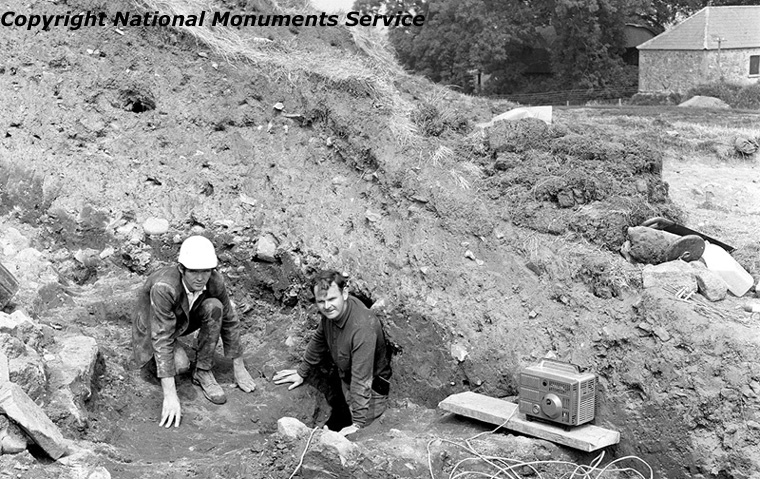 John Rock (left) and George Eogan (right) at the Eastern tomb at Knowth in August 1969.
This led in towards the mound and, though progress became more difficult, uprights from each side having fallen inwards towards one another, he was able to clamber over them and come upon what he described as the most amazing sight of his life: a well-preserved cruciform Passage Tomb chamber similar to those at Dowth North and, more significantly, Newgrange, but untouched by human hand for more than a thousand years. In the light of his torch he could see a number of decorated stones and a masterly basin stone, beautifully shaped and decorated.
It is given to few people to come across one major intact Irish Passage Grave, but no one other than George Eogan has had the joy and surprise of finding a second example in the same mound.
The two tombs are not small, like those at Dowth, and the second tomb has a passage much longer than the similar example at Newgrange as well as a chamber rivalling Newgrange's in height. The two Knowth tombs are totally different: the first has a chamber which is an expansion of the passage, and the second is cross-shaped in plan. Yet both are fitted snugly back-to-back with one another and almost meet in the centre, the gap between them being less than 10ft (3m). Finding two very different tomb types under the same mound raises the intriguing chicken-and-egg question: which came first, or were they both built at the same time? Sadly, neither tomb is accessible to the public, but it is possible to view a stretch of the passage to the eastern tomb from a recently constructed chamber in the mound.
Decoration in the Eastern Tomb
A great number of the stones in this eastern tomb bear signs of pocking, creating a roughened surface probably by means of a pointed flint. The kerbstone outside the entrance has a series of boxed rectangles, like a pair of eyes looking out at the world as through angular spectacles and inspecting those who enter the tomb behind the central vertical line. Decoration begins to increase about two-thirds of the way along the passage, where it is difficult to make much sense out of the juxtaposition of angular and curved lines in the stones.
Similar features occur on some of the stones of the highly decorated chamber walls, and one gets the impression that the artists, who almost certainly would not have regarded themselves as such, were becoming more and more adept at an ever-increasing stylisation the farther they distanced themselves from what must originally have been a realistic model for the designs, like the gradual transition from realism to abstraction in the world of painting a century ago. The chamber of this eastern tomb has a much stronger geometrical streak, with series of zigzags, positive and negative triangles, rows of diamond shapes arranged point-to-point and even one 'rayed sun' motif, perhaps a reference to a main god worshipped by the Passage Tomb builders.
Knowth's Megalithic Art
Aside from there being two great tombs under the one mound, a further feature that makes Knowth stand out among its peers is the richness of the decoration on the 123 exposed kerbstones. Here we find many of the motifs we have already encountered, zigzags, spirals, concentric circles, positive and negative diamond rows, all with various permutations and combinations, but most executed in a very competent manner by pecking out the designs from the fairly smooth surface of the greywacke boulders. Two are particularly notable. One, numbered 13 by George Eogan, has an arrangement of diamond shapes which, as on a decorated stone at Fourknocks on the Dublin-Meath border, I can only interpret as a splendidly stylised human face with eyes and nose. Even more remarkable is the next-but-one neighbour, No. 15, which is dominated by what looks like a sundial, even having a small hole for a gnomon, which could have helped mark the times of the day. Eogan was able to establish that, when the decorated kerbstones are combined with the ornamented stones in both chambers, Knowth incorporates a quarter of all the megalithic art known anywhere in Europe, and almost half of all the known megalithic art hitherto recognised in Ireland.
The Knowth Macehead
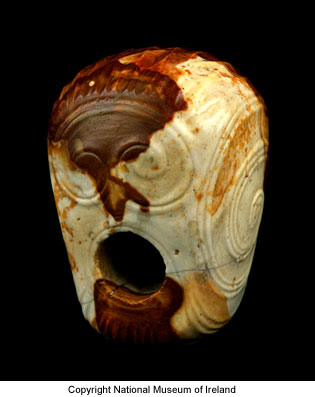 The Knowth mace-head.
Since these people were capable of creating such sophisticated patterns on stone, it comes as somewhat of a disappointment to see the generally poor quality of the pottery
associated with the burials, which seem largely to have been cremations. One stunning find at Knowth, however, shows just what high-calibre goods could be deposited with the
dead in Irish Passage Tombs. This is an ovoid macehead discovered on the old ground level at the entrance to the right-hand recess of the eastern tomb. Carved from flint,
it is perforated to hold a wooden handle, the hole serving also as the mouth for a superbly stylised face with spiralled eyes, a beard and backward-groomed hair. The sides
consist of three-strand spirals curling into a centre with a modelling that looks forward to the finest Aeolian columns of classical Greece. This is a piece of stylised art which,
though physically small, dwarfs in quality any grave goods from elsewhere in Ireland, indeed, from anywhere else in Europe at the time. It shows the builders of Passage Graves
to have been 'giants' in achievement, in both the ingenuity of their structures and the quality of their art. We should doff our caps to Ireland's first master craftsmen!
The Knowth mace-head.
Since these people were capable of creating such sophisticated patterns on stone, it comes as somewhat of a disappointment to see the generally poor quality of the pottery
associated with the burials, which seem largely to have been cremations. One stunning find at Knowth, however, shows just what high-calibre goods could be deposited with the
dead in Irish Passage Tombs. This is an ovoid macehead discovered on the old ground level at the entrance to the right-hand recess of the eastern tomb. Carved from flint,
it is perforated to hold a wooden handle, the hole serving also as the mouth for a superbly stylised face with spiralled eyes, a beard and backward-groomed hair. The sides
consist of three-strand spirals curling into a centre with a modelling that looks forward to the finest Aeolian columns of classical Greece. This is a piece of stylised art which,
though physically small, dwarfs in quality any grave goods from elsewhere in Ireland, indeed, from anywhere else in Europe at the time. It shows the builders of Passage Graves
to have been 'giants' in achievement, in both the ingenuity of their structures and the quality of their art. We should doff our caps to Ireland's first master craftsmen!
Treasures of the Boyne Valley Contents
- The Boyne from Source to the Sea
- Edenderry and the western end of the Boyne
- Clonard to Donore
- Trim and environs
- Bective area
- Navan area
- Along the Boyne Walk towards Slane
- Heading towards Slane
- Slane
- The Bend of the Boyne, Brú na Bóinne and Duleek
- Oldbridge, Mellifont and the Battle of the Boyne
- Drogheda
- The estuary and the sea
- Ireland's oldest man-made artefact
- The Mesolithic
- The Neolithic, or New Stone Age
- Passage Graves in the Bend of the Boyne
- Dowth
- Knowth
- Newgrange
- Sacred landscape
- The Hill of Tara
- The Hill of Slane and the coming of Christianity
- Upstream to Clonard
- High Crosses
- Round Towers and Vikings
- Mellifont
- Trim Castle
- Drogheda Town Walls
- Newtown Trim
- Medieval effigies
- Bective Abbey
- Athlumney Castle
- Wayside Crosses
- The Battle of the Boyne
- Bellinter House
- St Peter's Church of Ireland Church, Drogheda
National and Historic Monuments of Ireland
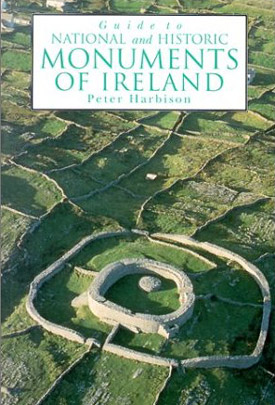
Peter Harbison is an archaeologist and historian. The author of many books, including the definitive Guide to the National and Historic Monuments of Ireland, now in its fourth edition, he was for many years the editor of Ireland of the Welcomes, the principal periodical publication of Fáilte Ireland the Irish Tourist Board. He is the leading authority on Irish high crosses and is a former vice-president of the Royal Irish Academy, Honorary Member and Professor of Archaeology at the Royal Hibernian Academy and an Honorary Fellow of Trinity College Dublin.
Since its first publication in 1970, the 'Guide to the National and Historic Monuments of Ireland' has introduced countless thousands to the archaeological riches with which the Irish landscape is endowed. Detailed plans and reference maps, reconstructions and illustrations enliven the text, which describes all the monuments in close detail. A comprehensive introduction places these monuments within the context of Irish history.
Purchase at Amazon.com or Amazon.co.uk.