Knowth Megalithic Passage Tomb
Knowth is a Neolithic passage tomb complex in the Boyne Valley, County Meath. Built over 5,000 years ago, it forms part of the Brú na Bóinne UNESCO World Heritage Site. The Great Mound contains two passage tombs and is surrounded by smaller satellite tombs.
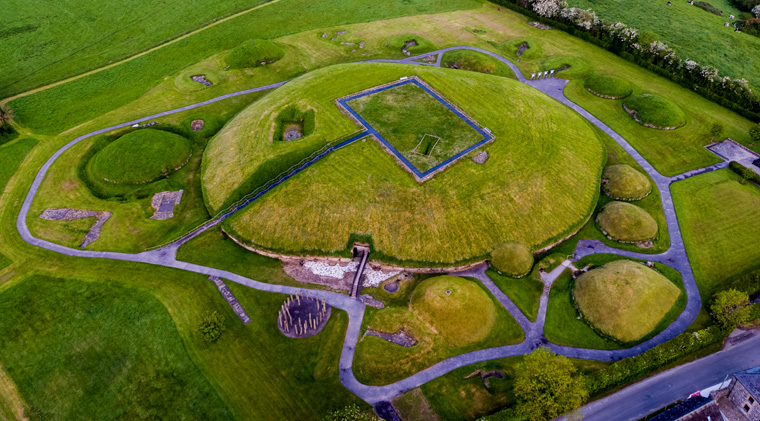 Knowth Aerial View | The enclosure on top of the mound is a Medieval Grange.
Knowth is renowned for its intricate megalithic art and a wealth of archaeological treasures that provide a captivating glimpse into the rituals and beliefs of our ancestors. As you step onto the hallowed grounds of Knowth, prepare to be transported back in time, unravelling the mysteries of a bygone era etched into the very stones that define this extraordinary passage tomb.
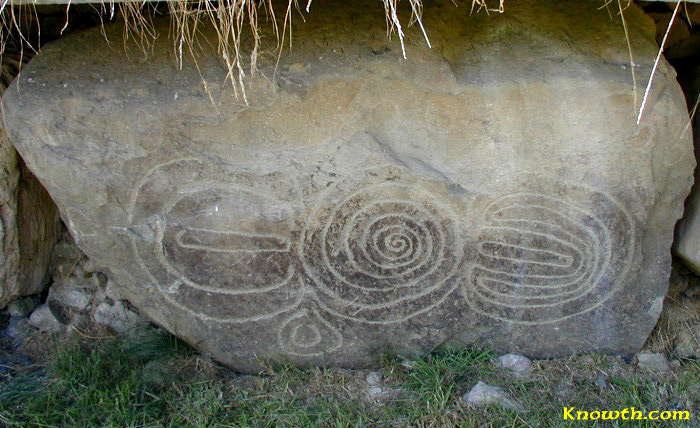
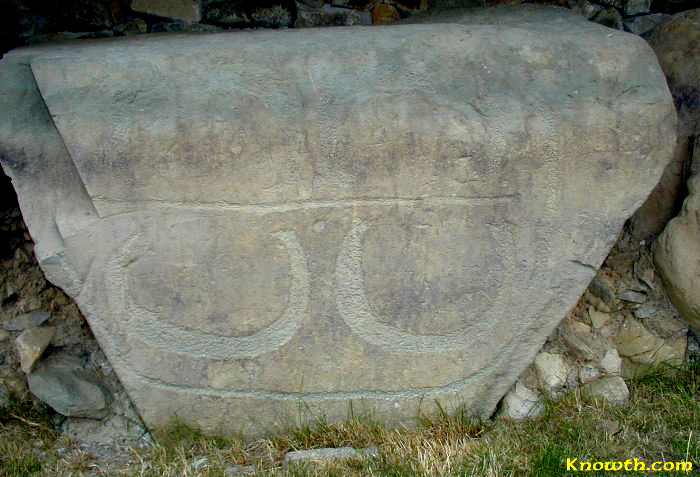
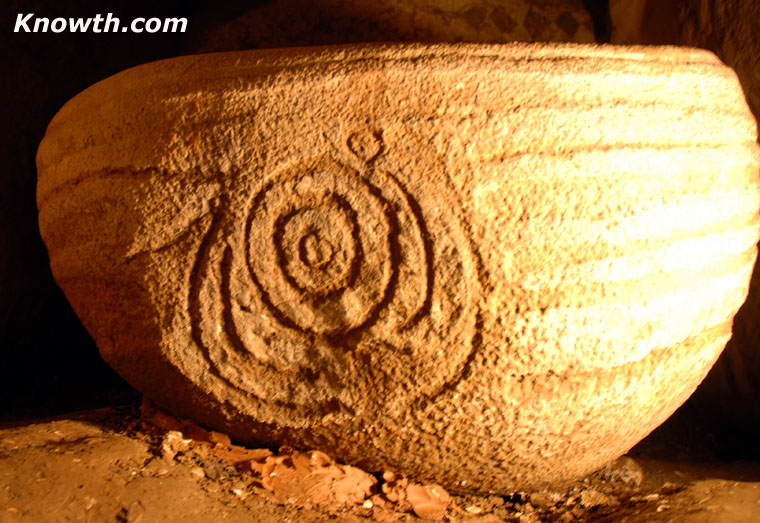 Basin Stone from the eastern chamber at Knowth.
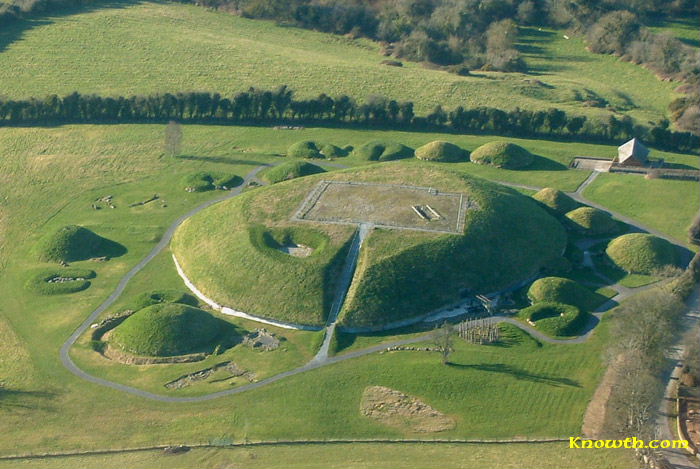 Knowth Aerial View - More aerial views of Knowth.
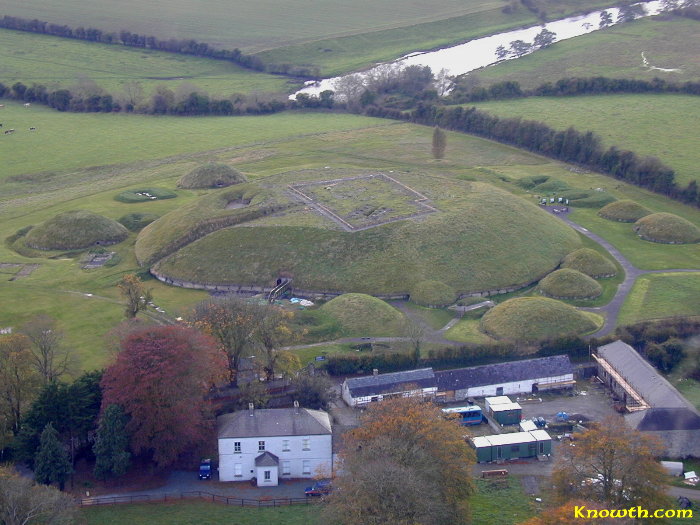 Knowth Aerial View from a helicopter in 2001 before the days of drone photography.
Knowth Passage Tomb and the Excavations of George Eogan
Knowth is one of the largest and most important prehistoric monuments in Ireland and forms part of the Brú na Bóinne UNESCO World Heritage Site in County Meath. Dating to around 3200 BC, it is slightly larger than Newgrange and contains one of the richest collections of megalithic art found anywhere in Europe.
Modern archaeological investigation of Knowth began in 1962 when Professor George Eogan of University College Dublin commenced what would become one of the longest-running archaeological excavations in Europe. Inspired by discoveries at nearby passage tombs, Eogan set out to investigate the great mound at Knowth and, over the following decades, transformed our understanding of the monument and the people who built it.
Satellite Tombs Around the Great Mound
Rather than immediately excavating the main mound, Eogan first explored the area surrounding it. This careful approach led to the discovery of an extraordinary complex of 19 smaller satellite tombs clustered around the base of the monument. These tombs varied considerably in design, ranging from simple box-like chambers to more elaborate passage tombs with cruciform layouts.
The variety of plans suggests that the cemetery developed over a long period rather than being constructed as a single project. Some of the satellite tombs may even predate the construction of the great mound itself. Excavations revealed cremated and unburnt human remains, pottery known as Carrowkeel Ware, chalk balls, decorated bone pins and stone basins, all typical features of Ireland's Neolithic passage tomb tradition.
Several of these smaller tombs have been reconstructed and can be visited today, providing a rare opportunity to experience the scale and atmosphere of a Neolithic burial monument.
A Monument Built Over Earlier Structures
Excavation evidence suggests that the history of Knowth may extend back even further than the visible monument. Professor Eogan proposed that some of the decorated stones incorporated into the mound had originally belonged to an earlier and now vanished passage tomb. These reused stones were placed with their carvings hidden from view, suggesting they may have been recycled from an older sacred structure.
This idea led Eogan to suggest that there may have been a significant monument at Knowth before the construction of the great mound, adding another layer of complexity to the site's history.
The Great Mound and Its Two Tombs
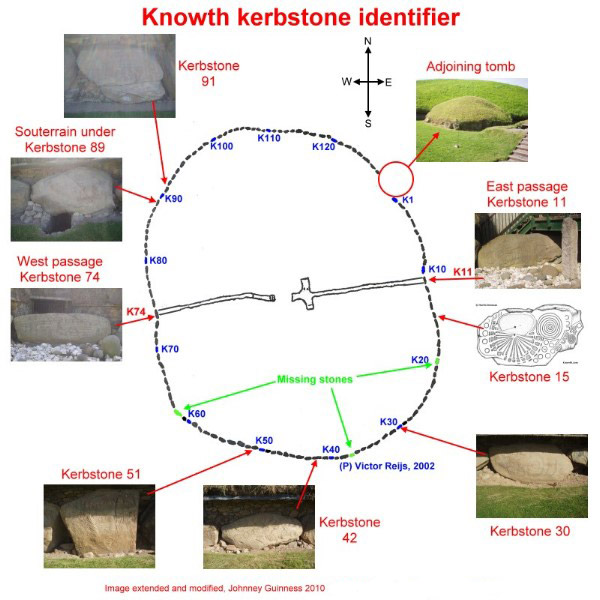
The main mound at Knowth is about 10 metres (33 feet) high and 95 metres (312 feet) across at its widest point, covering about 0.6 hectares (1.5 acres). Constructed from alternating layers of stone and sod, it was carefully engineered and enclosed by a ring of large kerbstones, many of which are richly decorated.
One of the most remarkable discoveries made during the excavations was that the mound contains not one but two major passage tombs. The first, discovered in 1967, is located on the western side of the mound. The western passage and chamber together extend 34 metres (112 feet).
The western tomb contains decorated orthostats, a large stone basin and numerous examples of megalithic art. Some of the carvings have been interpreted as highly stylised human figures, while others consist of spirals, rectangles and geometric motifs whose meanings remain unknown.
An even greater surprise came in 1968 with the discovery of a second tomb on the eastern side of the mound. The eastern passage and chamber together extend over 40 metres (131 feet). This tomb contains a large cruciform chamber similar in design to those at Newgrange and Dowth. The chamber remained largely untouched for more than a thousand years and preserved some of the finest examples of passage tomb art at Knowth.
The two tombs are positioned back-to-back within the mound and almost meet in the centre, separated by only a few metres. Their differing designs raise important questions about how and when the monument was constructed.
Megalithic Art at Knowth
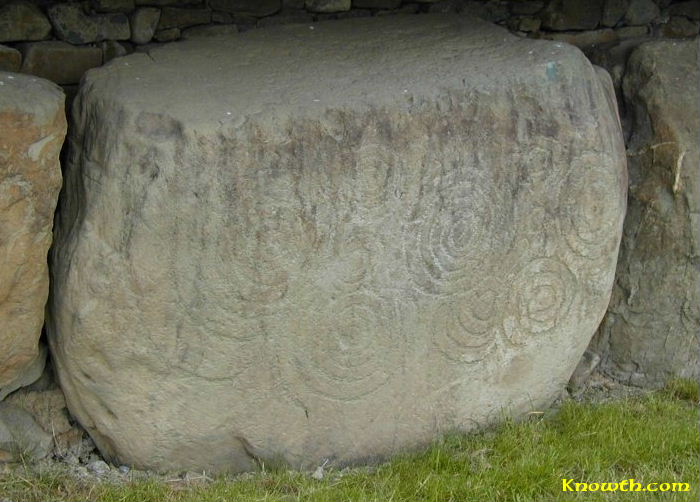
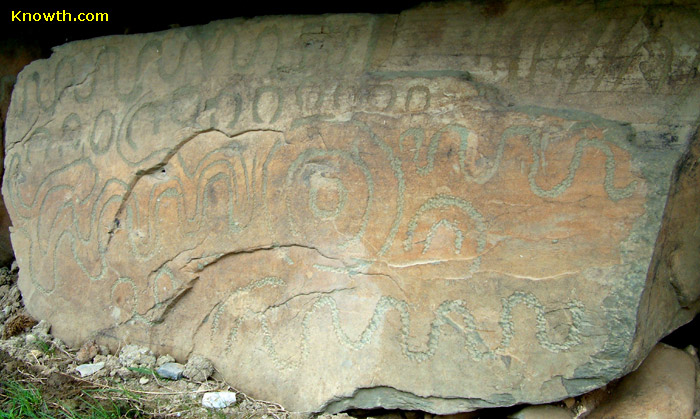
Knowth is internationally famous for its megalithic art. The site contains 123 decorated kerbstones along with numerous carved stones inside both tombs. The carvings include spirals, zigzags, concentric circles, lozenges, diamonds and abstract geometric patterns created by pecking designs into the greywacke stone surfaces.
Several kerbstones are particularly celebrated. Kerbstone K13 contains an arrangement of diamond shapes that has been interpreted as a highly stylised human face. Nearby Kerbstone K15 features a remarkable circular design that resembles a sundial and is among the most discussed carvings at the site.
The quantity and quality of the artwork at Knowth are unparalleled. Professor Eogan estimated that the monument contains approximately a quarter of all known megalithic art in Europe and nearly half of the known megalithic art in Ireland.
The Knowth Mace Head
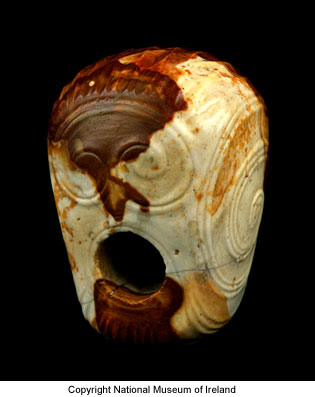 Among
the finest artefacts discovered during the excavations is the famous Knowth Mace Head. Found within the eastern tomb, this beautifully carved flint object was originally mounted on a wooden handle through a central perforation.
Among
the finest artefacts discovered during the excavations is the famous Knowth Mace Head. Found within the eastern tomb, this beautifully carved flint object was originally mounted on a wooden handle through a central perforation.
The mace head is decorated with spiralled eyes, a stylised face, a beard and flowing hair, all executed with extraordinary craftsmanship. It is widely regarded as one of the finest pieces of Neolithic art ever discovered in Europe and demonstrates the remarkable artistic abilities of the people who built the passage tombs of Brú na Bóinne.
Together, the monumental architecture, extensive megalithic art and exceptional artefacts make Knowth one of the most important archaeological sites in Ireland and one of the outstanding achievements of Neolithic Europe.