Newgrange Triple Spiral
The triply spiral on orthostat C10 is the best known motif within the chamber at Newgrange. The stone is located on the right hand side of the rear recess, at the back of the chamber. In Michael J. O’Kelly’s numbering system, the letter C identifies the upright stones or orthostats within the chamber.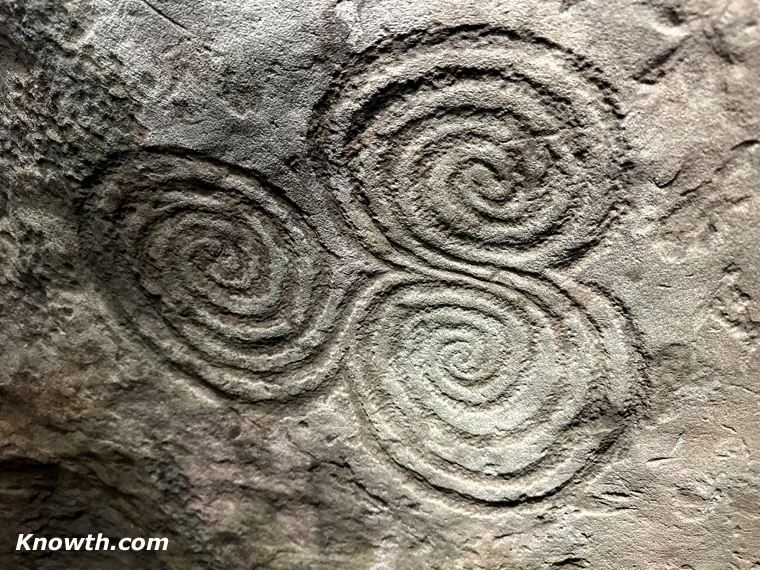 The triple spiral on orthostat C10 in the rear recess at Newgrange.
The motif is three double spirals, joined on the front face. It measures about 30 by 28 cm (12 by 11 inches), smaller than the spirals on kerbstone K1 at the entrance. Claire O'Kelly called the design a three-spiral, because each of the three spirals is drawn as a double line. The same carving is also called a tri-spiral, a triskele or a triskelion.
The carving is Neolithic. It was cut about 2,500 years before the Celts reached Ireland.
The winter sunrise
People living near the mound told the O'Kellys that the rising sun used to light this stone in the end recess. That account is what led Michael J. O'Kelly to watch the winter solstice sunrise. He recorded the belief in Newgrange: Archaeology, Art and Legend.
Pick-dressing and the other motifs
Much of orthostat C10 is covered with pick-dressing, produced by repeatedly striking the stone with a pointed stone tool. The triple spiral occupies an area of the face that was largely left undressed, with the surrounding pick-dressing extending towards the left side of the design.
The southern face carries several smaller motifs, including a spiral and an oval.
What Does the Newgrange Triple Spiral Mean?
The original meaning of the Newgrange triple spiral remains unknown. Carved more than 5,000 years ago, the design has been interpreted as a symbol of life, death and rebirth, the changing seasons, or the continuous cycles of nature. Its location within a Neolithic passage tomb has also encouraged suggestions that it was connected with burial rituals and beliefs about the afterlife.
The number three has attracted particular attention, with some interpretations linking the three spirals to the past, present and future, or to birth, life and death. However, these are modern interpretations, and there is no archaeological evidence to establish what the design meant to the people who created it. The triple spiral predates Celtic culture in Ireland by thousands of years and should not be confused with the later Celtic triskelion or its associated symbolism.
The Discovery Programme model
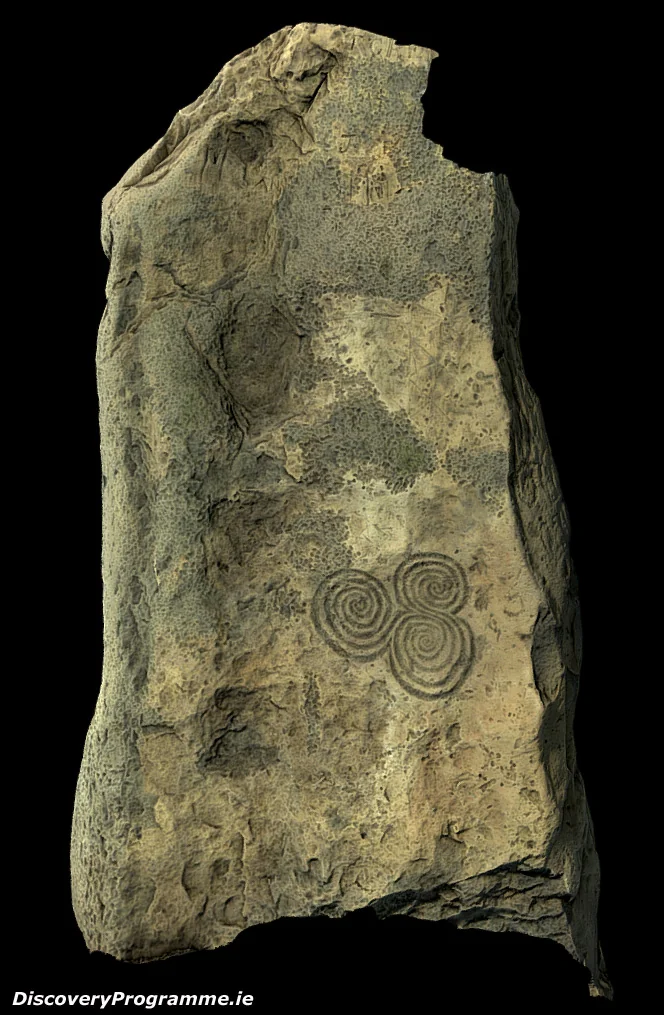 Orthostat C10 | Discovery Programme model.
The Discovery Programme scanned orthostat C10 on 14 July 2014 and reprocessed the scan in 2024 to make this model, as part of the 5Dculture project.
More photographs of the passage and chamber are on the Newgrange chamber page.