The Celts
The Celts were an ancient and fascinating civilisation whose presence first appears in written sources around 700 BC, recorded by Greek writers. They were not a single unified people, but a network of loosely connected tribes living north of the Alps, especially around the Danube region in central Europe. In the centuries that followed, their cultural influence spread widely across Europe, reaching both eastward and westward.
The Celts in Ireland
The Celts are generally believed to have reached Ireland around 500 BC. Exactly how and when this process occurred remains uncertain, as firm archaeological or historical evidence is limited. Rather than a single invasion, it is more likely that Celtic influence emerged gradually, spreading over time and reshaping society across the island over several generations.
In the centuries that followed, Celtic language and culture became firmly established. By the fifth century AD, the arrival of Christianity marked another major turning point. The interaction between existing Gaelic traditions and the new Christian faith played a central role in shaping early Irish society. The legacy of this period continues to influence Ireland’s cultural identity to this day.
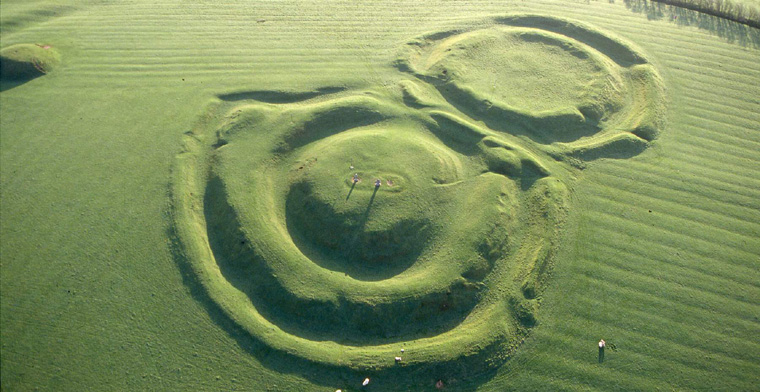 Hill of Tara, Celtic Royal Site in Ireland's Ancient East.
Some Thoughts on the Celts
In Some Thoughts on the Celts, Desmond Johnston explores how ancient monuments such as Stonehenge and Avebury became wrongly associated with Celtic Druids. This idea, largely promoted in the 18th century by William Stukeley, helped create the long-standing misconception that the Celts built monuments which in fact predate them by thousands of years.
The recognition of the Celts as a later Iron Age culture, broadly contemporary with Greek, Roman and Etruscan societies, only became widely accepted during the 20th century. Even today, confusion remains about the true heartland of Celtic culture, with many still placing it in Ireland or Scotland rather than in central Europe around the Upper Danube.
Read the full article Some Thoughts on the Celts
Ireland and the Celtic Culture
Few words are more closely linked with Ireland today than the term “Celtic.” It appears everywhere, from Celtic music and Celtic spirituality to Celtic crosses and even everyday merchandise. The label has become a convenient shorthand for anything perceived as traditionally Irish.
Yet how accurate is this association? To what extent is Ireland truly “Celtic”? These questions have been the subject of considerable debate among modern Irish archaeologists and historians, and the answers are often more complex and nuanced than popular usage suggests.
Read the full article Ireland and the Celtic Culture
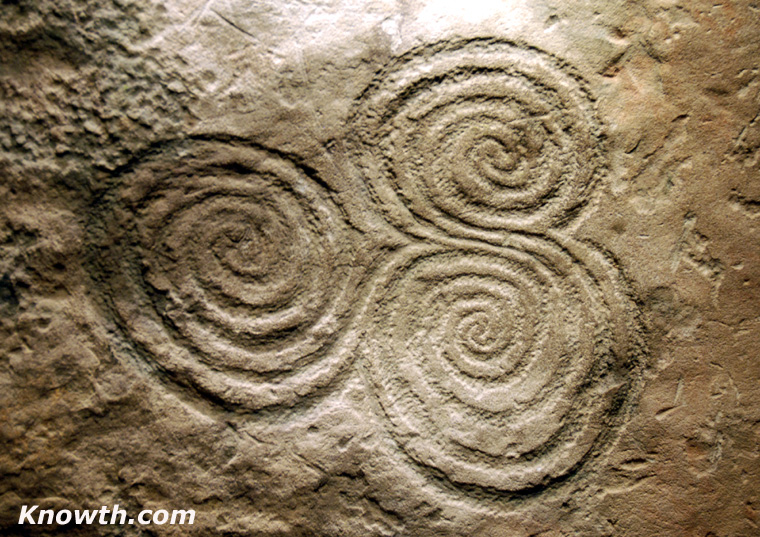 The tri-spiral symbol carved on orthostat C10 inside Newgrange.
Newgrange Tri-spiral
At Newgrange, the famous tri-spiral motif carved on the inner chamber wall is frequently described as a Celtic symbol. In reality, it predates the arrival of the Celts in Ireland by at least 2,500 years. The monument itself was constructed around 3200 BC, during the Neolithic period, long before Iron Age Celtic culture emerged in Europe.
Although the carving is not Celtic in origin, later generations incorporated these ancient monuments into their own mythology. In early Irish tradition, the great passage tombs became known as sídhe, or fairy mounds, entrances to the Otherworld. Brugh na Bóinne, the ancient name for the Newgrange complex, was associated with Oengus (Aonghus), the youthful god of love and poetic inspiration. According to legend, Oengus never aged while dwelling at Brugh na Bóinne, reinforcing the idea of the site as a timeless and supernatural place.
The term “Celtic race” is itself misleading. The Celts were not a single unified people, but a loose network of tribes and communities connected by language, art styles and shared cultural practices. They formed alliances for defence, trade, ritual and social exchange rather than functioning as a centralised civilisation. Unlike the literate societies of Greece and Rome, Celtic culture relied heavily on oral tradition. Much of what we know comes from archaeology and from later written accounts by Classical authors.
While primarily oral in character, the Celts in Ireland did develop a distinctive writing system known as Ogham.
Ogham
Ogham was used in Ireland roughly between the fourth and eighth centuries AD. The script consists of a series of straight strokes or notches carved along the edge of a standing stone or piece of wood. Each letter is formed by one to five strokes arranged in relation to a central line. The inscriptions are typically brief and often record personal names, suggesting that Ogham stones functioned mainly as memorials or territorial markers.
Although the surviving examples date from the early medieval period, some scholars have proposed that the system may have older roots. One theory suggests it evolved from a form of hand signalling, possibly associated with learned elites such as druids. Whether or not this is the case, Ogham represents one of the earliest forms of writing in Ireland and provides a rare written glimpse into early Gaelic society.