Knowth Kerbstone K38
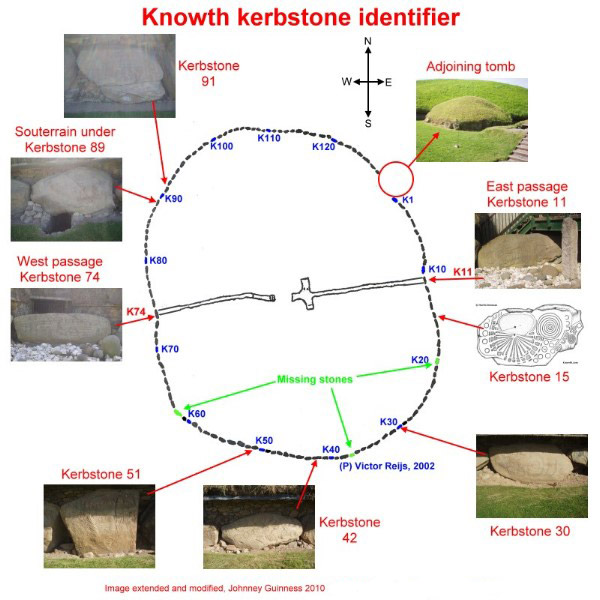
Kerbstone K38 is one of the 127 kerbstones numbered in Professor George Eogan's record of the Knowth monument. It is located on the southern side of the great passage tomb mound.
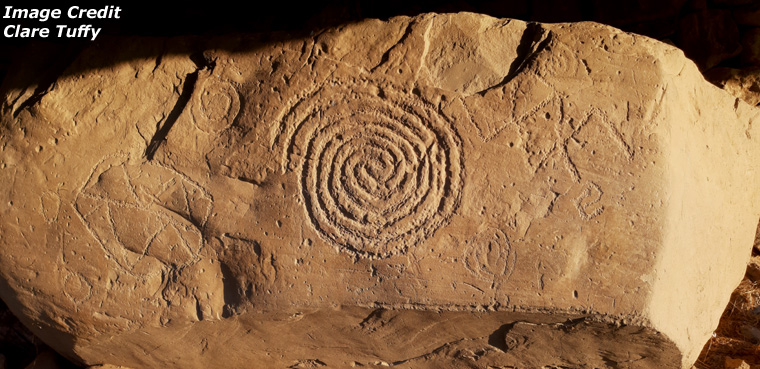 Knowth Kerbstone 38.
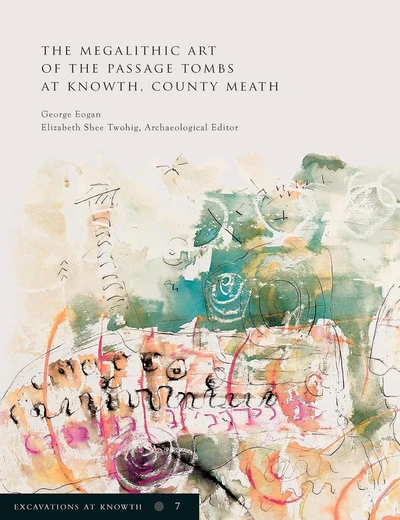
The Megalithic Art of the Passage Tombs at Knowth, Co. Meath
Description of Kerbstone 38
Most of the carving was lightly picked with a rounded point. There are two very finely picked small circles at the lower-left. To their right there are two lightly picked zigzags separated by a horizontal line and surrounded by a polygon. Above this is a short spiral of two turns. At the right of the stone, two sets of zigzags are arranged to form lozenges, and three small arcs/circle motifs.
An anti-clockwise double spiral motif is much more deeply picked than the other carvings, and although it does not directly overlap the more lightly picked motifs, it seems likely that it may have been done at a later date than them. It is similar to the deeply carved central spiral on Kerbstone 34. Some dispersed pickmarks occur on the face.
Excavations at Knowth Volume 7: The Megalithic Art of the Passage Tombs at Knowth, Co. Meath
Purchase at Amazon.com or Amazon.co.uk. View or download at Digital Repository of Ireland.
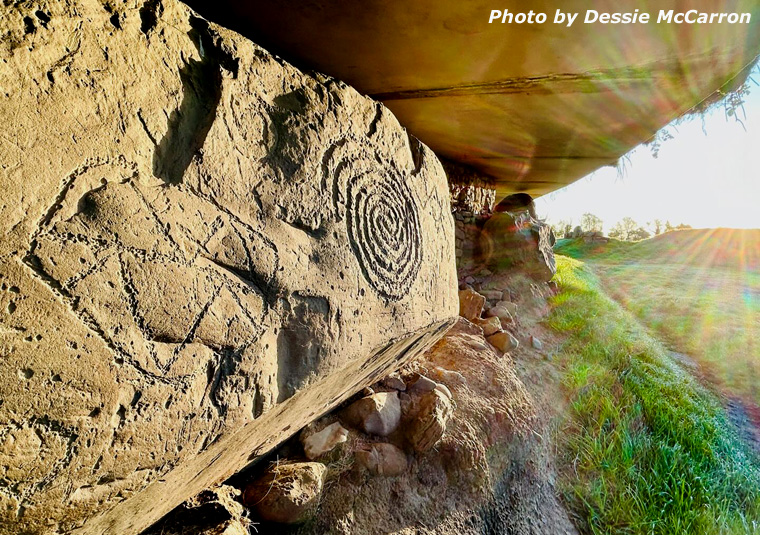 Knowth Kerbstone 38.
Knowth Stone Age passage tomb
K38 forms part of the ceremonial kerb documented during decades of excavation at Brú na Bóinne by Professor George Eogan and his team. One hundred and twenty-four kerbstones still ring the base of the Great Mound, which is 95 metres (312 feet) across at its widest point. Many carry carved spirals, lozenges, concentric circles and other abstract motifs that can be viewed on a circuit of the mound (kerbstone gallery).
Roughly half of all Irish passage-tomb art and about a third of the megalithic art of Europe comes from Knowth. The carvings share a distinctive Boyne Valley style that links kerb, passage and chamber stones into a single artistic tradition (Excavations at Knowth Volume 7).
The mound cannot be visited independently. Access is by guided tour from the Brú na Bóinne Visitor Centre at Donore, on the south bank of the Boyne, with a shuttle bus to the site and interpretation by trained guides.
The first farmers reached the Boyne Valley around six thousand years ago, probably travelling by river. They cleared woodland, cultivated wheat and barley on rich soils, and kept herds of cattle, sheep, pigs and goats before committing enormous communal labour to the great tombs.