Directions to Fourknocks Megalithic Passage Tomb
Access to Fourknocks Passage Tomb is by key, which can be obtained from the White family (Tel: +353 1 835 4722) before 6pm. Their house (Eircode A42 FN40) is located approximately 1.5 miles west of the tomb and is signposted from Fourknocks. A refundable cash deposit is required, and the key must be returned before 6pm.
Google maps directions to Fourknocks
Directions to Fourknocks from Drogheda.
- Travel 14 km via Duleek to Ardcath Village, top left of map above.
- Travel south-east towards Garristown for 1.5 km, passing the school and church.
- Turn left at crossroads towards Clonalvy, Fourknocks is signposted.
- Travel for 2 km, passing Donnelly's Pub in Clogherstown on the right.
- Turn left onto a narrow road, currently no signpost for Fourknocks.
- Travel for 0.5 km to collect key at White's house which has a plaque with the name WHITE built into the stone wall at the roadside. There is a red hay barn behind the house.
- Travel 1.5 km to a STOP sign where the road joins an equally narrow road, keep to the left.
- Travel a short distance to a fork in the road, keep to the right towards Naul.
- Travel for 175 metres, the Fourknocks pedestrian entrance is on the left-hand side.
- The pedestrian entrance is unsuitable for wheelchairs.
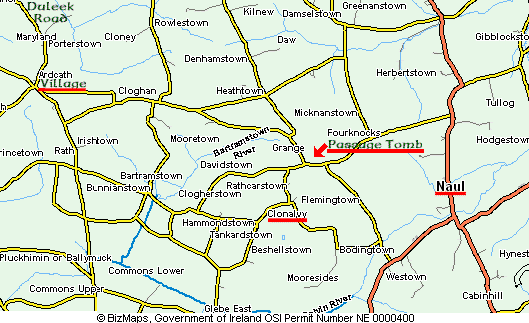
Ordnance Survey map 43
GPS - N 53°35.795 W 006°19.589 (N 53.596583 W 6.326483)
Fourknocks Passage Tomb
Fourknocks Passage Tomb is located near Stamullen in County Meath, approximately 16 kilometres (10 miles) south-east of the Newgrange monument. The name Fourknocks derives from the Irish Na Fuarchnoic, meaning “the Cold Hills”.
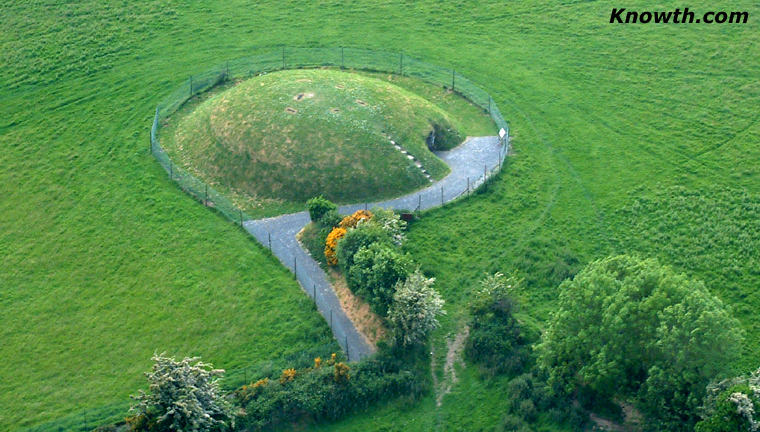 An aerial view of Fourknocks Megalithic Passage Tomb.
The monument remained unknown to archaeologists until 1949 when a visitor to Newgrange mentioned similar mounds on her uncle's farm near Naul. Her uncle, Patrick Maguire, subsequently brought archaeologist P. J. Hartnett to inspect the site. What initially appeared to be a modest overgrown mound concealed one of Ireland's most important passage tombs.
Excavation in the early 1950s revealed a Neolithic passage tomb dating to approximately 3000 BC. Archaeologists discovered the remains of more than 65 individuals together with decorated pottery, beads, pendants and other artefacts. These finds demonstrated that Fourknocks had served as an important burial and ceremonial centre for many generations.
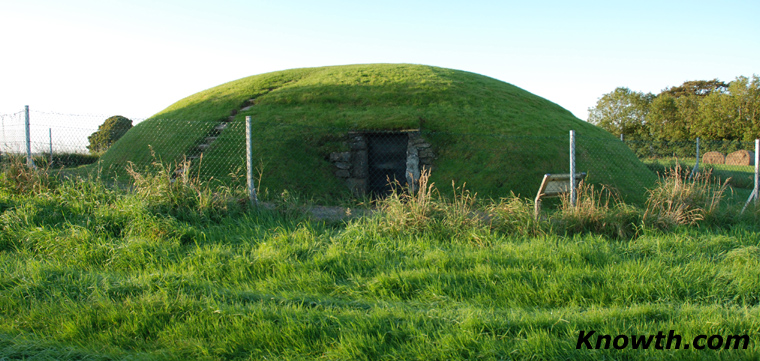 Entrance to Fourknocks Passage Tomb.
The tomb consists of a short entrance passage leading into a large central chamber with three side recesses. Unlike Newgrange and several other Irish passage tombs, Fourknocks was probably not covered by a corbelled stone roof. Instead, evidence suggests that a central timber post supported a wooden roof, which eventually decayed and collapsed. The monument is now protected by a modern concrete structure that preserves the interior while allowing limited natural light to enter the chamber.
Fourknocks is particularly renowned for its megalithic art. Twelve stones within the chamber are decorated with finely executed carvings, including zigzags, lozenges, arcs and geometric motifs. The quality of the artwork ranks among the finest examples of Neolithic stone carving in Ireland.
One decorated stone has attracted special attention because its design resembles a human face. Sometimes referred to as the "Old Man of Fourknocks", it may represent one of the most convincing depictions of a human face from Neolithic Ireland. Whether intentional or coincidental, the carving remains one of the most distinctive features of the monument.
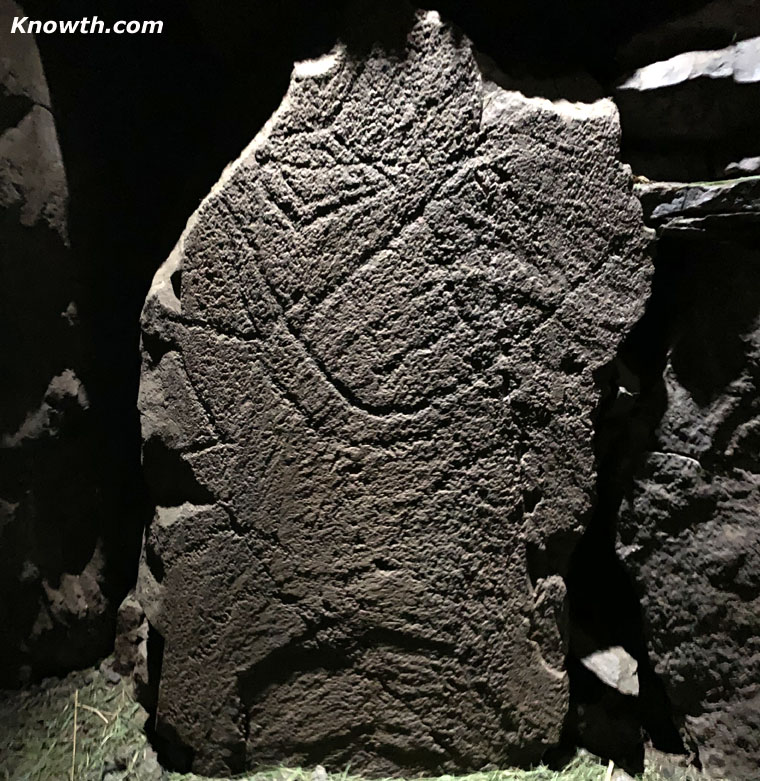 Fourknocks Face Stone | Possibly anthropomorphic (representing a human form).
The journey through the narrow entrance and into the chamber appears to have been carefully designed. Visitors are required to bend and pass through confined spaces before entering the larger central chamber, creating a strong sense of transition from the outside world into a special ceremonial space.
Among the most remarkable discoveries was a carved object made from the antler of a young red deer. Decorated with chevron patterns, the antler artefact had been deliberately broken before being placed among the burials. Archaeologists believe it may have held ritual significance and was likely associated with status, authority or beliefs concerning fertility, ancestry and renewal.
Two additional mounds form part of the Fourknocks complex. Although these monuments were excavated, they were not reconstructed and are not generally accessible to visitors. Archaeological evidence suggests that one may have been associated with cremation activities connected to the burials in the main tomb.
Today Fourknocks remains one of Ireland's most intimate and atmospheric passage tombs. Its relatively small scale allows visitors to experience the chamber at close quarters, while its remarkable carvings and archaeological discoveries provide a fascinating insight into the beliefs and traditions of the Neolithic communities who built and used the monument more than 5,000 years ago.