Knowth Timber Circle
Between 2800 BC and 2500 BC a timber circle or woodhenge was constructed near the eastern passage entrance at Knowth. The circle has been re-created using the 33 prehistoric post holes.
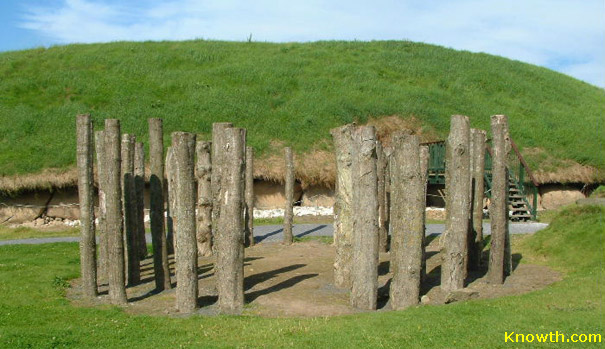 Timber circle or woodhenge at Knowth World Heritage Site.
This period is known as the Grooved Ware period, from a pottery type with a flat bottom and straight sides. Grooved pottery was found near the timber circle. Votive offerings were also found in and around it, suggesting ritual use, possibly after the Great Mound had fallen into disuse.
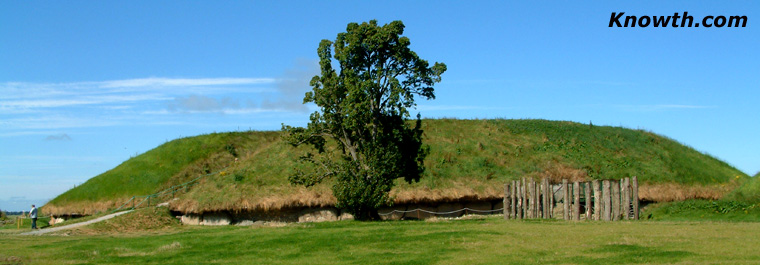 The Great Mound at Knowth.
The timber circle belongs to a later phase of activity at Knowth. The Great Mound dates to around 3200 BC, the same broad period as nearby Newgrange and Dowth. Surrounded by 19 smaller satellite mounds, it contains two tombs entered from opposite sides. The western passage and chamber together measure 34 metres (112 feet). The eastern passage and chamber have a combined length of 40 metres (131 feet).
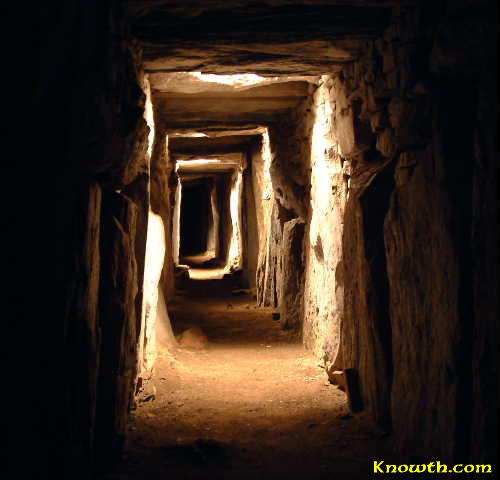 Eastern Passage at Knowth.
The eastern passage at Knowth leads into a chamber with three recesses. Its roof was built by laying stone slabs in overlapping courses, each projecting further inwards until the opening could be closed at the top. This corbelling technique was also used at Newgrange. The stone tomb and the later timber circle show how people returned to this part of Knowth and created different structures over time.
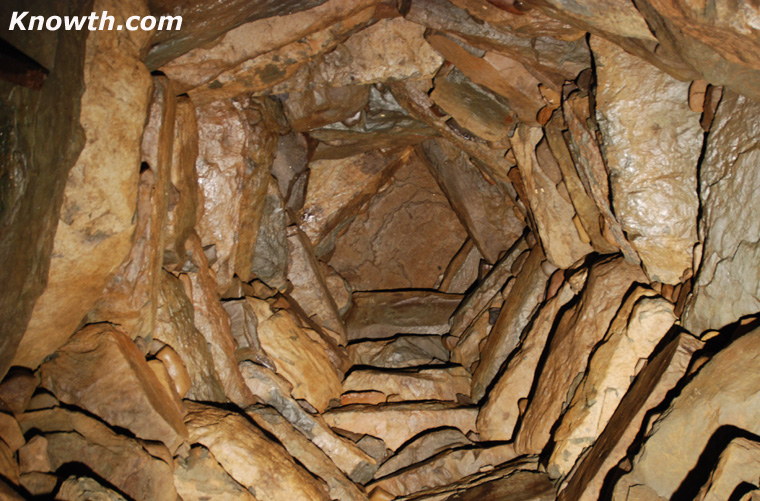 Corbelled roof over the chamber in the eastern tomb.