Tlachtga - Hill of Ward
Tlachtga (Hill of Ward) near Athboy, Co. Meath, lies about 19 kilometres (12 miles) from the Hill of Tara. The upstanding earthwork is a quadrivallate enclosure about 150 metres (490 feet) in diameter and is most impressive from the air.
 Tlachtga - Hill of Ward.
Geophysical survey has shown that it overlies a larger trivallate enclosure of about 195 metres (640 feet), with a smaller enclosure to the south. Excavation points to ritual activity from the Bronze Age into the Iron Age.
 Hill of Ward - Tlachtga.
In early tradition Tlachtga was one of the great assembly places of Mide, alongside Tara, Tailtiu and Uisneach. Folklore and later writing associate it with the Great Fire Festival begun on the eve of Samhain (the eve of 1 November). The festival probably lasted several days. The site takes its name from Tlachtga, daughter of the druid Mug Ruith, who in legend died there giving birth to triplets. The hill is clearly visible from Tara, and the Samhain fire lit here was remembered as a prelude to ceremonies at Tara.
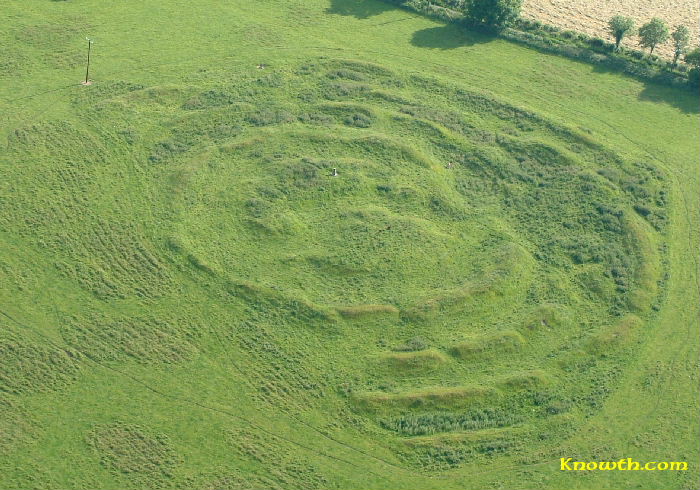 Tlachtga aerial view.
With the coming of Christianity the festival was incorporated into the Christian calendar as a time of remembrance for the holy souls, so the Samhain festival of the ancestors retained its relevance. Customs of Samhain that did not fit into Christianity survived as Halloween. Irish immigrants carried the Halloween tradition to North America in the nineteenth century.
Keating and the Fire of Tlachtga
The seventeenth-century historian Geoffrey Keating gave Tlachtga a central place in the Samhain story. In his History of Ireland he describes a great fire kindled on the hill on the eve of Samhain, with household fires across Ireland quenched and then relit from that communal flame. Whether every detail is historical or not, the picture stuck, and it still shapes how people imagine the hill.
Keating also wrote of the Feis Temro, the feast at Tara held once every three years, with days of gathering before and after Samhain when laws were made and alliances renewed. In that calendar Tlachtga's fire and Tara's assembly belong to the same season of ending and beginning.
A night between worlds
In Irish storytelling Samhain is a threshold night, when ordinary boundaries loosen and the living may meet visitors from the Otherworld. As the days shorten, fire answers the gathering dark. John Gilroy's reading of Tlachtga also ties the hill to Mog Ruith and solar symbolism, so the festival flame becomes a reply to the fading strength of the sun.
Later folklore welcomes ancestors with food and a place by the hearth, while masks and disguises help the living move carefully among less friendly spirits. The aos sí, the fairy folk of the mounds, were said to move more freely then, and passage tombs such as Newgrange, Knowth and Loughcrew already stood as doorways into that story world long before the later tales were written down.
Donn and the house of the dead
Among the figures tied to the realm of the dead is Donn. In the story of the Milesians he drowns after the storm off Ireland's coast, and his dwelling becomes Tech Duinn, the House of Donn, commonly identified with Bull Rock off the Beara Peninsula in County Cork. Irish tradition makes that remote island a gathering place for the dead and a gateway to the Otherworld.
An ancestral figure who receives the dead gives Samhain a deeper register than winter alone. The living world opens, for a night, to ancestors, gods, fairies and the dead. For a fuller account of these traditions see Samhain on Newgrange.com, adapted in part from Gilroy's Tlachtga: Celtic Fire Festival.
Samhain in the tales
Early Irish literature often chooses Samhain as the night when remarkable things happen. For the Fianna it closed the fighting and hunting season until summer returned at Beltane. One famous tale brings Fionn mac Cumhaill to Tara to face Aillén, a fire-breathing attacker who struck every Samhain night. Lugh arrives at a royal gathering as an extraordinary guest, and stories of Medb and Cú Chulainn draw on the season's unsettled mood.
For the writers of these tales, royal halls, remote islands and familiar hills could become meeting places between human life and the Otherworld. Fire, feasting and remembrance from that night still echo in Halloween.
More on the Hill of Ward, Samhain at Tara and Samhain in the Boyne Valley.