The Rainbow
A rainbow is one of nature's most beautiful and fleeting spectacles. In the Boyne Valley, where shifting light, showers and open skies often combine to dramatic effect, a rainbow can seem especially memorable. When one appeared above Newgrange during the winter solstice, it added an extra sense of wonder to an already remarkable morning.
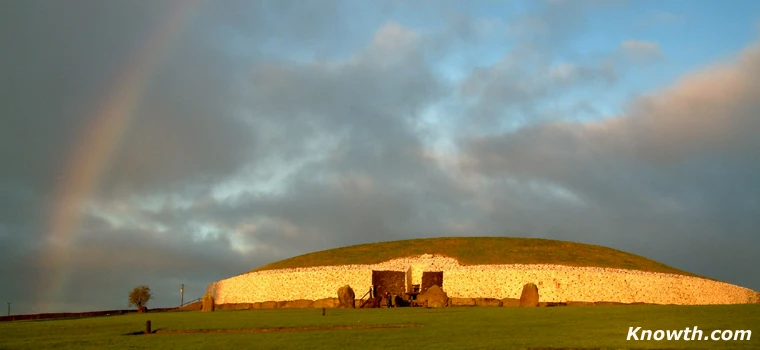 The white quartz stone illuminated by the winter solstice sunrise with a rainbow to complete a wonderful spectacle.
In Irish legend Leprechauns bury pots of gold at the end of the rainbow, but since a rainbow can only be seen at a distance, the gold is forever elusive. In Greek and Roman mythology Iris, the goddess of the rainbow, was one of the messengers of the gods. In Indonesia a rainbow is described in traditional belief as a bridge used by soul boats. The Arabs and the Bantu peoples of Africa have seen the rainbow as a divine bow for firing arrows. In Christian tradition, the rainbow represents the throne of Christ and is also widely understood as a sign of promise and hope.
Rainbows have inspired stories in many cultures because they appear suddenly, glow with extraordinary colour, and vanish just as quickly. In Norse tradition the rainbow bridge Bifröst linked the world of gods and humans. Elsewhere it has been seen as a heavenly pathway, a divine weapon, or a sign from the otherworld. Such beliefs remind us that people have long looked at the sky not only with curiosity, but also with wonder.
With so much myth and legend associated with the rainbow, it was fitting that one should illuminate the sky for the people outside Newgrange while the fortunate few inside were experiencing the illumination of the chamber. At the winter solstice sunrise, a shaft of sunlight enters the roof-box above the entrance and penetrates the passage to light the chamber within, a phenomenon designed more than 5,000 years ago by the builders of this great Stone Age monument.
The Science of the Rainbow
A rainbow with its colours of Red, Orange, Yellow, Green, Blue, Indigo and Violet is created when sunlight is refracted in raindrops and reflected back to the observer. As light enters a raindrop it bends, because water slows the light slightly. It is then reflected from the back of the drop and bends again as it leaves. Because each colour has a slightly different wavelength, the white light is separated into a band of colours.
To see a rainbow, the sun must be behind the observer and rain must be falling in front of the observer. The angle between the sun, the observer and the raindrops is important, which is why a rainbow changes position as the observer moves. Large raindrops usually make the brightest and most clearly defined rainbows, while smaller droplets produce broader and less vivid colours.
Although we usually see a rainbow as an arc, it is actually part of a complete circle. From the ground, the horizon hides the lower portion. From an aircraft, however, it is sometimes possible to see a full circular rainbow. This helps explain why the end of the rainbow can never be reached, because the rainbow is not fixed in one place, but depends on the position of the observer.
Sometimes a secondary paler coloured rainbow can be seen. It appears because some of the light that enters the raindrops is reflected not once but twice from the back of the raindrops before it leaves. This extra reflection reverses the order of the colours, so the secondary rainbow has red on the inside and violet on the outside. The darker band of sky often visible between the two arcs is known as Alexander's band.
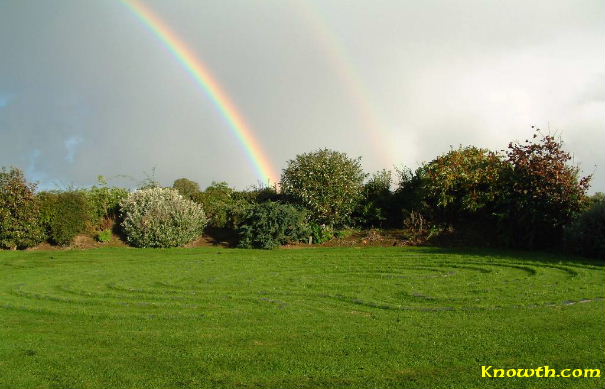 A double rainbow above a lawn labyrinth.
A double rainbow above a lawn labyrinth, notice how the colours are reversed in the secondary rainbow. The second arc is usually fainter because more light is lost during the extra internal reflection inside the raindrops. Even so, when conditions are right, a double rainbow can be one of the most striking displays in the sky.