Megalithic Cairns on Loughcrew Carnbane East
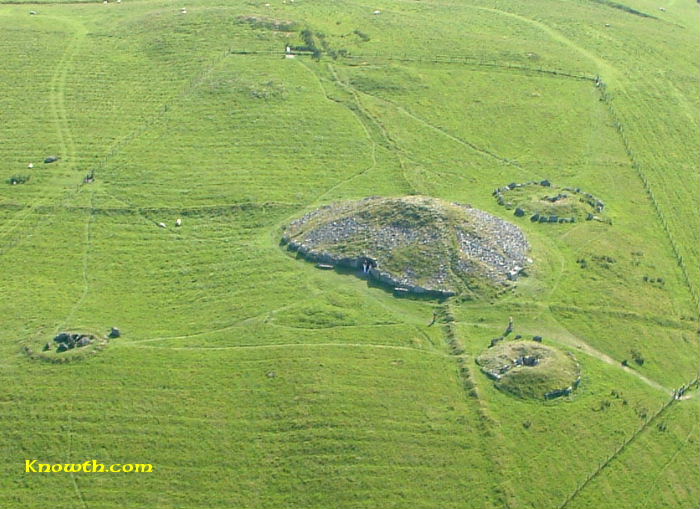 Aerial photograph of Loughcrew Carnbane East.
Carnbane East is the principal hill of the Loughcrew passage tomb cemetery and contains some of the most important prehistoric monuments in Ireland. Rising to 275 metres (904 feet) above sea level, it is the highest point in County Meath and commands extensive views across the Irish midlands. The hill forms part of the wider Sliabh na Calliagh complex, one of the largest concentrations of passage tombs in the country.
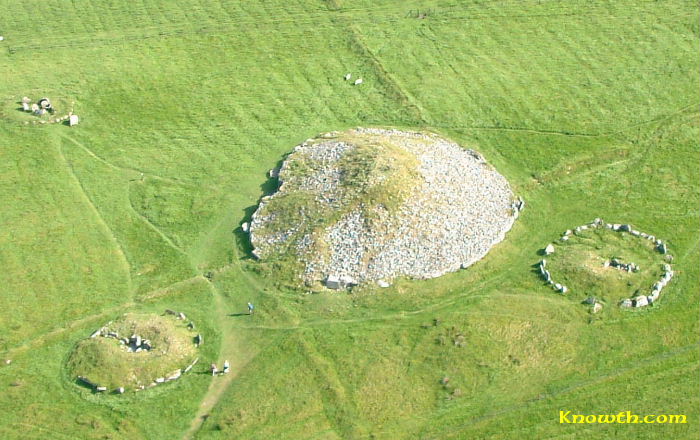 Loughcrew Carnbane East - Cairn S, Cairn T and Cairn U.
At the summit stands Cairn T, the largest and best-known monument at Loughcrew. Surrounded by a group of smaller satellite tombs, Cairn T dominates the hilltop and contains one of the finest collections of megalithic art in Ireland. Spirals, circles, chevrons, lozenges and other geometric motifs are carved into many of the stones, creating a remarkable artistic legacy from the Neolithic period more than 5,000 years ago.
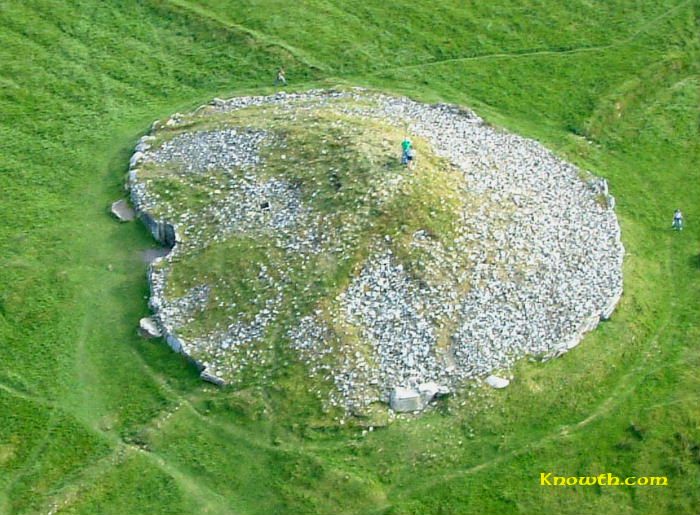 Cairn T is the main cairn on Loughcrew Carnbane East.
Carnbane East contains several other important monuments, including Cairns S, U and V. Together these tombs formed part of a carefully planned ceremonial landscape used by generations of farming communities. Excavations carried out by Eugene Conwell in the nineteenth century revealed cremated human remains, pottery and other artefacts, demonstrating the long importance of the site as both a burial place and a centre for ritual activity.
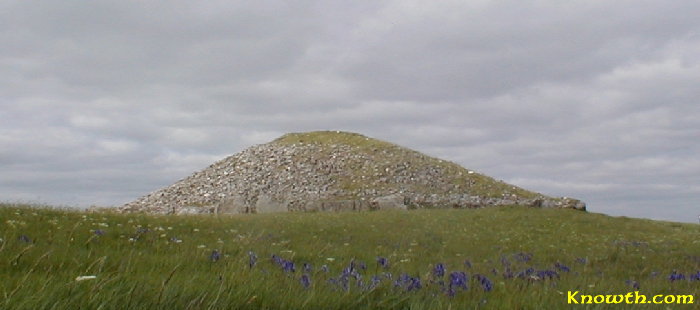 Cairn T on Loughcrew Carnbane East.
The monuments of Carnbane East display a wide variety of architectural forms and artistic traditions. Cairn T contains a cruciform chamber with three recesses, while Cairn U and the surrounding monuments preserve evidence of related passage tomb designs. The decorated stones found throughout the hill provide valuable insights into the beliefs and symbolic world of Ireland's first farming communities.
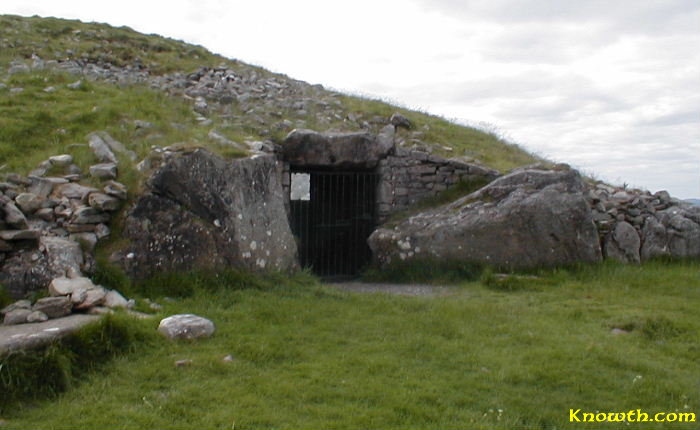 Entrance to Cairn T, Carnbane East, Loughcrew.
Although the precise meaning of the carvings remains unknown, the monuments clearly served purposes beyond simple burial. The combination of monumental architecture, megalithic art and carefully chosen landscape setting suggests that Carnbane East was a place of ceremonial importance where communities gathered to honour their ancestors and observe significant events in the solar year.
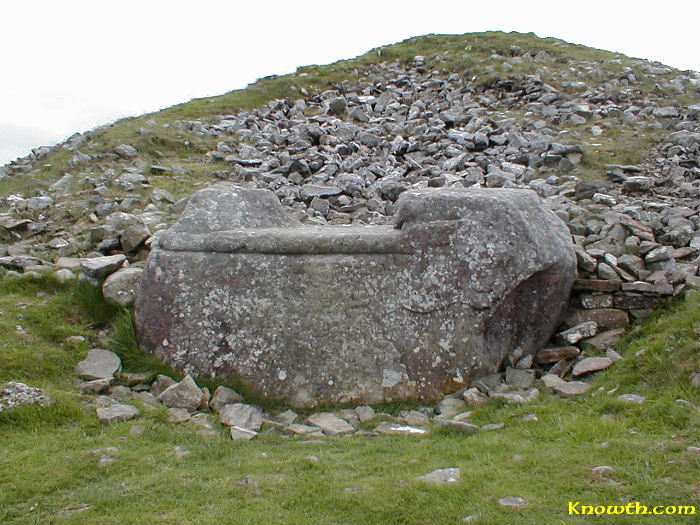 Loughcrew Cairn T - Hag's Chair.
One of the most remarkable features of Cairn T is the illumination of its decorated backstone by the rising sun during the spring and autumn equinox period. The sunlight travels through the passage and gradually lights the intricate carvings within the chamber, creating one of the best-known archaeoastronomical events in Ireland.
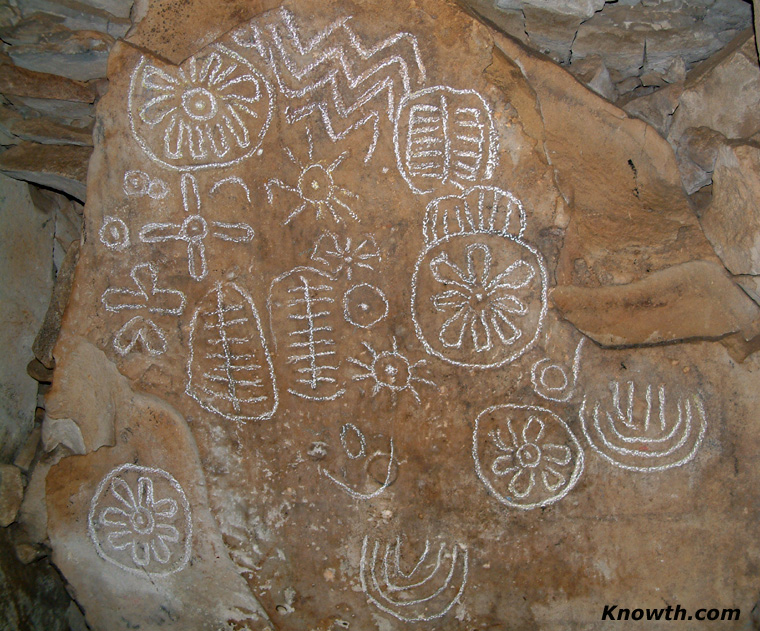 Loughcrew Cairn T - Backstone.
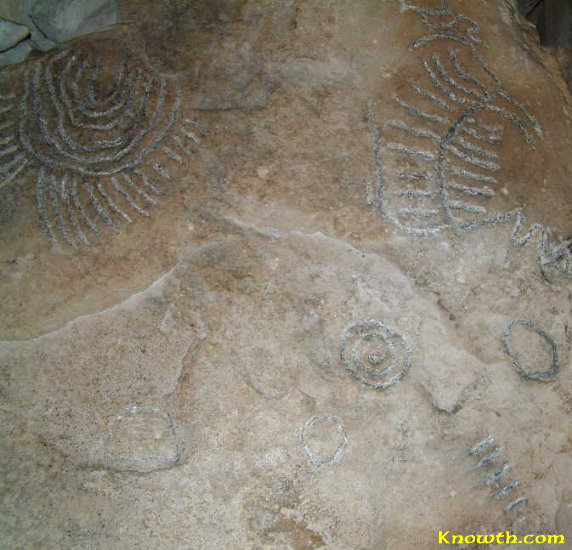 Loughcrew Cairn T - Right recess.
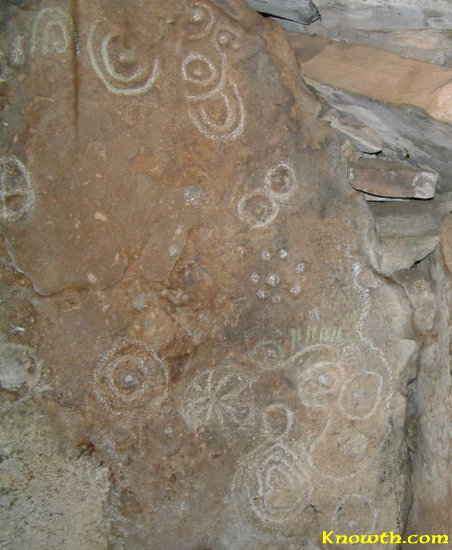 Loughcrew Cairn T - Left recess.
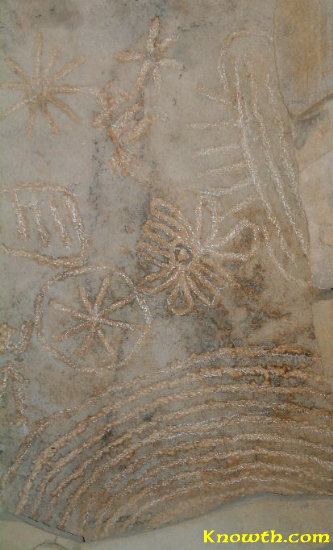 Cairn T - Ceiling Stone.
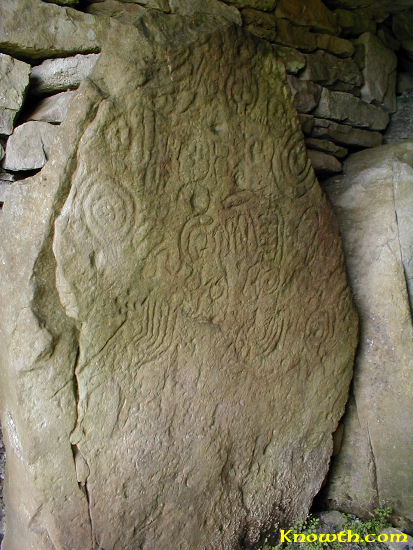 Cairn T - Orthostat R1.
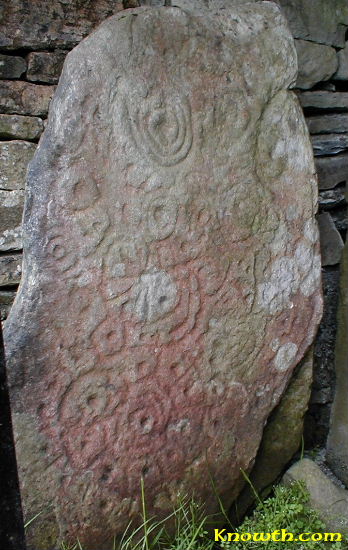 Cairn T - Orthostat L1.
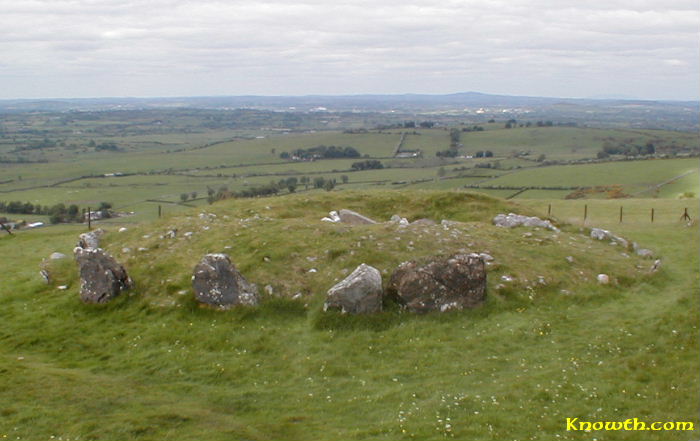 Loughcrew Cairn U - Carnbane East.
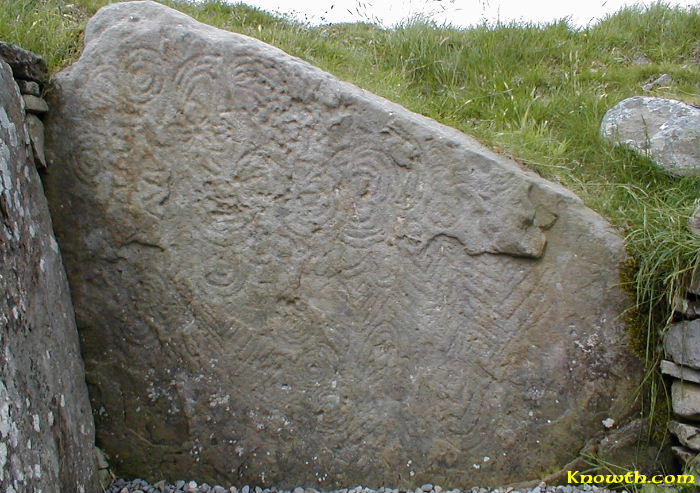 Loughcrew Cairn U - Carving on backstone of right-hand chamber.
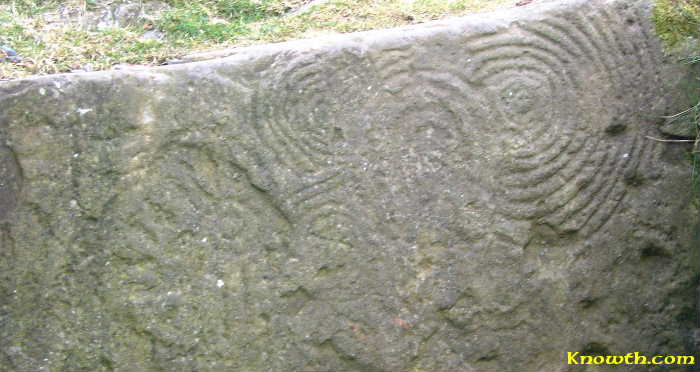 Loughcrew Cairn U - Carving on backstone of left-hand chamber.
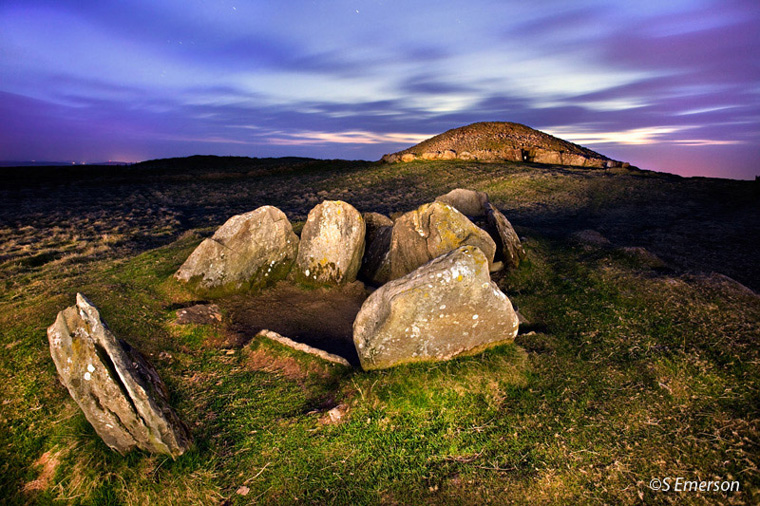 Loughcrew Cairn V with Cairn T in the background, photo by Steve Emerson.
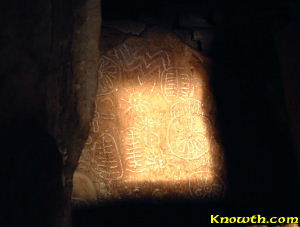 Equinox light on the Cairn T backstone at Loughcrew.
The illumination of the passage and chamber at the winter solstice sunrise in Newgrange is world famous. Less well known is
the equinox illumination at sunrise in Cairn T at Loughcrew. The backstone of the chamber is illuminated by a beam of light
at sunrise around the spring and autumn equinoxes.
Equinox light on the Cairn T backstone at Loughcrew.
The illumination of the passage and chamber at the winter solstice sunrise in Newgrange is world famous. Less well known is
the equinox illumination at sunrise in Cairn T at Loughcrew. The backstone of the chamber is illuminated by a beam of light
at sunrise around the spring and autumn equinoxes.
The sunlight is shaped by the stones of the entrance and passage and descends the backstone while moving from left to right, illuminating the solar symbols.