Gavrinis, Brittany, France
The Isle of Goats just off the coast of Brittany in France is home to the remarkable Gavrinis megalithic cairn. Constructed around 3500 BC, the monument is about 5,500 years old and belongs to the rich Neolithic landscape of the Gulf of Morbihan in north-west France. The cairn measures about 60 metres (200 ft) in diameter and covers a carefully built passage and chamber lined with elaborately engraved stones. The 12 metre long passage leads to a small central chamber measuring about 2.7 x 2.3 metres (9 ft x 7.5 ft), which is roofed by a massive granite capstone. The mound that covers the tomb is built from layers of stone carefully arranged to create a stable cairn over the chamber below.
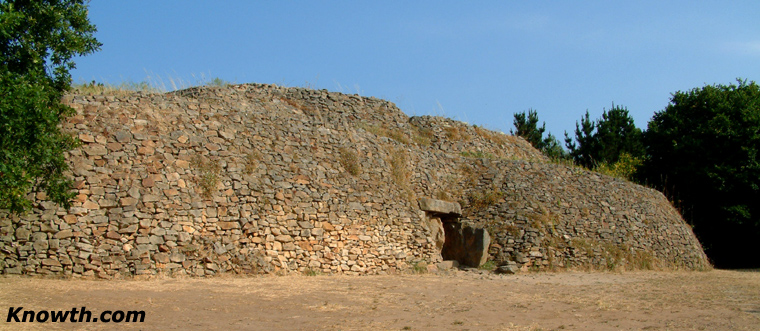 Gavrinis megalithic cairn front entrance.
Gavrinis is widely regarded as one of the finest examples of Neolithic megalithic architecture in Europe. The monument was originally built when the island formed part of the mainland. Rising sea levels in the later prehistoric period gradually created the Gulf of Morbihan and turned Gavrinis into an island. Despite this change in landscape, the cairn has survived remarkably well, preserving one of the most important collections of Neolithic carved stones in western Europe.
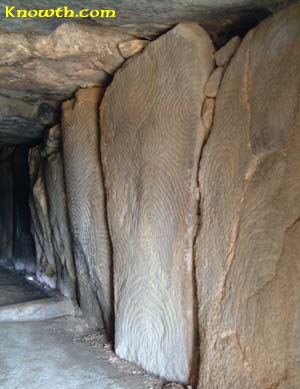 The interior passage is one of the most impressive decorated corridors in European prehistory.
Nearly every orthostat lining the passage is covered with deeply carved designs that include
zig-zags, concentric circles, chevrons, herringbone patterns and stylised axes. These carvings
are pecked into the stone surfaces with remarkable skill, creating a continuous sequence of
symbols that leads visitors toward the chamber at the centre of the mound.
The interior passage is one of the most impressive decorated corridors in European prehistory.
Nearly every orthostat lining the passage is covered with deeply carved designs that include
zig-zags, concentric circles, chevrons, herringbone patterns and stylised axes. These carvings
are pecked into the stone surfaces with remarkable skill, creating a continuous sequence of
symbols that leads visitors toward the chamber at the centre of the mound.
Archaeologists believe these engravings were created using stone tools and represent an important form of symbolic communication among Neolithic communities. Some of the decorated stones also appear to have been reused from earlier monuments. When fragments of carvings on different blocks are matched together they form larger designs, suggesting that earlier standing stones or monuments were deliberately broken and incorporated into the cairn.
Gavrinis is remarkably similar to Newgrange in Ireland, which was built around three centuries later. Both monuments are large stone cairns covering a passage and chamber, and both contain complex megalithic art carved into the stones lining the interior. These similarities have long suggested that the Neolithic communities of Brittany and Ireland were connected through Atlantic seaways. The distance between the Gulf of Morbihan and the Boyne Valley is about 400 km (250 miles), and the sea may have acted as a route of communication rather than a barrier.
 The wider Morbihan region contains one of the densest concentrations of megalithic monuments in Europe.
Nearby sites include the famous standing stones at Carnac, the passage tomb on the island of
Locmariaquer, and many other chambered cairns scattered throughout the surrounding countryside.
Together these monuments form part of a remarkable ceremonial landscape built by farming communities
during the Neolithic period.
The wider Morbihan region contains one of the densest concentrations of megalithic monuments in Europe.
Nearby sites include the famous standing stones at Carnac, the passage tomb on the island of
Locmariaquer, and many other chambered cairns scattered throughout the surrounding countryside.
Together these monuments form part of a remarkable ceremonial landscape built by farming communities
during the Neolithic period.
Today Gavrinis (Gavr'inis) is reached by a short boat trip from the harbour at Larmor-Baden. The crossing takes about ten minutes and the round trip, including the guided visit inside the monument, usually lasts around one hour and twenty minutes. Access to the interior is controlled in order to protect the delicate carvings, and visitors are not permitted to take photographs inside the cairn to prevent accidental damage to the decorated stones.
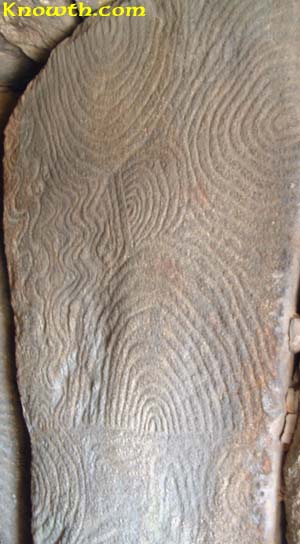
Within the passage and chamber, 23 of the 29 upright stones are decorated with engravings. The carvings include zig-zags, concentric circles, herringbone motifs, axes, bows and arrow-like shapes. These designs are part of a wider artistic tradition known as megalithic art, which appears across Atlantic Europe from Brittany to Ireland and Iberia. Gavrinis is widely considered one of the finest and most complete examples of this remarkable prehistoric art form.
Julian Cope in his book The Megalithic European comments "A pavement lined the floor of this passage and chamber, the entrance to the latter being defined by a carved sillstone reminiscent of those beautiful carved lintels seen at Ireland's Fourknocks and at the Bend in the Boyne"
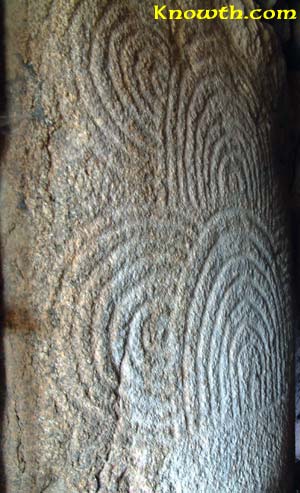 Aubrey Burl in his book Megalithic Brittany comments
"It is for its art that Gavrinis is famous. No fewer than twenty-three of its twenty-nine upright stones have been carved, not in single
or isolated motifs but in a profuse series of compositions so that stone flows into stone or is mirrored by another in patterns engraved in low relief.
The art is balanced in panels horizontally and vertically in symbols of which the main elements are concentric arcs and axes. These latter implements
have splayed cutting edges like the big, prestige axes from the Carnac Mounds."
Aubrey Burl in his book Megalithic Brittany comments
"It is for its art that Gavrinis is famous. No fewer than twenty-three of its twenty-nine upright stones have been carved, not in single
or isolated motifs but in a profuse series of compositions so that stone flows into stone or is mirrored by another in patterns engraved in low relief.
The art is balanced in panels horizontally and vertically in symbols of which the main elements are concentric arcs and axes. These latter implements
have splayed cutting edges like the big, prestige axes from the Carnac Mounds."
The passage and chamber at Newgrange are clearly aligned to the rising sun at the Winter Solstice, Gavrinis is aligned in the same direction but the chamber is not illuminated like Newgrange at the Winter Solstice. Perhaps the ancient Irish were better engineers than the ancient Bretons.
Aubrey Burl comments "Looking from Stone 19, at the left-hand entrance to the chamber, towards Stone 1, the bearing is 128°, almost perfectly in line with the midwinter sunrise. The main axis of the passage is 134° towards the low-lying Arzon peninsula and the orientation is close to that of the major southern moonrise. It has been calculated that the two alignments, one solar, the other lunar, intersect halfway down the passage level with Stone 7, the white quartz slab whose undecorated surface may have been illuminated by the light of the rising sun and moon."
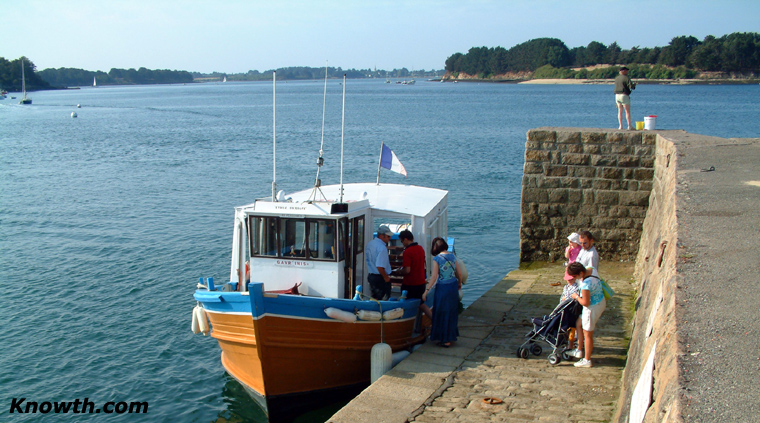 Gavrinis (Gavr'inis) is a 10 minute boat trip from the harbour at Larmor Baden.
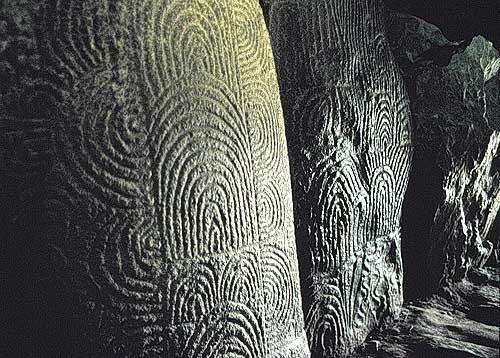 Megalithic art at Gavrinis.