Hill of Tara
The Hill of Tara in County Meath is one of Ireland’s most important archaeological landscapes. It is best known as the symbolic seat of the High Kings in early medieval tradition, but the site’s story begins much earlier. Tara is a complex of prehistoric monuments, later earthworks, and powerful place names and legends that kept the hill central to Irish identity for millennia.
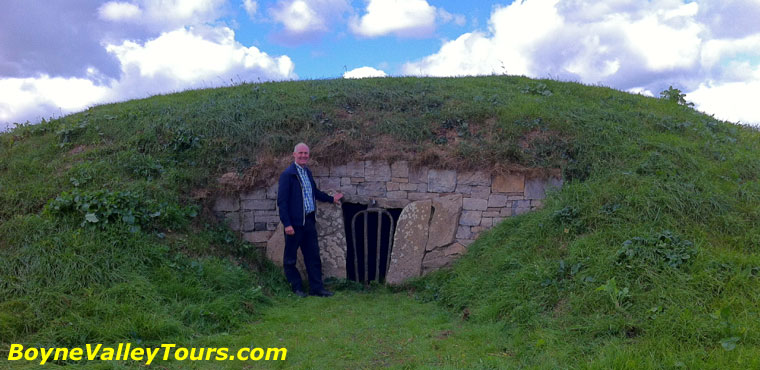 Mound of the Hostages - Hill of Tara
The Mound of the Hostages
The megalithic passage tomb known as the Mound of the Hostages (Dumha na nGiall) is the oldest surviving monument on the Hill of Tara. It dates to the Neolithic, around 3000 BC, and belongs to the same broad tradition of passage tomb building seen across the Boyne Valley and beyond. The tomb is small in scale compared with Newgrange or Knowth, but it is exceptionally important because it anchors Tara’s deep prehistory and provides clear evidence of burial and ritual practice.
The passage is about 4 metres (13 feet) long and roughly 1 metre (3 feet) wide. It is subdivided by sill stones into three compartments, each associated with cremated remains. Excavations found extensive burial evidence, including large numbers of cremations and associated artefacts, confirming that funerary use was a major element of the monument’s purpose.
Excavations and Finds
Modern archaeological excavations at the Mound of the Hostages were directed by Seán P. Ó Ríordáin in the 1950s and completed by Ruaidhrí de Valera. These investigations documented repeated burial activity and produced a clearer understanding of the tomb’s construction, internal form, and long use life. The evidence indicates that Tara’s significance did not begin with kingship traditions, but was already established in the Neolithic as a place of ceremony, burial, and memory.
Megalithic Art at the Entrance
 A decorated stone can be viewed from the entrance gate area. Its engravings are typical of Neolithic passage tomb art, consisting of abstract motifs such as circles, arcs and radial forms.
Some researchers have suggested that the arrangement of symbols may represent a schematic map of the Hill of Tara. However, the carvings date to around 3000 BC and therefore predate the
visible Iron Age earthworks on the hill by more than two millennia.
A decorated stone can be viewed from the entrance gate area. Its engravings are typical of Neolithic passage tomb art, consisting of abstract motifs such as circles, arcs and radial forms.
Some researchers have suggested that the arrangement of symbols may represent a schematic map of the Hill of Tara. However, the carvings date to around 3000 BC and therefore predate the
visible Iron Age earthworks on the hill by more than two millennia.
Interpretations vary widely. The motifs may be symbolic, cosmological or calendrical in nature, possibly relating to the sun, moon, stars, seasonal turning points, or the ordering of ritual time. As with much megalithic art, their precise meaning remains uncertain, and it is likely that the carvings carried layered and evolving meanings over time. Drawing of decorated orthostat.
Alignment and Seasonal Sunrises
One of the most remarkable features of the Mound of the Hostages is its solar alignment. The passage is oriented so that the rising sun illuminates the inner chamber around the cross quarter festivals of Samhain in early November and Imbolc in early February. This is a different emphasis from Newgrange, which is aligned to the winter solstice sunrise. At Tara, the alignment connects the tomb to key seasonal thresholds in the agricultural year, strengthening the idea that ritual time and the solar cycle were central to the monument’s design.
Passage Tomb or Temple
The term passage tomb is sometimes disliked by those who prefer to emphasise the ceremonial, astronomical, or temple like character of these monuments. In Tara’s case, however, the burial evidence is substantial. Excavations revealed remains from many individuals, much of it cremated, confirming that the monument functioned as a place of the dead as well as a place of ceremony. A better way to express this is that the tomb was both funerary and ritual, with burial practice taking place within a wider sacred framework.
The hills at Loughcrew can be seen to the west from the top of the mound, linking Tara visually to another major passage tomb cemetery on the horizon.
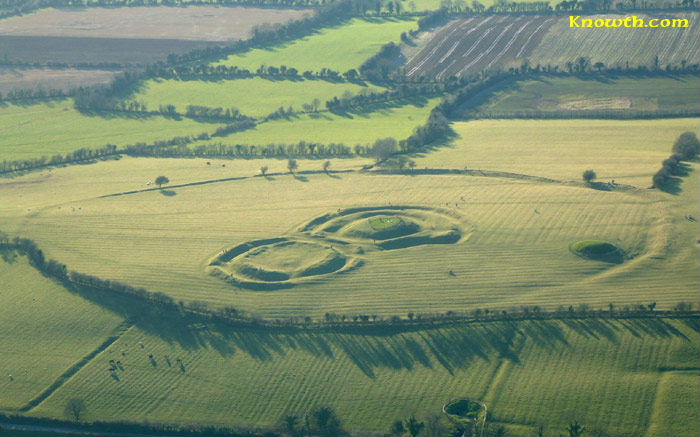 Hill of Tara - Aerial View
Royal Tara and the High Kings
Long after the Neolithic tomb was built, Tara became the symbolic seat of the High Kings of Celtic Ireland in early literature and tradition. Within the great earthwork complex known as the Royal Enclosure are monuments interpreted as ring forts and ceremonial structures. One is traditionally called Cormac’s House, linked to Cormac mac Airt. Another, the King’s Seat, may preserve an earlier monument beneath or within it, reminding us that later power often gathered around older sacred places.
Tara's Woodhenge
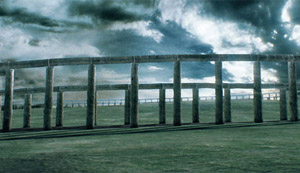 Ireland’s so called “Woodhenge” at Tara points to a further layer of prehistoric activity. Archaeological and geophysical research has identified timber circles
and large ceremonial features in the landscape, suggesting gatherings, rites, and repeated use of the hill long before written history.
Read More
Ireland’s so called “Woodhenge” at Tara points to a further layer of prehistoric activity. Archaeological and geophysical research has identified timber circles
and large ceremonial features in the landscape, suggesting gatherings, rites, and repeated use of the hill long before written history.
Read More
Lia Fáil and the Forradh
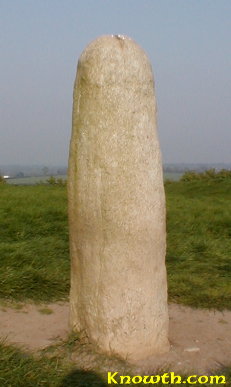 The standing stone known as the Lia Fáil was erected on the Forradh in the nineteenth century. Tradition places it close to the Mound of the Hostages,
and the two were long regarded as part of a meaningful ensemble. It has been suggested that the stone may once have stood nearer the tomb entrance,
echoing a wider passage tomb tradition of important standing stones placed at or near key ceremonial points. The Lia Fáil is often described as the Stone of Destiny,
and later legend claims it cried out in approval at the inauguration of a rightful king.
The standing stone known as the Lia Fáil was erected on the Forradh in the nineteenth century. Tradition places it close to the Mound of the Hostages,
and the two were long regarded as part of a meaningful ensemble. It has been suggested that the stone may once have stood nearer the tomb entrance,
echoing a wider passage tomb tradition of important standing stones placed at or near key ceremonial points. The Lia Fáil is often described as the Stone of Destiny,
and later legend claims it cried out in approval at the inauguration of a rightful king.
The Lia Fáil stands about one metre (3 feet) in height and has been interpreted in various ways, including as a fertility symbol in later folklore. Whatever its original purpose, its later association with kingship tradition demonstrates how the ancient monuments of Tara were continually reinterpreted and woven into evolving political and ceremonial narratives.
Earth Energies
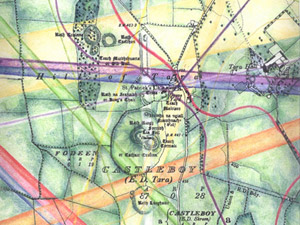 Some researchers and visitors have suggested that the Hill of Tara contains aligned earth energy fields associated with key monuments such as the Banqueting Hall,
the King’s Chair, the Mound of the Hostages and Teach Cormac. These interpretations propose the presence of a central “silver line” running through the complex.
While such ideas form part of modern spiritual readings of the landscape, they are not supported by mainstream archaeology.
Read More
Some researchers and visitors have suggested that the Hill of Tara contains aligned earth energy fields associated with key monuments such as the Banqueting Hall,
the King’s Chair, the Mound of the Hostages and Teach Cormac. These interpretations propose the presence of a central “silver line” running through the complex.
While such ideas form part of modern spiritual readings of the landscape, they are not supported by mainstream archaeology.
Read More
Tlachtga and the Wider Ritual Landscape
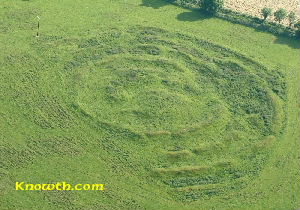 Tlachtga, on the Hill of Ward near Athboy, lies approximately 19 kilometres (12 miles) from the Hill of Tara.
The site is visible from Tara, and the ceremonial fire traditionally lit there on the eve of Samhain may have formed part of a wider ritual landscape connected with seasonal gatherings at Tara.
Read More
Tlachtga, on the Hill of Ward near Athboy, lies approximately 19 kilometres (12 miles) from the Hill of Tara.
The site is visible from Tara, and the ceremonial fire traditionally lit there on the eve of Samhain may have formed part of a wider ritual landscape connected with seasonal gatherings at Tara.
Read More
- Hill of Tara Aerial Images.
- Samhain Sunrise illuminates the Mound of the Hostages.
- Teamhair - Hill of Tara by Tom Kumpf.
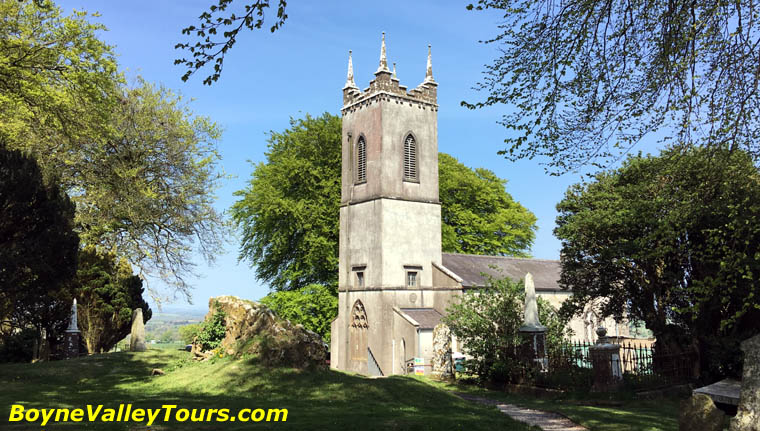 Saint Patrick's Church and Graveyard on the Hill of Tara.