Newgrange Megalithic Passage Tomb
Newgrange is Ireland's most celebrated passage tomb, famed across the world for the winter solstice sunrise that floods its inner chamber with light. It stands with Knowth and Dowth at the heart of Brú na Bóinne, one of only three UNESCO World Heritage Sites on the island. These Neolithic monuments rank among the finest prehistoric achievements in Europe.
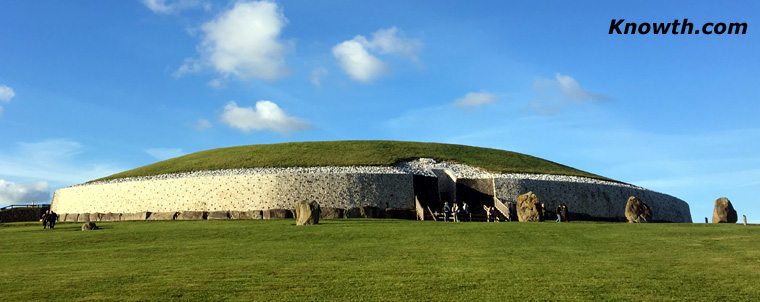 Front view of Newgrange with white quartz facade.
The passage tomb was built around 3200 BC, making it older than both Stonehenge and the Great Pyramids of Giza. The kidney-shaped mound covers more than one acre. It measures approximately 85 metres in diameter and rises 13 metres high. It is surrounded by 97 kerbstones ringing the base of the mound. Only some are carved. The most celebrated are the entrance stone, Kerbstone K1, and Kerbstone K52 on the opposite side of the mound, both richly engraved with spirals and other motifs among the finest prehistoric art in Europe.
The 19 metre long inner passage leads to a cruciform chamber with three recesses and a magnificent corbelled roof rising to almost six metres in height. The roof has remained watertight for over five thousand years. Inside the chamber are large stone basins which once held cremated human remains, along with grave goods such as beads and pendants. Radiocarbon dating places the main construction phase around 3200 BC.
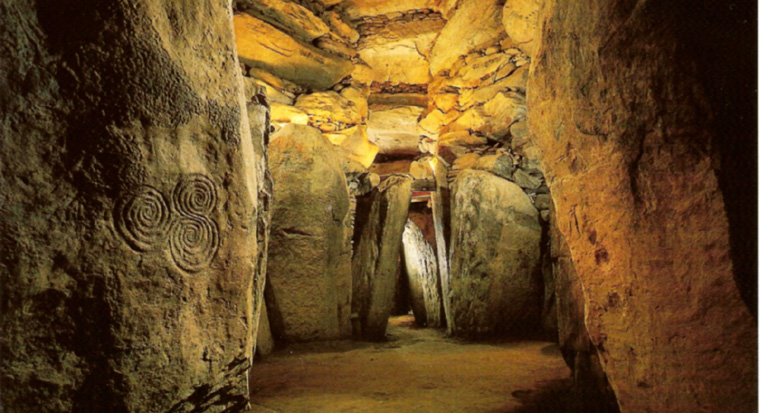 The chamber and passage at Newgrange seen from the end recess.
There is no direct access to the Passage Tomb at Newgrange. All visits are by guided tour departing from the Brú na Bóinne Visitor Centre, located near the village of Donore on the south side of the River Boyne. From there, visitors travel by shuttle bus to the monument. Access to the chamber is carefully controlled to protect the integrity of the site. Tours of Newgrange operate throughout the year, except for a short closure over the Christmas period. During winter, when Knowth is closed, a Newgrange-only tour is available. The combined tour including both monuments generally runs from March to early November. Exact opening dates and ticket information should be confirmed in advance through the official Visitor Centre website.
It is estimated that the construction of the Passage Tomb at Newgrange would have required a workforce of around 300 people working over a period of at least 20 years. The large structural stones of the mound, known as greywacke, were not quarried locally at the site itself. Geological analysis indicates that many of these stones originated in the Clogher Head area of County Louth, approximately 20 kilometres to the northeast. It is widely believed that the stones were transported by sea along the Irish coast and then brought inland via the River Boyne before being hauled uphill to the monument.
The sparkling white quartz used in the facade was likely gathered from glacial deposits in the Wicklow Mountains. Mixed within this quartz revetment are rounded granite cobbles, carefully selected for colour contrast and visual effect, with the granite most likely originating in the Mourne Mountains. The combination of bright quartz and darker granite created a striking frontage that would have caught the light and stood out prominently in the Neolithic landscape. The transport of these materials over considerable distances demonstrates careful planning, organised labour and a sophisticated understanding of landscape and waterways.
Winter Solstice
The passage and chamber inside the Newgrange mound is illuminated by the winter solstice sunrise. A specially designed roof-box above the entrance allows a narrow shaft of sunlight to penetrate the passage at dawn. As the sun rises, the beam gradually extends along the floor of the passage before illuminating the rear chamber. The dramatic event lasts for approximately 17 minutes and occurs on the Winter Solstice and a few mornings either side, weather permitting.
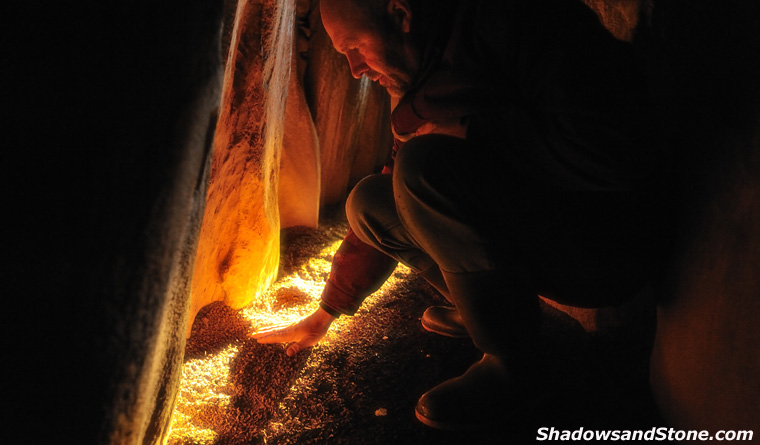 Tour guide Michael Fox inside the chamber of Newgrange as the Winter Solstice sunrise illuminates its sacred interior.
The alignment demonstrates a precise understanding of the solar cycle. For a brief period each year the darkest part of the chamber is filled with natural light, symbolically linking the monument with themes of renewal and rebirth at the turning point of the year. The phenomenon was rediscovered in 1967 by Professor Michael J. O’Kelly during his excavation of the site.
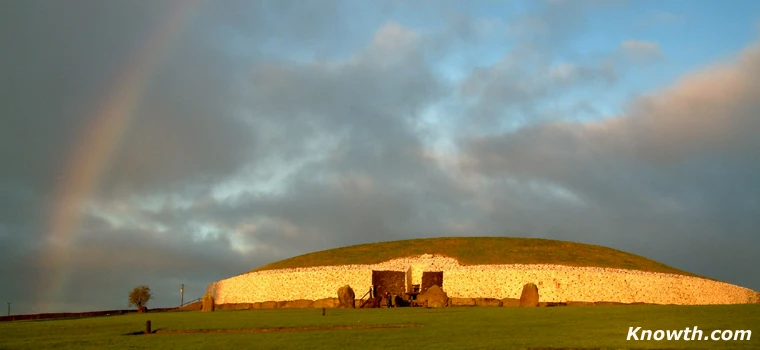 The white quartz stone illuminated by the solstice sunrise with a rainbow to complete the spectacle.
Admission to the Newgrange chamber for the Winter Solstice sunrise is by lottery, with application forms available at the Brú na Bóinne Visitor Centre. In September each year, names are drawn, with two places awarded to each successful applicant.
Megalithic Mounds
Newgrange forms part of a wider ceremonial landscape within Brú na Bóinne, alongside Knowth and Dowth and over 40 smaller passage tombs, henges and settlement sites. In later centuries these ancient monuments became woven into Irish mythology and were identified as sídhe, or fairy mounds. According to early medieval literature, Newgrange was known as Brú na Bóinne and was associated with the Dagda and his son Oenghus, deities of the Tuatha Dé Danann. Oenghus was said to have gained possession of the mound through cunning, securing it for “a day and a night,” which in Irish tradition meant eternity.
After falling into gradual obscurity, the mound was rediscovered in 1699 when labourers removing stone for road building exposed the entrance. Antiquarian interest followed in the 18th and 19th centuries, though systematic archaeological excavation did not begin until 1962 under Professor Michael J. O’Kelly. His work continued until 1975 and included the careful restoration of the white quartz facade using material found scattered at the base of the mound.
World Heritage Site
Newgrange is part of the Brú na Bóinne Archaeological Ensemble, designated a World Heritage Site by UNESCO in 1993 in recognition of its outstanding universal value. The site attracts visitors from around the world each year and remains one of Ireland’s most significant and carefully managed archaeological monuments. The monument and Visitor Centre experience is overseen by the Office of Public Works and is presented as a guided interpretative tour designed to protect the integrity of the site while allowing access to the chamber and passage.
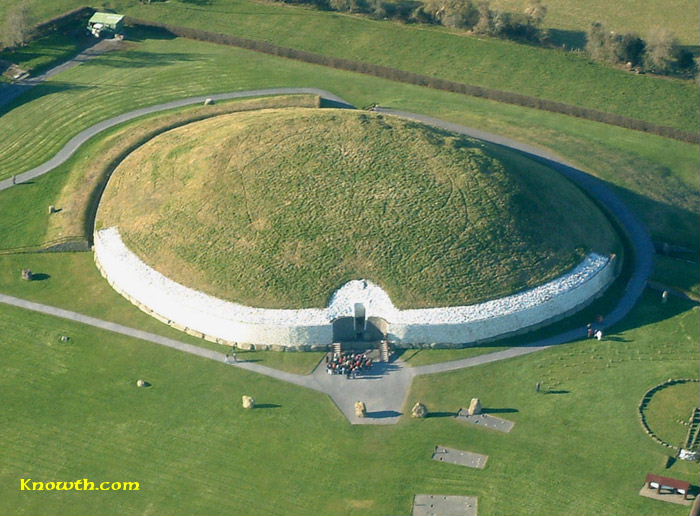 Newgrange UNESCO World Heritage Site - Aerial View.
Newgrange Images
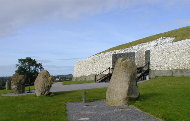 Images of Newgrange, 12 standing stones survive of an estimated 35 stones that once surrounded the monument.
The large mound is built of alternating layers of earth and stones and is 85m (279ft) across and 13m (43ft) high, and covers 4,500 sq.m (1 acre) of ground.
Images of Newgrange, 12 standing stones survive of an estimated 35 stones that once surrounded the monument.
The large mound is built of alternating layers of earth and stones and is 85m (279ft) across and 13m (43ft) high, and covers 4,500 sq.m (1 acre) of ground.
Newgrange Chamber
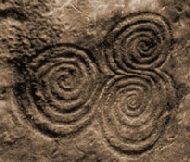 Images
from inside the chamber at Newgrange including the tri-spiral design on orthostat C10
which is probably the most famous Irish Megalithic symbol. It is often referred to as a Celtic design, but it was carved at least 2500 years before
the Celts reached Ireland. At 12 inches in
diameter the tri-spiral design is quite small in size, less than one-third the size
of the tri-spiral design on the entrance stone.
Images
from inside the chamber at Newgrange including the tri-spiral design on orthostat C10
which is probably the most famous Irish Megalithic symbol. It is often referred to as a Celtic design, but it was carved at least 2500 years before
the Celts reached Ireland. At 12 inches in
diameter the tri-spiral design is quite small in size, less than one-third the size
of the tri-spiral design on the entrance stone.
Newgrange - Further Reading
- A Passage to the Afterworld - the story of New Grange adapted from an article first published in the World Of Hibernia magazine.
- Directions to the Brú na Bóinne Visitor Centre the access point to Newgrange.
- Michael J. O'Kelly who excavated and restored Newgrange.
- Photographs of New Grange by Annaliese Moyer - Insight Photographic.
- Old Photograph of Newgrange and a newspaper report from 1928.
- Newgrange Excavation Report Critique - by Alan Marshall.
- Newgrange Books - factual books and a novel The Spirit Mound.
- Ireland in prehistory - Early Ireland, Megalithic Ireland, Ancient Ireland - Outside Influences.
- Emerald Sun - prologue to the historical novel The Princes of Ireland by Edward Rutherfurd. The prologue sets the scene of ancient Ireland with the winter solstice at Newgrange the centrepiece.
- Newgrange: empowering the salmon of wisdom by Philip Coppens.
- An anthropological lens applied to the early settlers of the Boyne Valley, adapted from a lecture by Dr. Gabriel J. Byrne.
- Messages from the Monuments - How Neolithic Monuments Communicate About Religion and Status by Paul K. Wason.
- Newgrange plans from Michael J. O'Kelly's book Newgrange Archaeology, Art and Legend.
- Newgrange Links - External resource links.
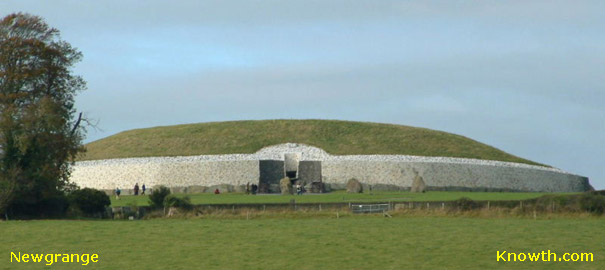 Newgrange megalithic passage tomb from a distance.
Gavrinis
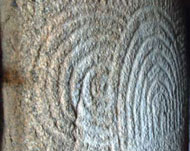 The Gavrinis passage tomb in Brittany, France, shows remarkable similarities to Newgrange.
Built around 3500 BC, the cairn is approximately 60 metres in diameter and encloses a narrow passage leading to a central chamber.
Like Newgrange, it demonstrates careful architectural planning and a strong emphasis on symbolic decoration.
The Gavrinis passage tomb in Brittany, France, shows remarkable similarities to Newgrange.
Built around 3500 BC, the cairn is approximately 60 metres in diameter and encloses a narrow passage leading to a central chamber.
Like Newgrange, it demonstrates careful architectural planning and a strong emphasis on symbolic decoration.
Within the passage and chamber, 23 of the 29 upright stones are intricately engraved. The carvings include zigzags, concentric circles, herringbone patterns and finely shaped axe motifs. The density and precision of the artwork make Gavrinis one of the most important examples of megalithic art in Europe, underlining the shared artistic traditions that linked Atlantic communities during the Neolithic period.