Loughcrew Megalithic Cairns
Clusters of Megalithic Cairns are dotted around the Slieve na Caillaigh hills at Loughcrew, the main concentrations are on Carnbane East where Cairn T is the centrepiece and Carnbane West where Cairn L is located.
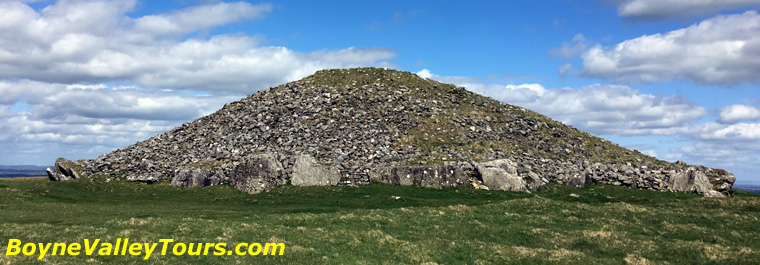 Loughcrew Cairn T on Carnbane East.
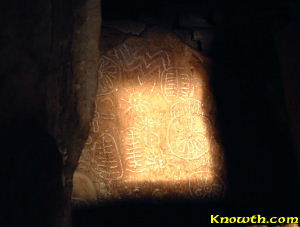 Equinox light on the Cairn T backstone at Loughcrew.
The illumination of the passage and chamber at the Winter solstice
sunrise in Newgrange is world famous. Less well known is the Equinox illumination at sunrise in Cairn T
at Loughcrew. The backstone of the chamber is illuminated by a beam of light at sunrise on the Spring and Autumnal Equinoxes.
Equinox light on the Cairn T backstone at Loughcrew.
The illumination of the passage and chamber at the Winter solstice
sunrise in Newgrange is world famous. Less well known is the Equinox illumination at sunrise in Cairn T
at Loughcrew. The backstone of the chamber is illuminated by a beam of light at sunrise on the Spring and Autumnal Equinoxes.
The sunlight is shaped by the stones of the entrance and passage and descends the backstone while moving from left to the right illuminating the solar symbols.
Visitors are welcome to walk up Carnbane East to Cairn T, a ten minute walk up a grassy hill from a small car park. There is currently no access to the interior of Cairn T. During the summer months a guide is present on Carnbane East to explain the site and its archaeology.
At Cairn L on Carnbane West the sunrise at Samhain (early November) and Imbolc (early February) illuminates the passage and chamber, lighting up the limestone standing stone in the cairn. The owner of the land where Cairn L is located does not allow public access to the site.
Equinox Stone - Loughcrew Cairn T
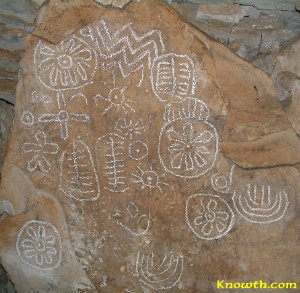 The equinox stone in Cairn T, Loughcrew.
Cairn T, also known as Hag's Cairn, forms part of the Loughcrew passage tomb cemetery in County Meath and is one of the most important monuments on Carnbane East. The cairn is broadly similar in design to Newgrange, consisting of a stone-built passage that leads into a central chamber. Traditionally described as a Passage Tomb, the monument also displays clear evidence that it was carefully aligned with astronomical events. The beautifully decorated backstone inside the chamber, carved with spirals and other megalithic motifs, strongly suggests that the cairn had a symbolic and observational role connected with the movements of the sun.
The equinox stone in Cairn T, Loughcrew.
Cairn T, also known as Hag's Cairn, forms part of the Loughcrew passage tomb cemetery in County Meath and is one of the most important monuments on Carnbane East. The cairn is broadly similar in design to Newgrange, consisting of a stone-built passage that leads into a central chamber. Traditionally described as a Passage Tomb, the monument also displays clear evidence that it was carefully aligned with astronomical events. The beautifully decorated backstone inside the chamber, carved with spirals and other megalithic motifs, strongly suggests that the cairn had a symbolic and observational role connected with the movements of the sun.
Around the time of the March and September equinoxes, a beam of sunlight from the rising sun enters the passage and slowly illuminates the decorated backstone at the rear of the chamber. As the sun rises higher, the beam of light moves across the surface of the stone, gradually revealing the carvings and patterns. The illumination lasts for about 50 minutes and creates a striking visual effect inside the otherwise dark chamber. This equinox event was recorded on the morning of March 23rd 2005, and a time-lapse version can be viewed in the Equinox Video, where the full 50 minute event has been compressed into a short sequence lasting 1 minute and 46 seconds.
The interior of Cairn L
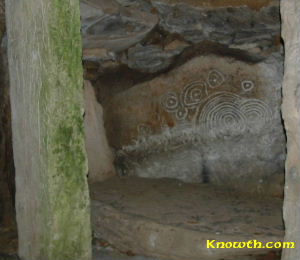 Limestone monolith in Cairn L, Loughcrew.
Inside the chamber of Cairn L at Loughcrew stands a striking freestanding limestone monolith, positioned slightly to the left of the chamber
interior (visible on the left of the image). Unlike the orthostats that form the chamber walls, this tall stone appears to have been deliberately placed as a central feature within the space.
Its presence gives the chamber a very different character to most passage tombs, where the stones usually form part of the structure rather than standing independently within the chamber itself.
Limestone monolith in Cairn L, Loughcrew.
Inside the chamber of Cairn L at Loughcrew stands a striking freestanding limestone monolith, positioned slightly to the left of the chamber
interior (visible on the left of the image). Unlike the orthostats that form the chamber walls, this tall stone appears to have been deliberately placed as a central feature within the space.
Its presence gives the chamber a very different character to most passage tombs, where the stones usually form part of the structure rather than standing independently within the chamber itself.
Research carried out by Martin Brennan suggested that the monolith had an astronomical purpose. Brennan discovered that the six foot high stone acts as a marker for the ancient cross-quarter days of Samhain in early November and Imbolc in early February. Around these seasonal turning points, sunlight enters the passage of Cairn L and illuminates the standing stone inside the chamber. The appearance of the light on the monolith may have served as a seasonal signal, marking important moments in the ancient calendar when communities gathered for ritual, ceremony, or seasonal observances connected with the agricultural year.
The presence of this monolith, together with the alignment of light within the chamber, suggests that Cairn L was not simply a burial monument but also a place where the changing cycles of the year were observed and marked. Such alignments are a recurring feature in the megalithic monuments of Ireland, linking architecture, landscape and the movements of the sun in a way that reflects the cosmological beliefs of the Neolithic builders.
- Map and directions to Loughcrew.
- Loughcrew Cairns - Boyne Valley Tours.
- Loughcrew Equinox Reflection by Sally McKenna.
- Reflections on Loughcrew and Newgrange by Tim O'Brien.
- Artwork by Helen Gavigan, inspired by the cairns and engravings at Loughcrew.
- A taste of the unexpected: subverting mentalités through the motifs and settings of Irish passage tombs.
- Loughcrew Cairns as described in Vale of the Boyne and Royal Meath published in 1898 for the Great Northern Railway Company.
- Loughcrew Books including Loughcrew The Cairns a guide by Jean McMann.
- Megalithic Attractions of County Meath - Newgrange, Knowth, Dowth, Fourknocks, Loughcrew and Tara.
Loughcrew Cairns
Neolithic Cairns on the Hills of North Meath
In the rich farmlands of County Meath in Ireland's Ancient East lies the Loughcrew Cairns, one of the most extensive passage tomb cemeteries in Ireland. The monuments stand near the village of Oldcastle and occupy the summits of three hills known as Carnbane West, Carnbane East and Patrickstown. From these high vantage points the cairns dominate the surrounding countryside, marking the skyline with great mounds of stone that have endured for more than five thousand years.
Archaeologists believe that the Loughcrew complex contains around thirty monuments of varying size and condition. Many of these cairns are now heavily ruined, but their positions on the hilltops reveal that this was once an important ceremonial landscape during the Neolithic period. The builders chose the highest ground in the region, creating monuments that could be seen across wide stretches of the surrounding plains of Meath, Cavan and Westmeath.
Cairn T and the Equinox Alignment
The most famous monument at Loughcrew is Cairn T, located on the summit of Carnbane East. Dating to roughly 3000 BC, the cairn measures about 35 metres (115 feet) in diameter and is surrounded by a ring of kerbstones. A stone passage leads into a cruciform chamber, where large decorated orthostats display a remarkable collection of megalithic art including spirals and radial patterns carved into the stone surfaces.
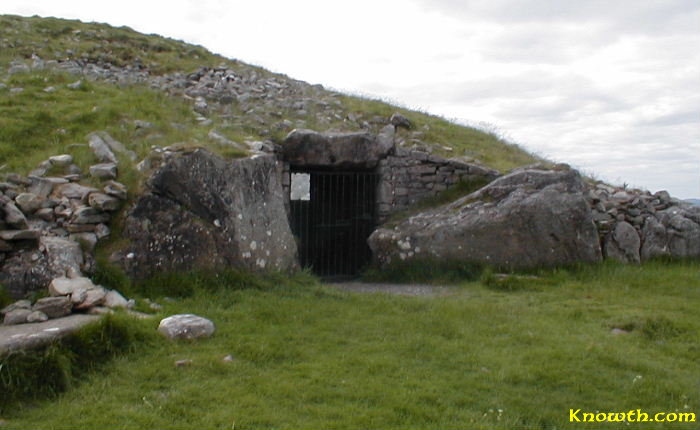 Entrance to Cairn T, Carnbane East, Loughcrew.
Cairn T is particularly well known for its solar alignment. Around the time of the spring and autumn equinoxes, the rising sun shines directly along the passage and illuminates the backstone at the rear of the chamber. As the light slowly moves across the stone it reveals the carved motifs, creating a striking effect that demonstrates the careful planning involved in the construction of the monument. This alignment shows that the builders of Loughcrew were closely observing the movements of the sun and marking important moments in the seasonal cycle.
 The backstone inside Loughcrew Cairn T, photo from Pre-Christian Ireland - From the First Settlers to the Early Celts.
A Passage Tomb Cemetery
Cairn T does not stand alone. It forms part of a wider cemetery that includes a number of smaller passage tombs scattered across the hilltops. Other cairns are located on Carnbane West and Patrickstown Hill, where additional monuments, kerbstones and chamber remains can still be seen today. Together these sites form a complex ritual landscape that was used by Neolithic communities over a long period of time.
Although the monuments at Loughcrew are broadly similar in form to those at Brú na Bóinne, they occupy a very different setting. The Loughcrew cairns crown high ridges, offering wide views across the surrounding countryside. The elevated location may have held symbolic meaning, linking the monuments with the sky and the movements of the sun and stars.
Visiting Loughcrew Today
In the realm of Irish ancient sites, Loughcrew is often described as a hidden gem. Unlike the heavily visited monuments at Newgrange and Knowth, the cairns at Loughcrew offer a quieter and more atmospheric experience. Visitors can walk across open farmland and climb the grassy slopes to reach the hilltop monuments, where the cairns appear much as they have for thousands of years.
Unfortunately, due to structural concerns, the interior of Cairn T is currently closed to visitors. However the site remains open to walkers and visitors who wish to explore the hilltops and surrounding monuments. During the summer months a guide is present on Carnbane East to explain the history and archaeology of the cairns.
The Hag's Chair
Among the kerbstones surrounding Cairn T is a large stone known as the Hag's Chair. This stone seat became an important local landmark and was used as a Mass Rock during the penal period, when Catholic worship was restricted in Ireland. The stone is also believed to have played a ceremonial role in earlier times, possibly connected with local assemblies or inauguration traditions during the early medieval period.
Myth and Folklore of Slieve na Calliagh
The Irish name for the Loughcrew hills is Slieve na Calliagh, meaning "The Hill of the Witch" or "The Hill of the Hag". According to local folklore, the cairns were formed when a supernatural figure known as An Cailleach Bhéara carried stones in her apron as she leapt from hill to hill. She successfully dropped stones on the first two peaks, forming the cairns there, but missed the final hill and fell to her death.
Like many ancient monuments in Ireland, the cairns at Loughcrew exist at the meeting point of archaeology, folklore and landscape. The surviving stones, the solar alignments and the enduring legends all combine to create one of the most atmospheric prehistoric sites in the Irish countryside.
 Loughcrew Megalithic Centre - Family Run Megalithic Centre with coffee shop and original thatched house
located near the car park for Stone Age Cairns at Loughcrew. Hostel accommodation, camping facilities and heritage tours of Loughcrew Cairns available.
Loughcrew Megalithic Centre - Family Run Megalithic Centre with coffee shop and original thatched house
located near the car park for Stone Age Cairns at Loughcrew. Hostel accommodation, camping facilities and heritage tours of Loughcrew Cairns available.
Read An archaeoastronomical assessment of Tomb L on Carnbane West by Dr Frank Prendergast.