Sacred Geography in Ancient Europe
Martin Gray 2006
Hill of Tara - Ireland
Cosmic and Cometary Induced Cataclysms, and the Megalithic Response
Page 1
Early in the spring of 1986 I began a year-long pilgrimage around Europe by bicycle. Over four seasons I cycled through eleven countries to visit, study and photograph more than 135 holy places. In succeeding years I traveled to Europe several additional times, visiting other countries and their sacred sites. These travels took me to the sacred places of Megalithic, Greek and Celtic cultures as well as to the pilgrimage sites of medieval and contemporary Christianity.
For many thousands of years our ancestors have been visiting and venerating the power places of Europe. One culture after another has often frequented the same power places. The story of how these magical places were discovered and used is filled with myths of cosmic and cometary induced world destroying cataclysms, astronomers and sages, and nature spirits and angels.
Misconceptions about the so-called Ice Age and its glacier coverage
Before beginning our discussion of the megalithic use of power places in ancient Europe we should first address certain misconceptions regarding the cause of the transition between the Paleolithic and Neolithic eras. According to conventional beliefs (deriving from incorrect assumptions of the Uniformitarian theory of Charles Lyell and the Ice Age or glacial theory of Louis Agassiz in the early 1800's) enormous glaciers once covered vast regions of the northern hemisphere.These conventional beliefs state that the levels of the world's oceans were lower during the glacier age because of all the water supposedly frozen up in the polar ice cap. Between 13,000 and 8000 BC the vast glaciers melted and the levels of the world oceans rose by 120 meters. The effect of this glacial melting and sea level rise on archaic European life marked the end of the Paleolithic and the beginning of the Neolithic.
This idea of a so-called Ice Age, with enormous glaciers covering vast areas of the northern hemisphere, has been debated by numerous scientific studies in the fields of geology, paleontology, biology, zoology, climatology, anthropology and mythology. Readers interested in learning more about these studies and their revelations regarding the Ice Age and its less-than-previously-assumed glacier coverage, as well as alternative dates for the occurrence of the Ice Age, will enjoy the books Cataclysm: Compelling Evidence of a Cosmic Catastrophe in 9500 BC, by Allan & Delair and Ice Age Civilizations, by James Nienhuis. The factual material presented in this scholarly book is slowly making its way into university courses and text books around the world, thereby rewriting our understanding of early Neolithic times.
Cosmic and cometary induced cataclysms - 9500, 7640, 3150 and 1198 BC
Prior to embarking on a discussion regarding the discovery and use of power places by humans during Neolithic times there is another - and critically important - matter that must be explored first. This concerns the pass-by and actual impact of cosmic and cometary objects at four distinct periods in the prehistoric past. To begin to explore this matter let us first refer to the enigmatic writings of the 4th century BC Greek philosopher Plato. In the Timaeus dialogues, these being a record of discussions between the Greek statesman Solon and an Egyptian priest, Plato report the following:You Greeks are all children - you have no belief rooted in the old tradition and no knowledge hoary with age. And the reason is this. There have been and will be many different calamities to destroy mankind, the greatest of them by fire and water, lesser ones by countless other means. You remember only one deluge, though there have been many.
What might these calamities be which Plato's Egyptian informants are referring to? Evidence has accumulated from a variety of scientific disciplines which demonstrate that a massive cosmic object (probably a portion of an astronomically-near supernova explosion) passed close by the earth in approximately 9500 BC.
This cosmic event caused a worldwide cataclysm of enormous proportions, including massive shifting of the earth's surface, devastating volcanic activity, mega-tsunami waves, subsidence of regional landmasses, and mass extinctions of both animals and humans. In this regard it is vitally important to note that many of the geological and biological effects previously attributed to the hypothesized glacier movements of ice age times could not have been caused by the slow movement of ice but were in fact caused by the rapid and vast displacement of oceanic bodies of water (this being caused by the irresistible gravitational pull of the enormous cosmic object passing by the earth). Additionally, the species-wide animal extinctions caused by this event occurred far beyond the geographical boundaries set for the 'Ice Age glaciations' by orthodox theorists.
The shifting of the earth's surface, termed crustal displacement by its primary theorist, Charles Hapgood, was also studied by Einstein who reported, "One can hardly doubt that significant shifts of the earth's crusts have taken place repeatedly and within a short time."
To read more about the cosmic object pass-by and the ensuing crustal displacement of 9500 BC, refer to Cataclysm by D.S. Allan & J.B. Delair, The Atlantis Blueprint by Colin Wilson and Rand Flem-Ath, and Catastrophobia by Barbara Hand Clow.
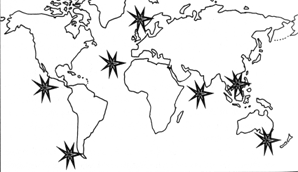 Approximately 2000 years later, in roughly 7640 BC, a cometary object sped
towards the earth. This time, however, rather than passing by the earth as
the cosmic object of 9500 BC had done, the cometary object actually entered
the atmosphere, broke into seven pieces, and impacted the earth at known
locations on the planet's oceans. The map shows the general
location of each of the seven impacts.
Approximately 2000 years later, in roughly 7640 BC, a cometary object sped
towards the earth. This time, however, rather than passing by the earth as
the cosmic object of 9500 BC had done, the cometary object actually entered
the atmosphere, broke into seven pieces, and impacted the earth at known
locations on the planet's oceans. The map shows the general
location of each of the seven impacts.
Scientific studies of the effects of rapidly moving large objects impacting with the ocean surface have conclusively demonstrated that waves resulting from a massive cometary impact would attain vertical heights of 2-3 miles, with forward speeds of 400-500 miles per hour, and a sustained force that would carry them 2000-3000 miles in every direction radiating from the impact location. From the above map it is clear where these great waves would have crashed upon the shores of numerous continents, totally obliterating, especially in coastal areas of gently rising lands, all human settlements and any structures they had built.
Archaic myths from many parts of Europe (and around the world) refer to this event by mention of bright new stars which fell to earth as seven flaming mountains, of how the oceans rose up in vast waves and totally engulfed the lands, and how summer was driven away with a cold darkness that lasted several years. In support of the mythological accounts of the vast waves covering the lands it is important to mention that many of the highest mountains in England, Scotland and Ireland are littered with beds of sand and gravel containing sea shells deposited in the very recent geological past. Geology also gives irrefutable evidence that at two times in the recent past, around 7640 BC and 3100 BC, there have been complete reversals of the earth's magnetic field caused by an outside influence, most probably a comet.
Estimates of the decimation of the global human population from this event range as high as 50-60% (many people would have lived on sea shores due to the availability of fish stocks). Therefore, the decimation of the planet's human population from the 9500 BC cosmic object pass-by compounded with that of the 7640 BC cometary impacts would have severely decreased the number of humans on earth during the following four thousand years. This is a crucial matter to consider, for the reason that orthodox archaeologists have long been mystified by both the relative scarcity of human remains from the period of 7500 BC to 3500 BC and, even more important, by the apparently sudden appearance of the highly developed civilizations of Megalithic Europe and Dynastic Egypt around 3100 BC.
Nearly 4500 years later, in 3150 BC, still another cometary object smashed into the earth, this time in the eastern Mediterranean. The cataclysm caused by this cometary impact, with massive waves radiating outward in all directions from the location of the impact, devastated coastal civilizations all around the Mediterranean (for example, Dead Sea levels rose 300 feet at this time). While less destructive in a global sense than the seven cometary impacts of 7640 BC, the 3150 BC impact gave rise to a large number of flood myths, such as those associated with Sodom and Gomorrah, and Noah's ark. Following this catastrophic event, the oldest societies with written records - Egypt, Mesopotamia, and the Indus Valley - emerged without any cultural antecedents. Seemingly out of nowhere there rapidly appeared a uniform code of laws, the wheel, and keen knowledge of astronomy.
It is certainly not a coincidence that these three centers of sophisticated culture emerged simultaneously in different geographic locations. Rather it is indicative of the 'seeding' of advanced culture into these areas by a pre-impact civilization. Evidence presented in Uriel's Machine points to the likelihood that the highly advanced astronomical and mathematical information were transferred from the early megalithic culture of northwestern Europe to the regions of both Egypt and Mesopotamia, whence it later influenced the sacred geography of the Greeks. In support of this matter, the Scottish Rite of Freemasonry (that which was in effect until 1813) speaks of the achievements of a Pre-Flood people, who were advanced in the sciences of Mathematics and Astronomy, who foresaw the coming of the flood, and who transferred this information to the early Egyptians.
A Mediterranean account of an extraterrestrial impact also occurs in the Sibylline Oracles, which refer to a 'star' falling into the sea and causing the rapid onset of a long period of winter temperatures. Additionally, the Book of Enoch, a part of the Dead Sea Scrolls, contains the tale of a man who had been warned about the effects of cometary impacts and taught survival skills by a people from the far northwest of Europe. Astronomical data in the Book of Enoch indicates latitude between 52 and 59 degrees north, the same general location as the astronomically advanced megalithic culture. Specific directions are also given in the Book of Enoch concerning how to build an astronomical observation device (a horizon declinometer or stone ring) that can be used to recreate calendars and thereby assist in the re-establishment of agriculture following a great flood. To read more about the seven cometary impacts of 7640 BC and the early megalithic responses to them, refer to Uriel's Machine by Christopher Knight and Robert Lomas.
Lastly, between 3113 BC and 1198 BC, there were the pass-by and eventual impact of the cometary object (called Proto-Encke) which destroyed the legendary island of Atlantis, located approximately 250 miles west of the Straits of Gibraltar. In his dialogues, Critias and Timaeus, Plato states that Atlantis sank beneath the waters following a great cataclysm 9000 years before his time. Until recently, the notion of a sunken island in the Atlantic was considered preposterous yet recent geological, oceanographic, climatological and biological studies have conclusively shown that numerous islands did indeed exist in the Atlantic and other parts of the world in Paleolithic and Neolithic times.
However, a more perplexing mystery concerning Plato's account was the time he had given for the sinking of Atlantis, 9000 years previous to his own life. While it is true that adding 9000 years to the 400 years separating Plato's time from the time of Christ and then adding 2000 years which have elapsed since then, gives an approximate date of 9500 BC for the cataclysm, there are definite archaeological problems with this date. The cultural, architectural and scientific developments which Plato attributed to the Atlanteans were simply too advanced for this era of time. Additionally, if such a highly developed civilization had existed so close to mainland Europe and Africa in early Neolithic times it would have left at least some indications of its presence - which it has not. This matter has caused many scientists to criticize or deny the possibility of Atlantis ever having existed.
Yet, to resolve the dilemma, we only need to consider the crucial matter of how the ancient Egyptians recorded time. In actuality, the Egyptians used four different calendars simultaneously; these being solar, lunar, stellar and genealogical versions. Eudoxus of Cnidos, an early Greek pioneer of astronomy who studied in Egypt, tells how the priests of various temples employed a lunar calendar which recorded months as years. Herodotus, Manetho and Diodorus Siculus also wrote that the Egyptian priests and astronomers meant months when they spoke of years. Given this fact, and reducing Plato's 9000 years by a factor of 12, places the cometary impact and sinking of Atlantis at around 1200 BC. A comprehensive study of the time period from 3113 BC to 1198 BC will reveal that numerous cultural groups left records of the pass by and eventual impact of the comet.
In 3113 BC, the comet, known as Proto-Encke, collided with asteroids in the asteroid belt between Jupiter and Mars, resulting in the Taurid meteors widely associated with the Bronze Age. As this comet then passed near to the earth it caused massive geological and climatological influences, including destroying an estimated half of the infrastructure of Atlantis. In 2193 BC, the comet Proto-Encke, converging with the comets Oljato and Hale-Bopp, again passed the earth and caused global seismic disturbances, enormous tsunamis and massive socio-cultural changes. In 1628 BC, Proto-Encke and Oljato returned again, causing further destruction. Finally, in 1198 BC, Proto-Encke and Oljato were pushed closer to the earth by Halley's Comet; Proto-Encke entered the planet's atmosphere and then impacted in the general region of the island of Atlantis. The towering volcano of Mt. Atlas exploded and Atlantis sank beneath the waves. To read more about these matters, consult the books by Frank Joseph, The Destruction of Atlantis, and Survivors of Atlantis.
According to the Egyptian priests that Plato's informant had spoken with, Atlantis had a prosperous and sophisticated civilization before its demise. Advanced in science, it was also in possession of knowledge concerning both the geography and geomancy of the entire earth. Geomancy may be defined as the discovery and mapping of power places on either regional or global scales. Evidence is accumulating which indicates that this mysterious culture had mapped a planet-spanning grid of these terrestrial power points positioned with geometric regularity. This geomantic information, in various forms, later left its imprint on the sacred geographies of numerous other cultures.
Globally occurring legends also tell of astronomer-sages who knew of grand celestial cycles, the existence of past cataclysms and the possibility of future ones. In anticipation of coming cataclysms and the catastrophic effects they would have upon the earth, these astronomer-sages journeyed to particular geomantic locations around the planet, where they built temples which contained wisdom teachings and information about the past and future cataclysms. Some of these geomantic power places would become, thousands of years later, the sacred sites of megalithic and succeeding cultures.
The Origin, Development, and Function of Megalithic Structures
Anthropologists and archaeologists study the locations where ancient people first began living in communities and theorize why these particular places were chosen as settlement sites. Conventional theories assume that sites were selected for agricultural, commercial or military purposes. While such explanations are plausible in many cases, they are not sufficient to explain the location of all early settlement sites.Extensive archaeological evidence indicates that many of humankind's earliest communal settlements had religious and scientific orientations and were chosen for those purposes with great care and precision. To understand this phenomenon, we must examine two matters:
1) A relatively unknown characteristic of prehistoric people, which is their sensitivity to and knowledge of the energies of the living earth.
2) The astronomical observation abilities of certain prehistoric people which allowed them to predict and prepare for cosmic catastrophes.
During their movements across the lands, the Neolithic nomads discovered particular places of spirit and power in the form of caves, springs, hills and mountains. They also sensed lines of subtle energy crossing the land and specific points of more concentrated forces along those lines. These places of power were often marked with large cairns of stones. Identified and marked in this way, they could be seen from a distance even if their energetic qualities were too distant to be physically sensed. Over the thousands of years that early Neolithic peoples wandered across central and northern Europe hundreds of these planetary power places were discovered and physically marked. Legends of these fabled sites were woven into cosmogenic myths from the Mediterranean to the Artic Seas.
Following the Pre-Boreal and Boreal periods (9500-6500 BC) came the Atlantic period (6500-4000 BC) and the extraordinary innovations of plant domestication and animal husbandry. No longer was it necessary for people to wander the countryside in search of their food, now they could grow crops and rear livestock in a fixed place of their choice. The vitally important question is where did these early people choose to first settle? At this stage in Europe's prehistory the population was very small (remember the massive population decline caused by the cometary effects of 9500 and 7640 BC). There were no civilizations to feed necessitating cities near rich agricultural lands, no commercial activities requiring access to trade centers, and no requirements for strategic positions to hold off invading armies. There were simply not enough people for these things. Not having such settlement location requirements, what then were the primary factors influencing early peoples' choices for permanent dwelling sites?
The first people making the transition from the hunter/gatherer existence to a more settled life were the direct descendants of the nomadic wanderers who had discovered and marked the locations of the terrestrial power places. In searching for a settlement location, a previously nomadic family or group of families might often choose a place that held mythic significance for their ancestors, a place of spirit and power. These groups of families would grow into larger groups and then into clusters of groups, thus leading to the development of the earliest villages and towns. As these social centers developed around the ancient nomads' sacred sites, the physical structures marking the precise power point locations would be rebuilt and enlarged. Such reconstructions reflect an increased use of the power places by the growing local populations and, more importantly, an increased understanding of how best to use the energies emanating from the Earth at these sites. Over many thousands of years these power places would come to serve as the pilgrimage locations of Megalithic, Celtic, Greek, and, finally, the Christian cultures.
Page 2 (Next Page)
Page 3
Boyne Valley Private Day Tour
 Immerse yourself in the rich heritage and culture of the Boyne Valley with our full-day private tours.
Visit Newgrange World Heritage site, explore the Hill of Slane, where Saint Patrick famously lit the Paschal fire.
Discover the Hill of Tara, the ancient seat of power for the High Kings of Ireland.
Book Now
Immerse yourself in the rich heritage and culture of the Boyne Valley with our full-day private tours.
Visit Newgrange World Heritage site, explore the Hill of Slane, where Saint Patrick famously lit the Paschal fire.
Discover the Hill of Tara, the ancient seat of power for the High Kings of Ireland.
Book Now
Home
| Newgrange
| Knowth
| Dowth
| Hill of Tara
| Fourknocks
| Loughcrew
| More Places
| Labyrinths
| Local Info
| Art Works
| Articles
| Images
| Books
| Links
| Boyne Valley Tours
| Contact