Sacred Geography in Ancient Europe
Martin Gray 2006
Avebury Stone Circle
Cosmic and Cometary Induced Cataclysms, and the Megalithic Response
Page 3
The Megalithic Culture - continued
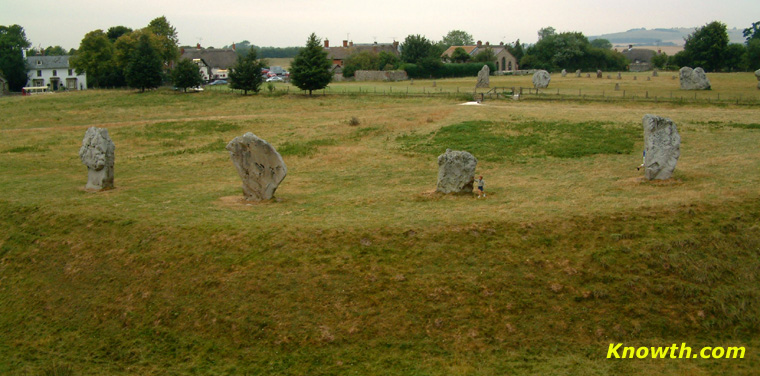
Another fascinating type of megalithic structure to be developed was the astronomical observatory form such as the stone rings and ellipses, for example Stonehenge and Avebury in England, and the grid patterned stone arrangements such as that of Carnac in France.Erected sometime after the first dolmens and menhirs (according to our current knowledge), the astronomical observatory type of megalithic structure mirrored ancient peoples' recognition of the periodic increase of power place energies, their knowledge of the celestial cycles which influenced those energetic periods, and their attempts to astronomically predict them. Additionally, and for this understanding we have Uriel's Machine to thank, certain of the megalithic astronomical observatories were used to predict (and thereby prepare for) the future occurrence of cosmic catastrophes such as cometary and meteoric impacts.
In comparison to the number of menhirs and dolmens at the power places, there are relatively few astronomical observatories. This may perhaps be explained by suggesting that sophisticated astronomical observatories were only erected at power places with major energetic emanations or at power places near social centers. In addition, it may be theorized that there were once more stone rings and grid pattern celestial observatories at the power places but that they have disappeared due to both natural and human causes. Climate changes have caused vegetation to grow over and hide some stone rings (such as occurred with the peat moss growth at the Scottish site of Callanish), other stone rings were torn down when Christianity sought to eradicate paganism from Europe, and still others were dismantled to provide building materials for more recent cultures.
This dismantling of stone rings would have occurred most frequently in areas of greater population. Throughout the remote, today mostly uninhabited moors and hills of the British Isles, over 900 stone rings are known to exist. In more populated continental Europe, they are far fewer in number and those mentioned in 19th century Swiss and Italian antiquarian guidebooks no longer exist.
The most well known of the megalithic structures are certainly the stone rings, particularly Stonehenge and Avebury in England. Research conducted over the past thirty years, combining insights from archaeoastronomy, mythology and geophysical energy monitoring, has conclusively demonstrated that the stone rings functioned as both astronomical observation devices and ceremonial centers. Simply stated, many of the stone rings are situated at locations with measurable geophysical anomalies (so called 'earth energies'); these earth energies seem to fluctuate in radiant intensity according to the cyclic influences of different celestial bodies (primarily the sun and moon but also the planets and stars); the architecture of the stone rings was engineered to observationally determine (by horizon astronomy) those particular periods of increased energetic potency at the sites; and those periods were then used by people for a variety of therapeutic, spiritual and oracular purposes.
The tradition of pilgrimage in megalithic times thereby consisted of people traveling long distances to visit sites known to have specific powers. Due to the absence of historical documentation from the megalithic age it is often assumed that we cannot know how different power places were used but this is a narrow view based solely on the mechanistic rationality of modern science. An enlargement of view to include an analysis of mythology will reveal that the legends and myths of sacred sites are in fact metaphors indicating the magical powers of the places. The ancient stories of the sacred sites and their deities and spirits will tell you how the places may still influence you today.
Only during the last 40 years have archaeologists begun to acknowledge the astronomical orientations of European megaliths and the extraordinary mathematical sophistication which allowed their construction. The early recognition of certain megalithic constructions as astronomical observatories is almost single-handedly the accomplishment of Dr. Alexander Thom, Professor Emeritus of Engineering Science at Oxford University. In 1934, Thom began meticulously surveying megalithic sites. By 1954, he had surveyed and analyzed over 600 sites in Britain and France and begun to publish his findings. Initially his discoveries were not well received. Professor Thom was not an archaeologist, but rather an engineer, and the archaeological community did not welcome what they considered to be heretical views of an "untrained" outsider.
Thom's evidence, however, could not be dismissed. Both overwhelming in quantity and painstakingly accurate in presentation, it undisputedly demonstrated the phenomenal astronomical knowledge, mathematical understanding, and engineering ability of ancient megalithic people. Indeed these abilities were so advanced that they were not equaled by another European culture for over 4000 years. Thom's excellent books, Megalithic Sites in Britain and Megalithic Lunar Observatories, show with eloquent certainty that megalithic astronomers knew the yearly cycle to be a quarter of a day longer than a round figure and that they recognized the precession of the equinoxes, the 9.3 year major and minor standstill cycles of the moon, and the lunar perturbation cycle of 173.3 days which allowed them to accurately predict eclipses.
Furthermore, these megalithic builders were extraordinarily keen engineers and architects expert in advanced geometry 2000 years before Euclid recorded the Pythagorean triangle theorems and over 3000 years before the value of Pi (3.14) was 'discovered' by Indian mathematicians. Surveying sites with the accuracy of a modern theodolite, these ancient builders developed a unit of measure, the megalithic yard of 2.72 feet, which they used in stone monuments from northern Scotland to Spain with an accuracy of +/ - .003 feet or about 1/200th of an inch. Following the leadership established by Alexander Thom, the English scholars John Michell and Robin Heath have gone on to demonstrate even more of the brilliance of megalithic mathematicians and engineers.
Previous to Alexander Thom's site surveys and their indisputable proof of megalithic culture's advanced scientific knowledge and social cohesiveness, archaeologists had always assumed Europe's prehistoric inhabitants to be a rough gathering of ignorant barbarians. Thom's discoveries, in showing this belief to be completely untenable, had a revolutionary, albeit gradual, impact upon the orthodox archaeological community. During the same period that Thom was surveying the megalithic sites other scientists were having an equally revolutionary effect upon the European archaeological community, but from an entirely different direction. Like the engineer Thom, these scientists were not archaeologists, yet their contributions, coupled with the implications of Thom's site surveys, would instigate a complete rewriting of European pre-history.
This other revolution in the European archaeological community was caused by the discovery of carbon-14 dating by Willard F. Libby in 1949 and the dendrochronological recalibration of this method by Hans E. Suess in 1967. Basically, carbon-14 testing, in conjunction with dendrochronology, or tree ring dating, is an absolutely accurate method of dating ancient organic matter and, by extension, the archaeological sites where that matter was found. To understand why these dating methods caused such a revolution in archaeological thinking it is helpful to know how the archaeological community viewed the subject of European pre-history prior to Libby's carbon-14 discovery in 1949.
Archaeology is a relatively recent scientific endeavor. During the entire course of its academic development, it has been powerfully influenced by the assumption that world wide cultures "diffused" from a few primary centers of original civilization. For more than a century, Pre-historians had assumed that most of the major cultural advances in ancient Europe were the result of a diffusion of influences from the great early civilizations of Egypt and Mesopotamia. These cultures could be dated by actual historic records, for both the Sumerians and the Egyptians had left lists of kings and dynasties going back to 2000 and 3000 BC respectively. Given these dates, and assuming an appropriate period of time for the diffusion of ideas from Egypt and Mesopotamia to northern Europe, it was calculated that Europe's megalithic structures could have been built no earlier than 1000 to 500 BC. Imagine the surprise and, at first, strident disbelief of the archaeological community when megalithic construction dates of 4000-2000 BC were factually established. The stone monuments of Europe were suddenly a thousand years older than those previously believed "world's oldest stone monuments," the Egyptian pyramids.
Carbon-14 dating had thus effectively and totally undermined the diffusionist theories as suitable explanations for the development of Europe's megalithic culture. This accurate archaeological dating technique, in conjunction with Thom's site surveys, demonstrated with irrefutable certainty that megalithic culture was indigenous to Europe, that it had developed wholly on its own (though perhaps with a mysterious Antlantean influence), and that it was the most scientifically advanced culture in the world during the long ago time of 4000 to 2000 BC.
As mentioned previously, each specific power place is unique by virtue of both its location and its energetic emanation. Certain power places were noted by ancient people as having energetic emanations which were influenced by particular astronomical cycles. The astronomical observatories erected at these power places were designed in such a manner as to be oriented toward the celestial body or bodies which influenced their power place emanations. While there were similarities in astronomical orientations between various observatories, there were no constant alignment patterns used, as each power place was unique in both its Earth surface location and its astronomical correspondence point. The energy link between these two unique points, planetary and celestial, produced a subtle energy emanation unlike any other place upon the Earth. As these energy emanations varied from place to place, so also did the type of structures that were erected to study the periodic changes in emanation of the earth energies.
Another reason for the megalithic astronomical observatories' diversity in structural size and complexity is human innovation and the effect it may have upon the development of scientific endeavors. As previously stated, the earliest megalithic structures at the power places were the more simple energy harnessing devices. These were followed by the observatories which megalithic people utilized to predict the periodic increases of subtle energy emanations at the power places. It is known from extensive archaeological evidence that the first rings and ellipses were constructed of wooden poles and only later, often after periods of a thousand or more years, reconstructed with stones.
It also known (and for this Stonehenge is the primary example) that the stone rings themselves went through stages of development in both size and structural complexity. These size and structural changes certainly indicate a greater understanding of planetary and celestial energy correspondences as they relate to the power places, yet they also seem to indicate the increasingly scientific use of the rings as contrasted to their initial sacred use. Contemporary astronomers seek to build ever more powerful optical and radio telescopes. Is there any reason to doubt that ancient astronomers felt these same desires for more precise observational tools and thus developed their design?
Another vitally important, though currently little understood, function of the megalithic astronomical observatories, in particular the stone rings, was to predict, in advance of their occurrence, the arrival of and impact by cometary and meteoric objects, such as had occurred in 9600 BC and 7640 BC. As explained in Uriel's Machine, the stone rings found in different parts of northern Europe have different arrangements and alignments of stones, dependant upon the latitude and longitude of the site, which allow them to precisely observe the movements of celestial bodies along the horizon and thereby gauge the long-term passage of time. Myths and legends traceable to periods of the early Neolithic seem to indicate that a mysterious group of 'astronomer-sages' knew of the periodicity of cometary objects and their potentially lethal effect upon the planet. Authors Knight and Lomas in Uriel's Machine make a convincing case that the stone rings of megalithic times were used as both calendrical indicators and cometary prediction devices in service to mankind.
Celtic Earth-based Spirituality
Thousands of years after the decline of megalithic culture came the Celtic age with its Druid spirituality. It is now widely accepted that Druid spirituality derives in part from pre-Celtic (for example, megalithic) traditions of far western Europe, which impressed the invading Celts to the extent that they adopted some of these traditions when they settled among the earlier-established tribes. In other words, the pre-Celtic traditions influenced existing Celtic practices resulting in what is now commonly called Celtic Druidism. In support of this matter, it is interesting to note that Julius Caesar reported that Druidism began in the British Isles and was only later exported to Gaul.Contrary to popular belief (and the historically inaccurate writings of various new-age novelists), the Celts neither used the stone temples of the earlier megalithic peoples nor continued their style of ceremonial architecture. Stonehenge, for example, was constructed between 2800 and 2000 BC, while the Celts did not enter England until 600 BC, fully 1400 years later. Not using the stone rings and chambered mounds, Celtic spirituality was instead concentrated at unadorned natural sites such as mineral springs and waterfalls, caverns and remote islands, curiously shaped peaks and forest groves. In Celtic spirituality the entire landscape was in fact filled with places where spirit was present. This spirit of place or anima loci was understood to be the essential personality of a location and the spirit places were transformed into sacred sites when humans discovered and acknowledged them.
As with the Megalithic people before them, the Celts believed different types of landscape forms were inhabited or guarded by specific deities. Sacred forest groves, called nemetoi, meaning 'clearings open to the sky' were dedicated to various goddesses such as Andraste, Belesama and Arnemetia. Mountains served as altars for deities, sites of divine power and places for seeking inspiration. Towering peaks were seen as abodes of masculine deities such as Daghda, the father god, and Poeninus, while various hills, the breasts of the goddess, were recognized to be the sanctuaries of Ana, the Celtic mother of the Gods, and Brigid. Caves, believed to be entrances to the underworld or the fairy kingdom, were used for seeking visions and for communication with the depths of the psychic unconscious. Strangely shaped trees and rocks were considered the resting places of elemental spirits, fairies and supernatural beings. Celtic people made pilgrimages to all these types of sacred places, leaving offerings of cloth, amulets and food for the resident deities, thereby seeking the archetypal spiritual qualities of the places and praying for both physical and psychic healing.
Conclusions and a call for further studies
From the preceding discussion it is apparent that there are several possible explanations for the original discovery of the power places of Europe: the archaic Neolithic nomads, the astronomer sages of the mysterious culture of Atlantis, and the early megalithic culture. The sites found and marked by these extremely ancient people continued to be used for thousands of years and became in time the sacred sites and pilgrimage places of other cultures such as the Celtic and ancient Greek.Myths originating from these later cultural epochs speak of the power places as being the abodes of deities, the haunts of magical beings, and the enchanted domains of elemental spirits. The pilgrimage traditions of the Celtic and Greek cultures are markedly different in external form but in essence each may by understood as an expression of early peoples' connection to and worship of the living earth. The sacred geography of the ancient Greeks will be more deeply examined in the next section of this essay.
Through countless years and cultural expressions human beings have made pilgrimages across Europe, drawn by the spiritual magnetism of the power places. Different religions and their assorted temples have risen and fallen yet the power places remain ever strong. Still beckoning pilgrims in our own deeply troubled times, these holy sites offer a plentitude of gifts for body, mind and spirit. Take the time to go on a pilgrimage to the sacred places of ancient Europe. Inspiration and health, wisdom and peace - these and other qualities are freely and abundantly given there by the enchanted earth.
Martin Gray Biography
Martin Gray is an anthropologist and photographer specializing in the study of sacred architecture, holy places and pilgrimage traditions around the world. During a twenty year period, Martin Gray traveled widely in 120 countries to study and photograph more than 1000 holy places of prehistoric, historic and contemporary cultures. Martin is an expert in the subjects of ancient religion, sacred geography, archaeoastronomy and ecopsychology.In 2004 National Geographic published The Geography of Religion and Martin Gray was the principal photographer. In August of 2006 the Japanese publisher Basilico issued a book of Martin's sacred site photographs, and in the spring of 2007 the American company Sterling will publish a book entitled Sacred Earth, which will feature 180 color photographs of sacred sites around the world. Martin's photographs and writings have been featured in documentaries, newspapers, magazines, books and web sites around the globe. Martin Gray has presented slide shows at museums, conferences and universities, for more than 125,000 people, in the United States, Europe and Asia. Martin's web site, Places of Peace and Power, may be seen at SacredSites.com
Page 1
Page 2 (Previous Page)
Boyne Valley Private Day Tour
 Immerse yourself in the rich heritage and culture of the Boyne Valley with our full-day private tours.
Visit Newgrange World Heritage site, explore the Hill of Slane, where Saint Patrick famously lit the Paschal fire.
Discover the Hill of Tara, the ancient seat of power for the High Kings of Ireland.
Book Now
Immerse yourself in the rich heritage and culture of the Boyne Valley with our full-day private tours.
Visit Newgrange World Heritage site, explore the Hill of Slane, where Saint Patrick famously lit the Paschal fire.
Discover the Hill of Tara, the ancient seat of power for the High Kings of Ireland.
Book Now
Home
| Newgrange
| Knowth
| Dowth
| Hill of Tara
| Fourknocks
| Loughcrew
| More Places
| Labyrinths
| Local Info
| Art Works
| Articles
| Images
| Books
| Links
| Boyne Valley Tours
| Contact