Sacred Geography in Ancient Europe
Martin Gray 2006
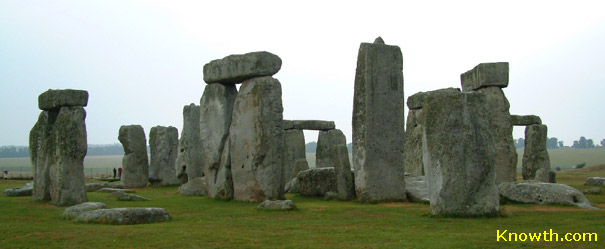
Stonehenge
Cosmic and Cometary Induced Cataclysms, and the Megalithic Response
Page 2
The Megalithic Culture
The megalithic (meaning 'great stone') culture, which is responsible for the stone rings, standing stones, and chambered mounds of Europe, existed from roughly 4000 to 1500 BC. Absolutely no written records exist from these times and therefore archaeologists make assumptions about the people based on excavations of their domestic, funerary, astronomical and ceremonial structures. Among a wide variety of these structures, we may distinguish four major types of stone structures with astronomical and ceremonial functions: single or grouped standing stones known as menhirs; rock chambers known as dolmens; enormous earthen mounds with passage ways leading to rock cut chambers; and the stunningly beautiful stone rings of which Stonehenge is the most famous example.The great advances in understanding of the Earth's subtle energies and the erection of the megalithic structures which harnessed those energies occurred during the Sub-Boreal period of 4000-1400 BC. Europe's climate was warm during those years (warmer than today) and this encouraged increased agricultural productivity, an ensuing growth in population, and the migration of members of this growing population into remote, previously unsettled regions of northern Europe. With these developments came a concurrent increase in commerce, scientific knowledge and, most importantly, the exchange of ideas between peoples of different geographic areas. To this exchange of ideas we may attribute: 1) the development of megalithic culture and 2) the erection of great earthen and stone monuments at the power places which had been venerated as sacred sites since hunter-gatherer times.
While places sacred to ancient civilizations exist throughout the world and their locations are often well known, the sacred functions of the sites are rarely understood. It is easy to see why this is so. There is often a corollary between the extreme age of an archaeological site and the scarcity of information regarding the site's origins and initial function. The further back in time archaeologists look, the less they know. Because of this, explanations of a sacred site's initial and primary functions are often no more than theorizations based on records of the site's use in more recent times.
The difficulty in accurately determining the function of sacred sites is further compounded by the conceptual influences of the contemporary paradigm. Many archaeologists and historians, deeply conditioned (as nearly all Western people are) by the religious and materialistic paradigm of the so-called 'post-modern' world, are unable to view ancient cultural behavior patterns in a clear and unbiased manner.
Today's researchers seek to interpret ancient people, yet all too often do so with intellects programmed by scientific and psychological assumptions relevant only to contemporary times. This approach is bound to produce poor understandings. Basically, the perceptual and interpretive limitations imposed by our present culture's belief systems exemplify an age old tendency of human beings to assume that they know more about life than their ancestors did. While this is certainly true with such matters as computer programming and aircraft design, it is not true in all areas of human knowledge and endeavor. Human beings develop skills and understandings uniquely appropriate to the environments and times in which they live. Ancient people, living in harmony with the Earth and dependent upon its bounty for all their needs, had developed skills which modern people no longer use, cultivate or even recognize.
Early settled people, like their nomadic hunter-gatherer ancestors, were sensitive to the natural creative energies of the Earth. Living close to the land and intimately aware of the movement of celestial bodies, they came to notice a correspondence between the flow of the Earth's subtle energies and the periodic movements of the sun and moon and stars. This harmonious balance between Heaven and Earth resulted in particular power places on the Earth's surface being highly charged at equally particular times of different celestial cycles.
Over the passage of many centuries, as the ebb and flow of the Earth's subtle energies were recognized to mirror celestial cycles, various types of megalithic structures were developed at the power places. Basically these different structure types were utilized to harness terrestrial and extraterrestrial energies, to observe astronomical movements in the interest of predicting the periodic increases of those energies, and to assist in the prediction of cosmic events such as future cometary impacts. While the structure types were different in form and function, they served one another and therefore are best understood in relation to one another.
One early type of megalithic structure to be developed was the earth energy harnessing device. While constructed in numerous different forms depending upon the geomorphic features of the land, the character of the power place emanation, and the style of local architecture, the energy harnessing devices were designed and utilized to gather, concentrate and emanate the subtle energies of the power places for the benefit of human beings. In Western and Mediterranean Europe, these energy harnessing megalithic structures are found in three general forms: raised earthen mounds (presently called hilltop forts and burial barrows), rock cut chambers known as dolmens, and single or grouped standing stones known as menhirs and dolmens. Let us examine each of these individually.
Conventional historical interpretations of the flattened hilltops in Britain (many with coiled circles and huge earthen mazes surrounding their tops) surmise that they were hill forts or castle foundations. Though it is true that many were used in this manner during the Iron Age and later by the Romans and Saxons, their original use was certainly not defensive. As forts they are indefensible. Most have numerous gaps in their earthen work walls, they are so large as to require thousands of people to defend their periphery, and they were often inconveniently placed for long term human habitation. Archaeological excavations at these sites reveal implements of construction, such as antler picks and stone axes, but rarely the artifacts of large scale settlements such as pottery and dwelling remains. Were these places used as habitation centers or sacred sites? Accumulating evidence seems to indicate their sacred rather than secular usage.
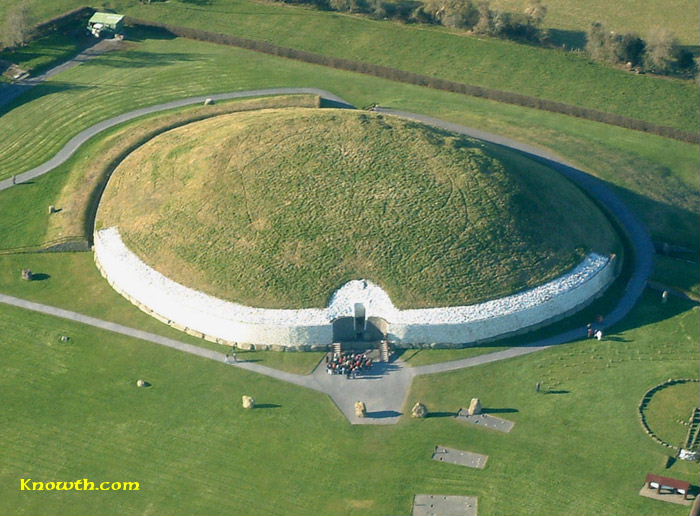
Another puzzling form of earthen mound is the so-called 'burial barrow' or 'burial mound', well known examples being located at Newgrange, Knowth, Dowth and Loughcrew in Ireland. Because burial remains have been found within some - and only a very few - of these structures, it has been assumed by the orthodox school of archaeology that their purpose was for interring the dead. If this were so, why then are the mounds so large (hundreds of feet in diameter) yet with so few burials (2 -10)? Why are there so few skeletons over such long periods of use (1000-2000 years)? Why are there so few trappings of wealth and power as is found in the burial remains of later Bronze and Iron Age tombs? Why are the carbon-14 dates of the rare burial remains much later than the Carbon-14 dates for the implements used in the mounds' construction?
And, most mysteriously, why are the entrance portals and passage ways leading to the mound interiors in absolutely precise alignment with the horizon appearance or disappearance of such celestial events as the solstices, equinoxes, lunar standstill dates, and the appearance of particular stars? Conventional archaeology is unable to answer these questions and therefore disregards them almost completely. In actuality these massive earthen structures were subtle energy concentrating chambers which ancient people initially used for healing and spiritual purposes. Later peoples, knowing the eternal nature of the human sprint, buried their dead within these chambers in the hopes that the dead person's spirit might have a more rapid journey to the realm of universal spirit. Still later people, having no understanding of either universal of human energies, used these mounds as they were convenient, already excavated chambers, suitable for disposal of the dead.
Another enigmatic class of megalithic structure is the dolmen or 'table-stone' (dol=table, men=stone). Dolmens normally consist of two to four enormous slabs of stone (often weighing several tons each) supporting even larger roof stones. Dolmens - or as they are called in other ancient European languages: quoits and cromlechs - are scattered throughout the European countryside from the Iberian peninsula to the remote islands of northern Scotland. Very rarely found with burial remains and often located far from any evidences of ancient habitation sites, dolmen structures - by the very difficulty of their construction - indicate a powerful purpose. Extraordinary work forces were needed to erect a dolmen's supporting stones and to place the table top stones upon them.
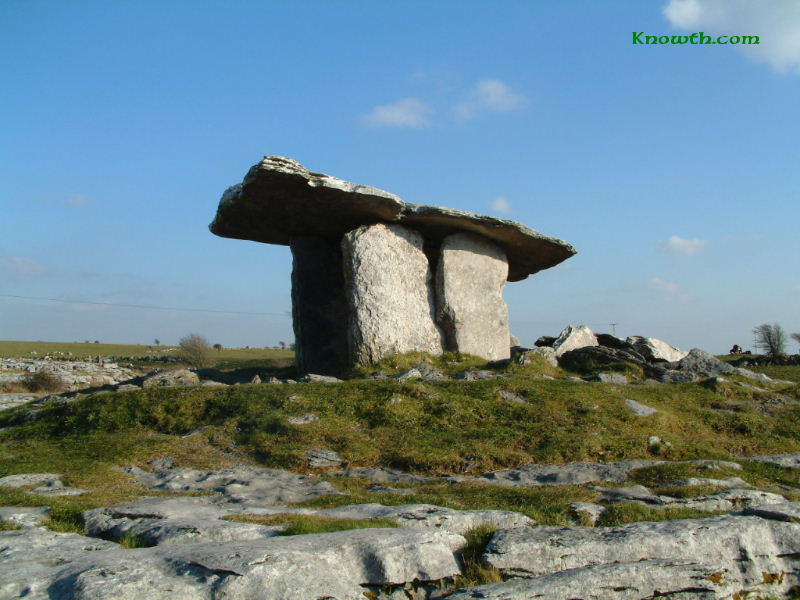
With primitive levers and ropes, three or four strong people are required to move a one ton stone, thus the 50 ton cap stones of certain dolmens would require 100-200 persons to move them. Many of these megaliths were erected upon high and remote plateaus and were fashioned from stones which were quarried hundreds of miles away. Moving stones up even small inclines requires the number of workers to be increased by a factor of five. Such enormous effort points to the great importance of the dolmens to megalithic people. Often erected directly over power points along the Earth's meridian lines, the dolmen megaliths served to tap terrestrial energies for the benefit of human beings.
Another fascinating thing to know about many of the dolmens is that they were originally entirely covered by alternating layers of organic and inorganic materials. While the purpose of this construction technique is presently unknown, it is interesting to note that the scientist and psychic Wilhelm Reich used the same technique in the construction of his so-called orgone generators, these being (much smaller) devices that were able to generate, concentrate and radiate a mysterious form of energy. Could the ancient builders of the dolmens have been using their unique construction techniques for a similar purpose? Orthodox archaeologists commonly assume these dolmen structures were used for funerary purposes because burials have been found in a small number of them (a very small number!). It is important to note, however, that the scientific dating of the burial remains shows them to be hundreds or thousands of years more recent that the structures themselves, thus casting serious doubt on the tomb theory.
Equally enigmatic are the megalithic structures called menhirs. While it is true that some of these single or grouped standing stones are outlying parts of the (soon to be discussed) megalithic astronomical observatories, the vast majority of menhirs are solitary needles of stone with no proximity to other structures. Ranging in height from two feet to over 30 feet, the menhir stones were presumably utilized by ancient people as both location marking stones and as emanating devices for power place energies. In remote areas of Europe, yet untouched by the land-grabbing onrush of modern civilization, menhirs may still be found, placed every few miles along dowsable energy lines leading to stone rings, dolmens and other ancient sacred sites.
Many of these solitary standing stones have odd symbols, spirals and map-like images carved upon their surfaces. Conventional archaeologists often interpret these as mere ornamental designs, yet a world-wide study of such markings will reveal their similarities to rock carvings in Australia, South America, Africa and India. The map-like images are perhaps actual maps, showing - according to the topographical methods of the ancient cultures - locations of other power places in the adjacent regions. Some scholars suggest that they may have been part of a vast sacred geography, long since ruined, while dowsers report that the solitary standing stones are situated to mark points of concentrated earth energies flowing along the lines between these sites (sometimes called ley lines). The strange spirals and whirling patterns are thought by some researchers to be graphic representations of the power point's vibratory characteristics as determined by oscillating pendulums.
Page 1 (Previous Page)
Page 3 (Next Page)
Boyne Valley Private Day Tour
 Immerse yourself in the rich heritage and culture of the Boyne Valley with our full-day private tours.
Visit Newgrange World Heritage site, explore the Hill of Slane, where Saint Patrick famously lit the Paschal fire.
Discover the Hill of Tara, the ancient seat of power for the High Kings of Ireland.
Book Now
Immerse yourself in the rich heritage and culture of the Boyne Valley with our full-day private tours.
Visit Newgrange World Heritage site, explore the Hill of Slane, where Saint Patrick famously lit the Paschal fire.
Discover the Hill of Tara, the ancient seat of power for the High Kings of Ireland.
Book Now
Home
| Newgrange
| Knowth
| Dowth
| Hill of Tara
| Fourknocks
| Loughcrew
| More Places
| Labyrinths
| Local Info
| Art Works
| Articles
| Images
| Books
| Links
| Boyne Valley Tours
| Contact