A taste of the unexpected: subverting mentalités through the motifs and settings of Irish passage tombs.
Andrew Cochrane 2005 - Page 5Shee Twohig (1996) has reviewed the construction of Cairn L and its visual imagery to contest Thomas's (1992) assertion that the innermost and deepest parts of a passage tomb are the most 'significant' or important and that this is represented via the complexity of the motifs. The evidence suggests that the individual cells, particularly Cell 6 on the northern right hand side and not the deepest (Cell 4), are more visually 'complex'.
Thus, Cairn L repeats many of the themes outlined for Cairn T, such as size and motif repetition, but also adds further dimensions and inversions of use by the incorporation of basins. These similarities and differences will be discussed further below.
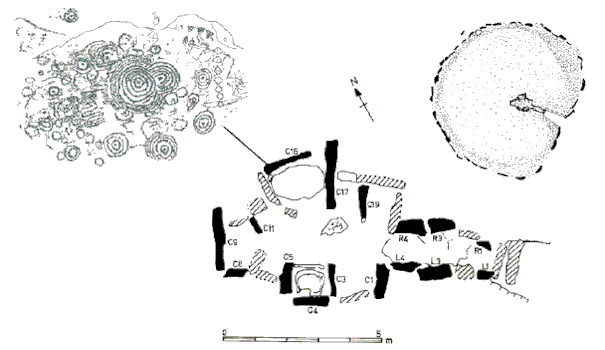
Plan of Cairn L with illustration of C16, Carnbane West, Loughcrew. Scale represents internal plan only (after Shee Twohig 1981, Figs. 222, 226; McMann 1993, 33).
Difference and repetition
With the exception of Cairn T, a recurring theme in a majority of the passage tombs at Loughcrew is the prominence of their right sides as you enter deeper into them. In some instances this is emphasised by the right cell being larger than the others (e.g. at Cairns H and U), and in other examples the central cell on the right side is larger (e.g. Cairns I and L) (Herity 1974, 42; Shee Twohig 1996, 78; McMann 1994, 532). Indeed, the right sides of the passage tombs often contain other distinguishing features such as the stone pillar and basin stone in Cairn L, and the basin/slabs in Cairns H and I.The right cells are often more elaborately decorated (Herity 1974, 42, 123), with the sill stones or backstones being the most visually striking, such as is seen in Cairns H, L, I, and U. In multi-celled passage tombs, the cell in juxtaposition to the elaborately decorated right cell is sometimes also stressed, such as in Cairns I and L. What we might be witnessing is the priority of 'dexter over sinister' (Herity 1974, 123). Shee Twohig (1996) has highlighted these occurrences and suggests that they constitute a choreography of the practices or performances that may have occurred within the passage tombs. She also noted that that the left cells appeared to be dominated by circular images, with the right cells demonstrating greater variety. Whether this is tantamount to more 'complex' panels is open to debate.
Thomas (1992, 146-7) creates a 'basic division' and considers spirals, meanders and dots as 'simple', with concentric circles and lozenges as more 'complex' arrangements. He proposes that 'simple' arrangements are rarely found on the same stone as the more 'complex' ones (1992, 149). In attempting to challenge the dichotomy of 'simple: complex', Shee Twohig (1996, 79) has argued that although 'simple' spirals and 'complex' lozenges do not occur on the same stones, spirals and concentric circles do (on 14 stones). She also notes that concentric circles and lozenges only occur on six stones in total, therefore making the distinctions less impressive and removing some of the assertions of Thomas's spatial depth analysis (1992, Fig. 11.3).
Returning to the superimposed motifs within underground settings, and in considering subversive engagements with them, we may think of these processes as the reversibility of perspectives (Merleau-Ponty 1962). By entering the passage tomb itself, we are seeing a reversal of the idea of Plato's cave. It is the people entering the artificial cave (passage tomb) or artificial worlds that are presented with alternatives to a reality, rather than the people who remain outside.
We can, therefore, envisage an Irish Neolithic spectator entering a decorated tomb and being absorbed in the pleasures or horrors of an artificially constructed world, the sublime experience of temporary immersion in an inverted world. Irish Neolithic motifs, through their nature or superimposed construct, are therefore not stable, but rather change their relationship to exterior reality at particular moments in time and place (e.g. the illumination of motifs at particular times of the year). As one mode of reality that is represented by an image loses ground, or is superimposed, another takes its place, creating a matrix consisting of realities within realities. Thus the images create difficulties and tensions.
Thomas's (1990; 1992; 1993) proposals create situations in which 'space' as well as 'spectator' are controlled. For Thomas, the Loughcrew passage tombs act as the 'gradual multiplication of bounded spaces [creating a] greater subdivision of the audience, depending upon how far they were allowed to penetrate into the monument' (1990, 176). The shapes of the passage tombs enforce a linear pattern of movement within the passageway and physical 'penetration' into the chamber is dictated by the orthostats and by crossing a 'symbolically-laden' forecourt entrance (Thomas 1990, 174; 176; 1993, 85). In some instances a person has to actually hunker-down to enter, such as at Slieve Gullion, Co. Armagh, and even lie down to see particular images (Lynch 1973, 155; and see discussions above).
Within this depicted scheme, 'lower ranked individuals' or more 'subservient' persons were only allowed to the outer parts of the passage tombs (Thomas 1990). Thomas's (1990; 1992; 1993) studies are therefore centred around an 'inside: outside' dichotomy, focused more upon the passage tomb interiors. Thomas (1992, 145) does not discuss external or 'public' engagements other than commenting that there may have been approved patterns of movement between the cairns, possibly a linear based one (see Cooney 1990), with the limited intervisibility between some individual passage tomb exteriors indicating possible sequential encounters. For instance, as one could not see the entrance to Cairn H from the entrance of Cairn L, Carnbane West, one would have to physically move closer to it.
As a response to studies that privilege the interiors of passage tombs, Fraser (1998) suggested that greater importance lay in the larger-scale and possibly more frequent social encounters that could have occurred in the spaces between and outside the passage tombs at Loughcrew. For Fraser (1998, 209), the public spaces did not only add legitimation to specific practices, authorities and beliefs, but also challenged or subverted them, as a direct result of the public nature of the places and events.
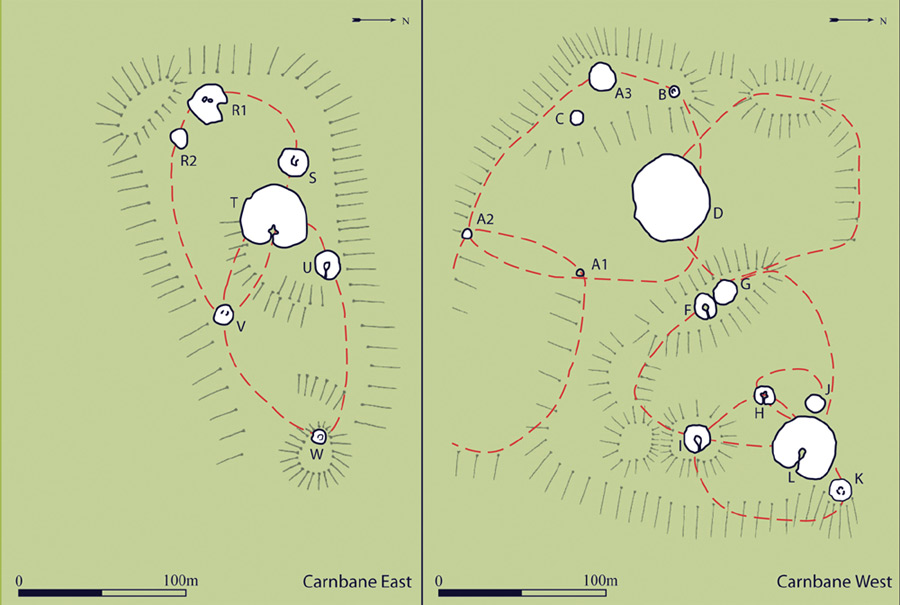
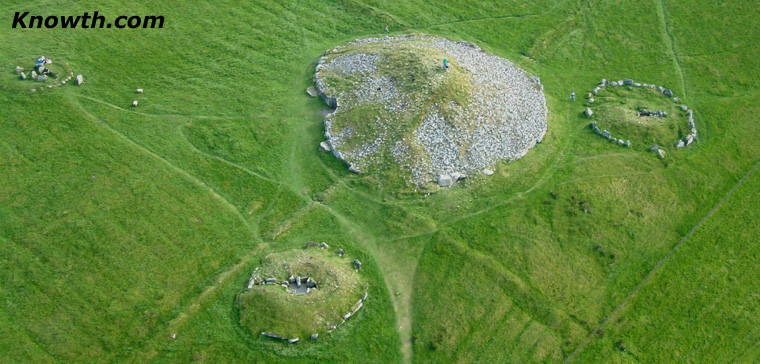
The spaces in between the cairns become 'theatres in the round' (Bradley 1998, 116) and as with theatrical performances, may have incorporated elements of apprehension, risk and danger.
The notion of risk and danger is amplified if one imagines the Loughcrew summits to be liminal zones where the dead or spirits dwelt or had access to. As with all theatre spaces, they are designed to produce systems of simulation and illusion of place and persons; the aim of theatre is unauthenticity (Pearson and Shanks 2001, 117). Indeed, it is within liminal spaces that all performances operate (Pearson and Shanks 2001, 53). By incorporating notions of performative simulation and the carnivalesque, we can begin to create more emotional narratives. Carnivalesque performances may have been at play within the open spaces, involving larger numbers of people; more people than the passage tombs could hold. As such, we can imagine some people acting with less physical restrictions to movement, deploying festive laughter to momentarily enjoy a symbolic victory over the spirits and death, over all the worldviews that restrict and maybe even oppress within daily life (see Stam 1989, 86).
By deploying carnival ideas people may have overcome the confines between passage tomb, cairn, hill topography, bodies that are alive or dead, whole or cremated, and the world in general. Bakhtin describes these events as 'interchange' and 'interorientation' and proposes that 'eating, drinking, defecation and other elimination (sweating, blowing of the nose, sneezing), as well as copulation, pregnancy, dismemberment, swallowing up by another body – all these acts are performed on the confines of the body and the outer world, or on the confines of the old and new body. In all these events the beginnings and end of life are closely linked and interwoven' (1968, 317).
Conclusion
We do not have to settle for interpretations that depict either some people operating within passage tombs, or conversely only performing outside cairns. By developing the models presented by Thomas (1990; 1992; 1993; 2001) and Fraser (1998), we can begin to speculate that different people were doing different things and sometimes even the same things, but in alternative settings (i.e. inside and outside the passage tombs). The Loughcrew settings may represent permanence in flux with punctuated shifts in social orientations. Within the passage tombs the activities may have been more formalised, with spatial distinctions, barriers and the motifs creating fluid and interactive types of communication. These events may have been the 'internal' simulacrum of carnivalesque performances as hyper-real (greater than real) worldview palliatives for the participants (Baudrillard 1994; Cochrane forthcoming).Outside the passage tombs these activities may have been temporally suspended, with the carnival in the 'island' areas erasing the boundaries between spectator and spectacle. We can maybe imagine the laughter of the masses creating an alternative form of free consciousness and unique perspectives on experience, that were no less important than seriousness or even tears (e.g. as seen at some modern Western funeral practices). Carnivals can certainly be transgressive, creating an 'irrational' yet real state of happiness, from miserable situations or locations (Stam 1989, 101, 119). Indeed, the apertures to the passage tombs themselves conform to carnivalesque modes in that they can instantly invert from an entrance threshold into an exit one, with entry leading to exclusion and openings becoming closings (or vice versa).
The conceptual models that were used to create the images on the interior of the passage tombs were made in a 'real' world to 'represent the world as being capable of being otherwise than we believe it to be' (Gell 1992, 217 original emphasis). The images on the Loughcrew passage tombs are simulations of a given reality, a hyper-reality and as Gell suggests, 'the world is as it is, but we think it could be otherwise, and it may be otherwise than we think' (1992, 217). The Loughcrew passage tombs act as nodes to continuity and rupture, and represent Neolithic simulations and simulacra in that they reference a reality that does or did not exist.
Simulation in a Neolithic context is not about referential beings or substances, it is the possible generation of a 'real' without origin or reality: a hyper-real (Baudrillard 1994; Cochrane forthcoming). The motifs, passage tombs, covering cairns and 'island' areas simultaneously represent, contest and invert spaces and place, visually and physically. These features were not static, sanitised and sterile. Neolithic people had no 'physical' access to alternative believed worlds, for if they had physically accessed them, they are no longer alternative believed worlds, but rather the actual world itself. Carnivalesque performances may have therefore facilitated at some level a feeling of being able to temporally rupture one world and access others.
Experimentation with simulations of a worldview via motifs on passage tombs, 'real' or 'imagined', possibly allowed some Neolithic people mental access to the other beyond (see Cochrane 2001). The visual motifs are therefore sources for invention and belonging, or processes with dimensions of creativity and 'reason', although they could have also been 'inept' and 'unreasonable', creating gaps and absences within the appearances of the solidity of the world in which they lived in (Shanks 1992, 118, 137). These processes can lead to an escalation of what is thought to be true, of the lived daily experience, through modes of display, engagement and disengagement.
This can create feelings of anxiety, and can also create an increase in the material production of images that are of the real. These anxieties can produce subversive and inversive technologies or strategies. The individual motif and the passage tomb within a specific location might therefore be an intensified expression of a chain of images, discourses and material realities that helped support and distort people's perceptions of their worlds in direct and indirect ways.
Acknowledgements
I would especially like to thank Dani Hofmann and Jess Mills for their comments and suggestions on earlier drafts of this paper - I have complete respect for you both! Discussions with Doug Bailey on the carnivalesque and visual culture were invaluable. Thank you also to Andy Jones for discussing ideas with me and allowing me access to his work. I am grateful to my supervisor Alasdair Whittle; he has supplied unfailing help and guidance throughout my research and this paper. The recommendations made by these people have undoubtedly improved this work, but the errors and mistakes are still mine alone.Next Page (6)
Previous Page (4)
Boyne Valley Private Day Tour
 Immerse yourself in the rich heritage and culture of the Boyne Valley with our full-day private tours.
Visit Newgrange World Heritage site, explore the Hill of Slane, where Saint Patrick famously lit the Paschal fire.
Discover the Hill of Tara, the ancient seat of power for the High Kings of Ireland.
Book Now
Immerse yourself in the rich heritage and culture of the Boyne Valley with our full-day private tours.
Visit Newgrange World Heritage site, explore the Hill of Slane, where Saint Patrick famously lit the Paschal fire.
Discover the Hill of Tara, the ancient seat of power for the High Kings of Ireland.
Book Now
Home
| Newgrange
| Knowth
| Dowth
| Hill of Tara
| Fourknocks
| Loughcrew
| More Places
| Labyrinths
| Local Info
| Art Works
| Articles
| Images
| Books
| Links
| Boyne Valley Tours
| Contact