A taste of the unexpected: subverting mentalités through the motifs and settings of Irish passage tombs
Andrew Cochrane 2005 - Page 4
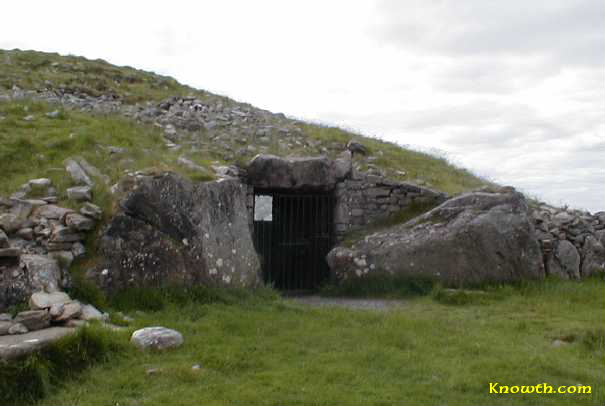 The facade at Cairn T, Carnbane East.
Cells 2 and 3 both show some repeated concerns that can help us appreciate the ways in which the tomb was experienced, the histories of its creation and its relationships with the cosmos. Both cells are heavily decorated, and it has been suggested that some motifs are deliberately placed in relation to sunlight. This is the case for Cell 2's central stone, C8, where particular motifs are illuminated by direct sunlight at the equinoxes (Brennan 1983; O'Brien 1992). It has been suggested that the reflected sunlight then illuminates the roofstone (Brennan 1983, 169). There are, however, inherent dangers in focusing on the particular images that are highlighted by the sun, as a result of the extensive OPW (Office of Public Works) restorations that altered the original shape of the entrance (McMann 1994, 537).
In terms of decoration, Shee Twohig (1996, 74) has noted that fine, coarse and medium point methods were employed in decorating C8. The particular images made with medium point continue under the supporting corbels, and suggest that the other fine and coarse images were made whilst C8 was in situ. Similarly, three grades of picking tool were used to create the panel on the roofstone in Cell 2 (Shee Twohig 1981, 217). This roofstone has imagery all over the underside face. As the motifs continue beyond the supporting corbels, it is likely that the stone was decorated before being placed into the passage tomb and in this respect it is similar to the right-hand recess roofstone in Newgrange Site 1, Co. Meath (see O'Kelly 1982, 181).
Furthermore, Shee Twohig (1981, 216) has commented that it would have been very difficult to decorate a stone so intensively whilst lying on ones back. Indeed, today the images are best seen when lying on one's back with one's feet facing towards the passage entrance. This feature has led Thomas (1992, 149) to comment that only those people who had access to the deeper areas of the passage tomb would be able to engage with these images. The motifs on the roofstone are varied and generally 'haphazardly' placed, especially near the centre (Shee Twohig 1981, 217, Fig. 238). As the images are basic abstract geometric, and as they do not conform to the modulations of the stone's surface, we can place this roofstone within step one of O'Sullivan's (1996) sequence.
Similar themes are played out in Cell 3. The underside of the cell lintel has a picked dot with six radiating lines, while the underside of the roof slab has an incised image consisting of parallel zigzags (Shee Twohig 1981, 217).
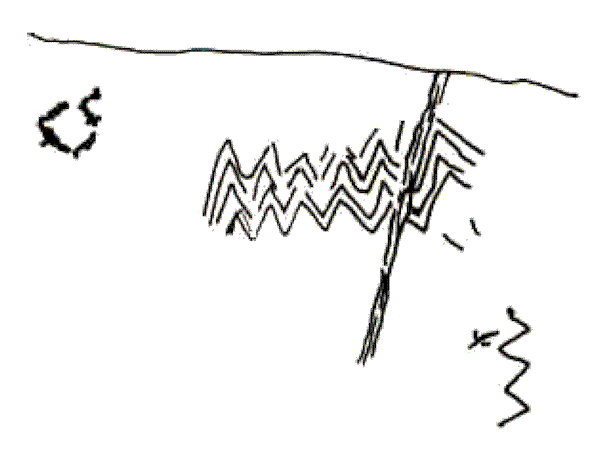 Underside of Roofstone Cell 3, Cairn T, Loughcrew, Co. Meath (Shee Twohig 1981, 238).
These angular incised motifs are thought to have occurred before the later picked motifs in the passage tomb (Jones 2004, 209). They therefore indicate episodes of superimposition. As several of the angles producing the zigzag do not meet, they can be considered as an entoptic 'fortification' illusion or teichopsia image (see Richards 1971; Niedermeyer 1990; Dronfield 1994). Its location on the underside of the roof slab, in an inaccessible position, might suggest that the image was produced before the stone was set in place. The notion that entoptic images were created onto/into stone before most other designs has previously been explored in detail on some of the Boyne Valley passage tombs (e.g. Cochrane 2001). That entoptic images were used might suggest a desire to incorporate otherworldly/alternative influences or interactions, and possibly performances influenced by psychoactive substances or individuals with pathological conditions.
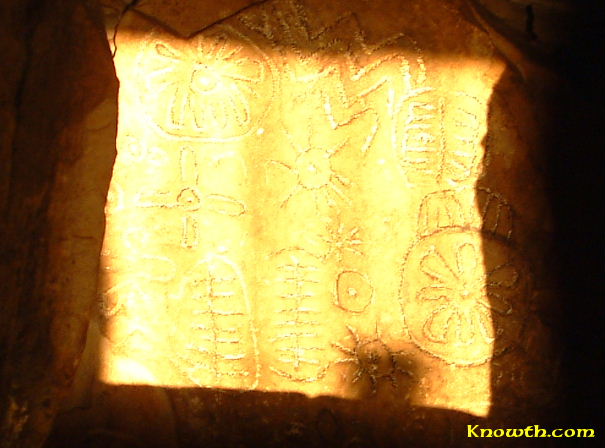 Photograph taken at 6:53am showing the shaped beam of equinox sunlight illuminating C8 (see also images in Brennan 1983, 100).
In the entire Cairn T passage tomb, radial images dominate, being present on 37% of all the carved surfaces. Shee Twohig (1996) has commented that Cairn T demonstrates a desire for coherence, with almost identically styled images appearing in juxtaposition to each other in the passageway, with the 4 main orthostats in the central chamber (C1, C5, C10 and C15) also having similar imagery. Such symmetry fits well with Foucault's (2002, 235) definitions of the roles that heterotopias may play. The juxtaposition of similar images creates a space of illusions that exposes and enhances the partitioning and ordering of movement within the passage tomb, whilst simultaneously reflecting and inverting the random, messy and jumbled aspects of life.
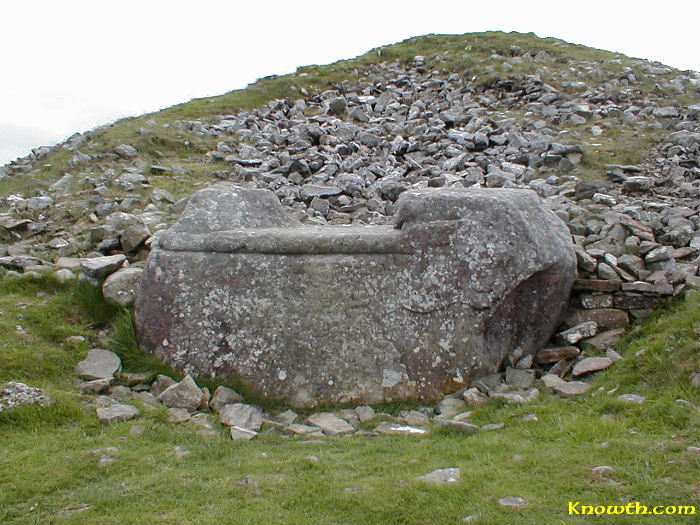 K29 also known as the 'Hag's Chair', Loughcrew, Co. Meath.
To the north of Cairn T and on the exterior is located K29 or the 'Hag's Chair'. This kerbstone has visual imagery on its front and back face. The top of the central part of this kerbstone is believed to be artificially cut to create the chair appearance (Shee Twohig 1981, 217; contra. Conwell 1866, 371), and the inlaid cross on the 'seat' surface may have been cut by surveyors engaged in the 'Trigonometrical Irish Survey' (Frazer 1893, 321; but see McMann 1993, 27). Conwell commented that many of the images on K29 were '…much defaced by the action of time and weather…' (1866, 372). The images that we see today, over a hundred years later, are unfortunately even more weathered, so that Shee Twohig (1981, Fig. 238) had to reproduce Du Noyer's water-colour sketch from Frazer's paper (1893, Fig. 45) in her corpus.
Six inverted boxed 'U' shapes and several double 'U' shapes and circles, one with central dot, however, still exist on the front face, and there are two roughly executed concentric circles on the back (Shee Twohig 1981, 217). Considering that K29 is the third largest kerbstone, decorated and such a prominent feature, it is surprising that it was not placed diametrically opposed to the entrance, as is seen at some of the Boyne Valley passage tombs (e.g. K52, Newgrange Site 1). That images are presented on the outside of the passage tomb does suggest that they were intended to be seen by spectators in 'public'. Such display may have allowed the passage tomb to operate within networks of opening and closing that both isolated and rendered it penetrable. Performances with these external images may have incorporated differing or mirroring gestures and permissions than the internal motifs.
Cairn L - focal passage tomb on Carnbane West.
Cairn L is the focal passage tomb on Carnbane West and is located on the north-eastern edge of the plateau. The passage tomb is orientated east-south-east, in the direction of Cairn M, with the entrance indicated by a curve inwards on the kerb circumference (Conwell 1866, 367; Figure 2.8). On the grounds of their size (c. 40.5m in diameter) and orientations some regard Cairns T and L as the two most important passage tombs in Loughcrew (e.g. Herity 1974, 53; Brennan 1983, 69).
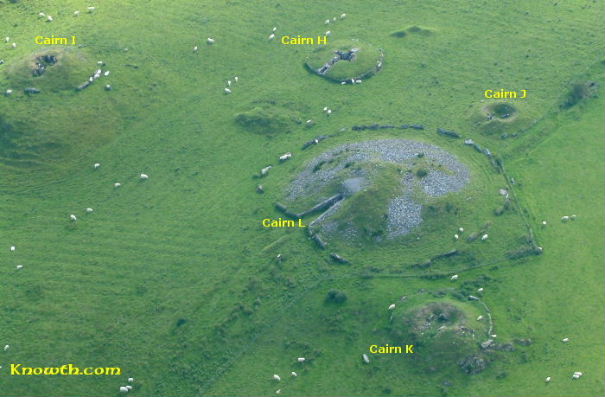 Cairn L is the focal passage tomb on Carnbane West.
As Conwell (1866) first observed, Cairn L is the only passage tomb at Loughcrew with the original corbelled roofing intact, although the central part has been replaced with modern concrete (Shee Twohig 1996, 75). The first 6m of the passage was also restored (Deane 1889-91, 164). The passage proceeds from the entrance into a large asymmetrical central chamber with eight adjoining cells (see plan below). The central chamber is marked by a large isolated limestone orthostat or monolith (Cooney 1996, 30), and this is suggested to be placed so that it is illuminated by the sun at certain times of the year (Brennan 1983, 110; although see above discussions on reconstructions).
This may have enhanced beliefs of permanence, dissolution and disappearance. The pillar may also have been associated with the ones north-west of Cairn D, Carnbane West, and may also have organised movements in and around the hilltop and the passage tomb itself (Shee Twohig 1996; McMann 1994). These movements may have been prescribed for certain festivals at different times of the year. Forty-three of the kerbstones currently survive and none contain visual imagery. The lack of imagery on the kerbstones may be the result of preservation, or it may have been deliberate.
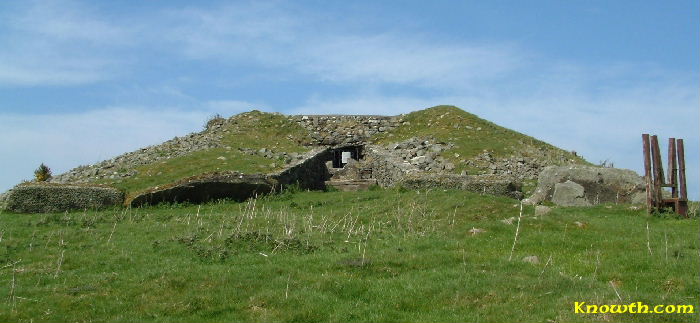 Cairn L - front view.
Cairn L - Front View
Six of the passage orthostats include imagery (R1, R3, R4, L1, L3 and L4). R4 is covered in deep cupmarks and although Frazer (1895, 64-71, cited in Shee Twohig 1981, 211) stated that they were caused by the burrowing of the sea urchin echinus lividus, McMann (1993, 34) has again suggested that these were created for or by the periodical insertion of stone or chalk balls. Other stones that have embellished natural hollows include C1 and C17.
Cells 2 and 6 both contain stone basins under which fragments of more than 900 charred bones, approximately 48 human teeth, 3 stone balls, 8 white balls and a polished oval object were found (Conwell 1866, 368; Herity 1974, 238). The fragmentation and disruption of human remains may have been a deliberate attempt to rupture notions of a given reality, creating new illusions and beliefs that ricochet between secure and destabilised knowledges (Bailey 2005, 183-7). The decorated orthostats surrounding the basin in Cell 2 (C3 west face, C4 and C5 east face) are mainly decorated with circular motifs (see plan below). This occurrence has led Shee Twohig (1996, 76) to draw comparisons between this left hand cell with a basin, and that of the left hand cell in Newgrange Site 1, Boyne Valley.
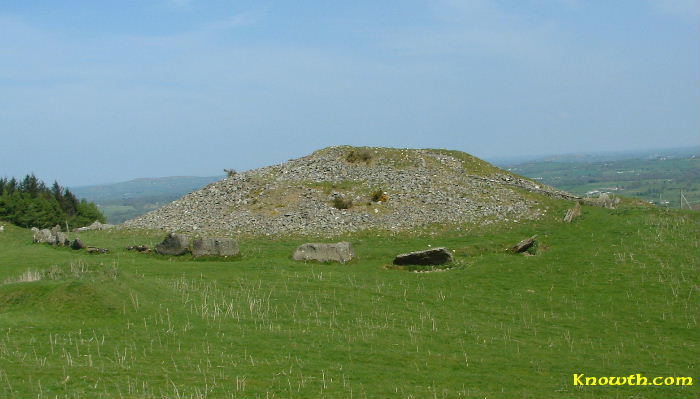 Side view of Cairn L, Loughcrew, Co. Meath.
Cell 6, located on the north and right hand side, is the largest cell in the structure and indeed Loughcrew. Its stone basin is almost 2m long (Conwell 1866, 368) and near the most 'extensively' decorated stone (C16) in Loughcrew (Herity 1974, 54; Shee Twohig 1996, 76). The motifs on this stone are closely grouped together and in some instances actually overlap, which is rare at this site (O'Sullivan 1993, 32), suggesting two chronological episodes. As the images on the lower portion are obscured by the stone basin, it is suggested that they were executed before the basin was set in place (Shee Twohig 1996, 76).