We Have Never Been Material.
Andrew Cochrane 2007 - Page 4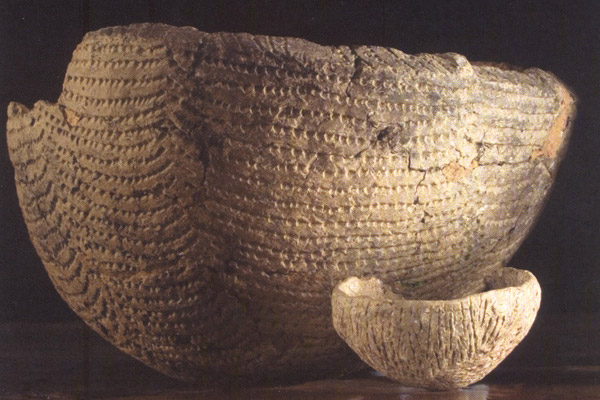
Carrowkeel pots from the pre-cairn cists at the Mound of the Hostages (O'Sullivan 2005).
SO HOW WERE THINGS? (Continued)
The occurrence, however, of complete Carrowkeel pots in the Mound of the Hostages and Knockroe passage tombs does suggest that they may have been originally deposited intact, with breakage occurring during later visits and interference, or as a result of burrowing animals, plant growth and weathering in denuded monuments (Herity 1974, 143; O'Kelly 1982, 105; O'Sullivan 1995, 26; 2005, 119, 237; see above image). The total lack of any pottery at Newgrange Site 1 might be a result of such disturbances or even robbing, although one would expect to find at least one fragment, if deliberate deposition had occurred (Herity 1974, 142; O'Kelly 1982, 122-3).At Newgrange Site 1, it might therefore have been deemed more appropriate to remove the pots after usage. Indeed, rather than just being 'burial goods', the pots may have played a role within activities performed inside and outside the passage tombs, such as containing food, drink, stimulating intoxicants, or other liquids (e.g. blood and semen), being deposited at the end of the performance (Herity 1974, 138; O'Sullivan 2005, 237). Droit regards prehistoric pots as mechanisms for protecting liquids, preventing the dispersal of a substance which is '… fanatically committed to leakage and loss…' (2005, 16). If these objects are to be considered as gifts that at some level can suspend liquid entropy, then intact Carrowkeel pots may have been viewed as appropriate offerings. Such intact deposits may have served as communication devices that helped bind relations between entities that were both present and absent.
The Carrowkeel pots are generally decorated on the whole outer surface of the vessel. The dominant decorative devices comprise either a series of looped rows of indentations, as is found on the examples from the Mound of the Hostages, or a chevron image arranged horizontally or vertically, often haphazardly, as is seen on pots from Fourknocks I and Loughcrew Cairn R2 (Herity 1974, 141). Interestingly, the chevron angular design is also found on the structural stones of Fourknocks I and on some of the pendants and on the shaft of the antler pin (Herity 1974, 141). That the pots were decorated may suggest that some people regarded them as being enmeshed within complex mixtures. For instance, the Huichol of Mexico decorate some of their bowls and regard the world of being constructed with essences that reside behind the appearances or skins of everyday 'reality'.
Through tutoring, engagement, performance and greater understandings of the worldview, some Huichol are able to 'see' through the layers of simulacra and into 'true' cosmos beyond (see Pollard 2001, 318). It is very possible that Carrowkeel pots operated in similar fashions at some level in passage tomb environments. Furthermore, the sensory effects of the shape, size, colours and textures of the Carrowkeel pots may also have linked the objects to other elements of the environment (see also Gosden 2005, 207; Ingold 2007). Within these interactions the decorated bowls do not merely act as passive representations of beliefs, but rather they actively instigate fuller entanglements with the world transgressing various boundaries.
Stone basins form an integral part of some passage tombs (e.g. Knowth Site 1, Newgrange Site 1, and Cairn L, Carnbane West), while being conspicuously absent from others (e.g. Fourknocks I, Sess Kilgreen and Knockroe). Interestingly, the greatest concentration of stone basins appears to occur in the Boyne Valley complex. Some sites have several examples, such as Knowth Site 1 with two basins in the eastern tomb and one in the western tomb, or Newgrange Site 1 which has four in its chambers, whereas Newgrange Z and Dowth northern tomb only have one each. The basins are mostly sub-oval in shape, although the restored Dowth one is sub-rectangular (O'Kelly and O'Kelly 1983, 152-3).
Some of these carved stone objects present decorated motifs (e.g. two large cupmarks on the upper of the two basins in Cell 3, Newgrange Site 1), with the basin in the chamber of the eastern passage tomb, Knowth Site 1 being possibly the most spectacular (Eogan 1986, 137, 147). The sides of this sandstone basin (1.2m in diameter) contain seven deep-cut horizontal lines which terminate at a central nest of three concentric circles, surrounded by two arcs, both enclosing a small circle, that face the entrance of the recess. The inside is decorated by a continuous line around the lip of the basin, with six nested arcs in the centre and radiating lines emanating from a central circle shape (Eogan 1986, 42, 147).
Lewis-Williams and Pearce (2005, 222-4) have recently suggested that the stone basins acted as metaphors for an axis mundi worldview perspective. They propose that the horizontal lines on the exterior of the basin represent tiers of the cosmos through which entities (e.g. the dead, shamans or specialists) travelled, with the nested arcs and radiating lines representing the possible vortices involved in puncturing through the various layers of the cosmos. The physical shape of the basin is argued to symbolically represent the kerb, the mound, entrances, passages, the chambers and the motifs inside and outside the passage tomb.
I agree that at some level the basins may have been seen by some as representing an axis mundi belief system, but I feel that the basins would have played a greater role than just passively epitomising symbolic systems. Instead the basins may have presented relational nodes between interpretations of realities, actively facilitating exposure to the fluid cosmos and inviting travel and framing interaction. The stimulating application of liquids such as blood, water, milk or semen may have magnified the fluid aspects of the basins (see Cochrane in press). As active entities the basins may have been influential in their own right, continually engaging and creating new relations, while reaffirming or disrupting old ones.
Next Page (5)
Previous Page (3)
Boyne Valley Private Day Tour
 Immerse yourself in the rich heritage and culture of the Boyne Valley with our full-day private tours.
Visit Newgrange World Heritage site, explore the Hill of Slane, where Saint Patrick famously lit the Paschal fire.
Discover the Hill of Tara, the ancient seat of power for the High Kings of Ireland.
Book Now
Immerse yourself in the rich heritage and culture of the Boyne Valley with our full-day private tours.
Visit Newgrange World Heritage site, explore the Hill of Slane, where Saint Patrick famously lit the Paschal fire.
Discover the Hill of Tara, the ancient seat of power for the High Kings of Ireland.
Book Now
Home
| Newgrange
| Knowth
| Dowth
| Hill of Tara
| Fourknocks
| Loughcrew
| More Places
| Labyrinths
| Local Info
| Art Works
| Articles
| Images
| Books
| Links
| Boyne Valley Tours
| Contact