We Have Never Been Material.
Andrew Cochrane 2007 - Page 3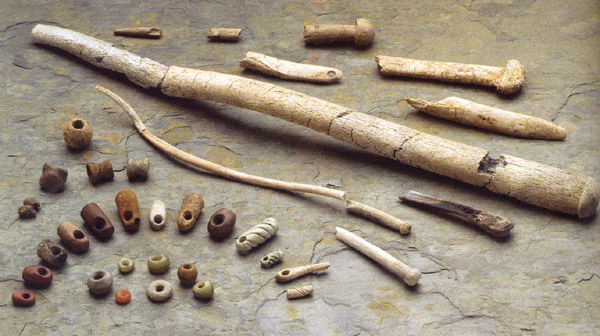
Figure 3. Miniature axeheads, beads and portions of pins (O'Sullivan 2005).
SO HOW WERE THINGS? (Continued)
Some of the pendants and beads discovered, such as from Fourknocks I, the Mound of the Hostages (see image above) and some of the Boyne Valley and Loughcrew sites, have been interpreted as miniature facsimiles of larger stone technologies, such as pestlehammers or axeheads (Herity 1974, 126-9; Eogan 1986, 142-4). If indeed they were copies or imitations, many interesting proposals can be explored. For instance, that miniature axeheads or maceheads (such as at the eastern tomb, Knockroe) and miniature pendants (such as at Fourknocks I) were used might suggest that they actively influenced particular people in novel ways, rather than merely being the passive ornaments of deceased 'individuals'.As such, the miniaturisation of objects might be less about accuracy through representation and more about experimentation with the physical world and possibly a critique or interpretation of it (Bailey 2005, 29). Miniaturisation can act as impressive visual strategies that can charge material objects with psychological tensions, generating intense sensory and emotional experiences for the maker and handler. This can result in the handler or spectator feeling both empowered and interested, but also unsettled or alienated, creating a dramatic form of social experience (Nakamura 2005, 32; Waddington 2007). Gell (1999b) remarked on some of these effects when he recounted being entranced by a matchstick model of Salisbury Cathedral. He recalled being captivated more by the model than the cathedral itself; it was for him dexterity in objectified form, operating by bringing both the technologies of enchantment and the enchantment of technologies together. With miniaturisation only certain traits of the full size are ever present, rendering the smaller version a compressed and powerful version of the larger one.
These interactions operate within an intimate sphere and offer different ways of seeing the world(s), creating alternative realities (Bailey 2005, 32). The object has to be picked up, held in the hand, turned around, felt, smelt and tasted, with the many of the textures and details absorbed. Such an encounter immediately distinguishes itself from performances with the passage tomb orthostats, in that once they were set within the structure it is unlikely that they were moved again. These engagements can result in the handler feeling empowered as they easily manipulate the object, but at the same time unsettled, as they may feel gigantic in relation to the object and dislocated from normal frames of reference (Tilley 2004, 137; Bailey 2005, 33; Nakamura 2005, 33). The spectator or handler is invited to tacitly engage with the object through size, yet at the same time distanced by it through the absence of other features (Bailey 2005, 32).
Within such a conceptual framework, the stone balls discovered (e.g. in Cairn L, Loughcrew, the Mound of the Hostages, Fourknocks I and Newgrange Site 1) may have been more than 'children's marbles' (Herity 1974, 136), being understood instead through habits of tactile appropriation in order to further interact with the 'aura' of the object (Benjamin 1977, 225, 242). Their form as durable, portable, possibly miniature, three-dimensional objects creates choreographies of relation (Nakamura 2005, 32). The decorated pins, such as the chevron patterned antler pin from Fourknocks I may have stimulated people in similar ways, and therefore have been more than functional fasteners for 'hair-buns' on the back of the head or for 'ceremonial cloaks' (Herity 1974, 134; Eogan 1986, 181).
Intimate relations with objects may also have resulted from entanglements with the stone shaped 'phalluses' from Knowth Site 1 and at Newgrange Site 1 (O'Kelly 1973, 140-1). That these devices were discovered outside the passage tombs, on quartz oval settings, may suggest that public performances were enacted via simulated or physically penetrating acts that were framed within a particular worldview. The double stone balls found in Newgrange Site 1 (O'Kelly 1982, 195) and the Mound of the Hostages (O'Sullivan 2005, 154) might also support the notion that fertility, renewal or sexual practices occurred within and outside some passage tombs (see also Herity 1974, 134; Eogan 1986, 179). The penetration of the sun's rays at particular times of the year through the entrances, and into the chambers beyond, of some of the passage tombs (e.g. Newgrange Site 1 and Cairn T, Loughcrew) may have magnified these beliefs (Sheridan 1985/6, 28).
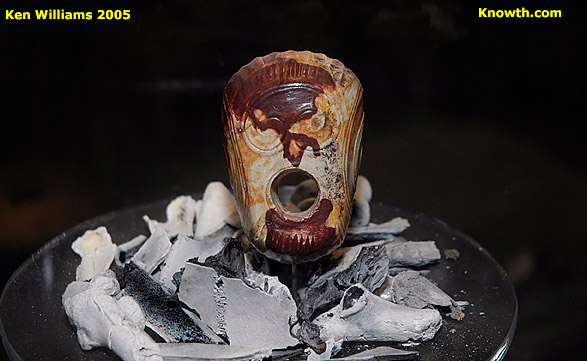
Replica of the decorated flint macehead (7.9 cm in length; 324.5 gm weight) found at
the entrance to the right-hand recess of the eastern passage tomb, Knowth Site 1
Associated with cremated human remains and discovered on the old ground surface at the entrance to Cell 3 (the right-hand recess) of the eastern passage tomb, Knowth Site 1, directly in front of the stone basin was discovered a highly decorated ovoid macehead made of flint (7.9cm long) (Eogan 1986, 42-3, 146). The macehead is decorated with spirals, lozenges and arcs. On each side of the macehead there is a single spiral; on one face there is an arc that in-turns at its ends, similar to the 'horned arc' or 'pelta designs' and around the hole for the handle are sets of lines, one of which trails off to form a spiral on the side (see photo above). The ends of the macehead have close fitting lozenge motifs that are carved in relief. The macehead would originally have been mounted on a shaft. The combination of the 'horned arc' image and the hole for the handle has been interpreted as being 'overtly anthropomorphic' (O'Sullivan 1993a, 40).
Anthropomorphic beings are often regarded by some 'shamanic' groups as occupying the upper realms of the three-tiered cosmos. The decorated macehead may have therefore been placed to assist in journeys from within the passage tomb to the heavens. The intrusion of a handle into the macehead would, however, diminish the impact of a facial representation. One could alternatively describe the motif as symbolising a mushroom, such as the hallucinogenic Psilocybe semilanceata (Liberty Cap) or Amanita muscaria (Fly Agaric), with the 'horned arc' forming the cap and gills, and the macehead handle the stem. Psychoactive mushrooms would certainly assist people in conducting journeys to other realms (see discussions in Cochrane 2001, especially chapter 3). Without applying a representational interpretation, one can propose that cosmological emphasis possibly resided more with the colour, sensual and sculptural elements of the stone.
Although occurrence of decorated maceheads is rare in Irish passage tombs, undecorated ones have been discovered, such as in the western tomb, Knowth site 1. Stone axeheads are also not found in all passage tombs, but do occur in some, such as between the entrance stones of Sess Kilgreen, Co. Tyrone and in the fill and foundation levels of the Mound of the Hostages (Coffey 1912, 108; O'Sullivan 2005, 158-9). As these artefacts do not feature largely in passage tombs, one might argue that the deposition or presence of stone axeheads and maceheads was deemed more appropriate in bogs, shallow waters such as lakes or ponds and rivers at fording points (Cooney 2000, 208). These objects may have been understood as being animate with biographies and origin myths, gifts in their own right from the earth or sky (i.e. ones that originated in mountain locations), within a cyclical character of life and death (Whittle 1995, 255-6; Cooney 1992, 24; 2000a, 210; A. Watson 2004, 83).
The placement in liquid deposits may therefore indicate how the objects were considered as fluid rather than static elements. The idea that stone is fluid also permeates some modern Western thought. For instance, in articulating the relationships between various components in an environment the artist Giuseppe Penone proposed that all mountains crumble and eventually transform into sand, and that it is just a matter of time (Kaye 2000, 148). Everything is always in a process of becoming. The paucity of 'traditional' scale stone macehead and axehead presence in passage tombs might therefore suggest that it was deemed by some as less appropriate to remove them from daily circulation by placing them within the structures.
It is possible that the material objects placed in passage tombs were oblations, gifts or exchanges that were set within practices of regeneration and fertility. Previous interpretations of the broken Carrowkeel pots in passage tombs have suggested that their destruction occurred as a result of intentional burial 'rituals' (e.g. Eogan 1986, 140). Fowler (2004, 73) has suggested that the breaking of an object such as a pot or necklace is performed and then given as an incomplete gift for the dead as reciprocation is not required, with parts of the fragmented offering being kept with the living to provide further stimuli for memories (Jones 2002, 169). The act of removing these objects from daily life and the subsequent placement of them in passage tombs may have incorporated acts of transformation that affected both present and the absent persons (see also Fowler 2004, 135).
Beck (1999) has illustrated that any social activity continually involves a degree of essential risk; the 'killing' of these objects by the placement of them in passage tombs may therefore have involved risk and concerns with pollution and closure. For instance, in the nineteenth century some African Americans in the southern United States frequently placed broken pots on top of graves to prevent the dead from rising, and coming back (Parker Pearson 1999, 10, 26). Such processes may operate by the dead or other entities having their attention drawn by the fragmented ceramic and human pieces, being enchanted and tantalised by the multitude of parts, resulting in them being rendered impotent (see Gell 1998, 90). Effectively the separate parts produce a 'network of stoppages' (Duchamp 1973). The fragmented elements of the passage tomb motifs could also perform in a similar fashion. These disjointed parts may have provided a cognitive indecipherability, in that they confuse the spectator who is unable to distinguish at once parts and wholes within (dis)continuity, synchrony and succession.
Next Page (4)
Previous Page (2)
Boyne Valley Private Day Tour
 Immerse yourself in the rich heritage and culture of the Boyne Valley with our full-day private tours.
Visit Newgrange World Heritage site, explore the Hill of Slane, where Saint Patrick famously lit the Paschal fire.
Discover the Hill of Tara, the ancient seat of power for the High Kings of Ireland.
Book Now
Immerse yourself in the rich heritage and culture of the Boyne Valley with our full-day private tours.
Visit Newgrange World Heritage site, explore the Hill of Slane, where Saint Patrick famously lit the Paschal fire.
Discover the Hill of Tara, the ancient seat of power for the High Kings of Ireland.
Book Now
Home
| Newgrange
| Knowth
| Dowth
| Hill of Tara
| Fourknocks
| Loughcrew
| More Places
| Labyrinths
| Local Info
| Art Works
| Articles
| Images
| Books
| Links
| Boyne Valley Tours
| Contact