Five specific criticisms of limited access models
1. Material culture and human remains.2. The assumed primacy of the interior of monuments.
3. The communal construction process.
4. Megalithic Art.
5. The simultaneous nature of the 'act' of access.
1) Access limits & material culture
The idea of an elite who could keep the majority of people away from certain parts of monuments, or even out of them altogether, goes right to the heart of understanding the Neolithic. Yet the existence of elites who controlled access and exercised other forms of higher power is not clearly supported by material patterns. Little account is made of the relative absence of other evidence that would support an unequal division of powers within Neolithic communities. On the whole, the fragmented picture from Neolithic monuments suggests equally that there were no major divisions of wealth or of elite power (materially manifested). There is little clear evidence for any class-like structure to society, and there is very little secure evidence for stating that the majority of people were kept away from tombs.Archaeologists are rightfully careful in assuming that the material record reflects real social conditions, acknowledging that the 'distortion' of social relations may have in fact been reflected (O'Shea 1981; Tainter 1978). However, the overt absence of any form of material aggrandizement in communities that harnessed such vast resources, raises the prospect of explanation based on some form of a sharing motif. There is comparatively little evidence of personal dwellings, virtually none in stone, and what there is suggests no real distinctions. We might assume that the concentration of power, in particular to marshal such sustained labor, would be reflected in material differences, this is not the case.
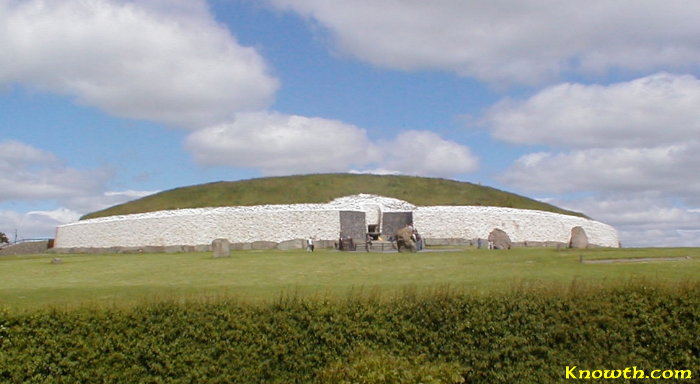
Nonetheless, monuments are often marked out for special material deposits. The finest artifacts are recurrently discovered in henge ditches, or exquisite mace-heads in passage graves. Human remains deposited at megaliths, for example, are often cremated and accompanied by antler pins and other ornaments (O'Kelly 1982). These are regularly of a quantity and quality that are open to many different interpretations. The ambiguous nature of the burial 'pattern' for most monuments is also very difficult to interpret. It is true, though, that in many cases the entirety of the community was not buried within their monuments. This is witnessed in the main passage grave of Knowth, which, while open perhaps for 500 years, contains only approximately 20 separate burials, some of which are only represented by fragments (Eogan 1986:177). At Newgrange the remains of only four individuals were recovered, but as O'Kelly notes, this may be only a fraction of the original number since the tomb has been opened since 1699 (1989:105). However, an expectation that each person would have been buried within a 'family' or communal tomb may also be a modern assumption.
Whether the minimal burial numbers can be linked to a non-egalitarian structure, or indeed to a limitation of access, is problematical. This is not the case at the exquisite Fourknocks passage grave in Co. Meath. There, some 65 individuals were placed within the tomb's recesses and passage (Bergh 1995:144; Grogan 1989). The chambered tomb at Insister contained some 341 individuals (Hedges 1982), and at many Irish megaliths; such as Loughcrew and Carrowkeel (Bergh 1995) there are layers of cremation deposits (Eogan 1986:135; Cooney and Grogan 1994:73-4). Stonehenge contains the remains of 100s of cremations (Cleal et al 1995), and the chambered tomb of West Kennett also held a large number of remains (Whittle and Thomas 1986). In many cases it is difficult to take MNI counts from such evidence, however many tombs speak more of an inclusive burial rite than an exclusive one. We might ask, therefore, whether the interiors of monuments have always been of such importance as to be the fulcrum for social divisions.
2) The importance of the interior of monuments
Archaeologists assume that the interiors of monuments were the most important foci and therefore the area to 'constrain movement into'. This applies to monuments with passages and recesses such as chambered tombs, but also to more open monuments such as enclosures. These supposed constraints are particularly acute with regard to causewayed enclosures, whose multiple 'entrances', rather than offering multiple access from many directions, instead become symbols of exclusion, a way to "physically inscribe the distinction between those who had access and those 'excluded' outsiders" (Harding 1998:288).However, the idea that the middle of the enclosures, or the recesses of the chambered tombs, were necessarily the 'center' may be a reflection more of our thinking today than of a past reality. While there are certain depositions, which mark off these areas as, at least, special, it is possible that they have been overemphasized. Knights encapsulates a modernist view of space when he states that if we cannot move into a space "we are inclined to conclude that it is not spatial; in the restricted, architectural sense of the term, space is a void that we move around in freely" (1994:123).
Chambered monuments, with covering mounds, are particularly espoused as examples of limiting the flow of people into the interior of monuments. Their various stalled compartments and recesses have come to stand for divisions, and their coves and sill-stones are seen as marking difference and exuding exclusion. However, as Colin Richards has cogently demonstrated, the tripartite/stalled cairns, of the Orkney Islands can still offer visual access to the interior. As Richards puts it, the "whole tomb is constructed from an external point of view, allowing an external audience visual access to the interior of the tomb and the actions which occur within (1991:52).
It is also noteworthy that in many cases where monuments possess internal spaces, such as passage graves, there is an element to the rituals that involves something going into the monument from outside. The passage grave of Knowth contains two passages into the chamber, which Eogan speculates may have been intended to allow for different celestial significances at different times of the season (1986). In the case of Newgrange this is the mid-Winter sun entering into the three recesses by way of the 'roof-box'. Ancient Irish literature speaks of legendary heroes bringing bodies to the 'Brugh' so that the sun might breathe life back into the dead (O'Kelly 1982:43; Herity 1974). This phenomena is quite widespread, at Stonehenge the shadow of the sun penetrates the inner circle, and at Calanais both the sun and moon are interpreted as 'entering' into the inner spaces of the settings (Ruggles 1999).
Was the center always the main area of concentration and of exclusion? If the power of a ceremony or ritual involved the element of surprise, hushed expectation, and awe at the very control of such major forces as the sun, moon or stars, then it might make sense for the intended audience to be within the internal settings at the time of the 'event'. Thus the role is reversed, and those who 'control' these forces might remain outside, and the audience remain inside. However, one could further argue that elite groups were chosen to be inside, with a ritual priest or priestess outside. This, in turn, leads to a consideration of the number of people involved in the construction and maintenance of monuments.
3) The number of people involved.
Many generations may have been involved in scouting out the sources of the various materials used in the construction of various monuments. Similar numbers must surely have been 'employed' in their transportation and erection. Some monuments possess stones from beyond the immediate reaches of the builders. At Newgrange some of the stone used was taken from a distance of 50 kilometers away, and at Stonehenge some sources of stone lay over 150 kilometers away (Chippendale 1979; Cleal at al 1995).The act of traveling long distances to collect construction materials may have served to set in stone long-distance relations with the communities and regions that the stones passed through (Parker-Pearson n.d.). In the majority of cases where local stone was used this process still drew upon the participation of at least the local community, and possibly several outlying groups working together over decades. This points to an inclusiveness and availability, an advertising of the monuments to a broader community, they are about monumentality and making memory (Holtorf 1997). To then limit access to these monuments seems in contrast to the entire project of their construction, and to the co-operation and organization of the population that it appears to represent.
A challenging issue for archaeologists' readings of monuments is that of the general population structure of Neolithic communities. This is further complicated by a paucity of evidence regarding the relationship between settlements and monuments (Darvill and Thomas 1996). However, while population estimates for Neolithic communities are difficult, it is usually agreed that they were somewhat low. Estimates for the population of the Boyne Valley in Ireland range from 1500-5000, with 3000 being a popular figure ((Herity 1974; O'Kelly 1981, 1989; Eogan 1986 ). Hedges discusses the chambered tomb at South Ronaldsy, Orkney. He concludes from a burial figure of 341 individuals that average life spans were 19 years 11 months at birth (1982:11), whereas those who survive into teenage years could expect to live for around 29-30 years.
What rules governed the deposition of remains over the length of the monument's operation are hard to ascertain, and it is possible that at certain times there were different age, gender, or some other 'class' limits on deposition. Despite criticisms (see Fraser 1982) Hedges' data raises very important questions about access to monuments and the 'control' of knowledge. In particular, he notes that "shorter life-expectancy poses problems for the passing on of specialist knowledge, while it makes the idea of its possession in the hands of an elite rather doubtful" (ibid:19). Perhaps before limited access and the associated control of knowledge are accepted in Neolithic interpretations, we should examine more carefully the practical implications of population size and structure, as well as life expectancy.
4) Limited Access and the Evidence of Megalithic Art
Megalithic and Neolithic 'art' has been interpreted as a sign system (O'Sullivan 1998). Bradley suggests that the carvings on some 'outlying' rocks may have provided directions to some of the monuments (1997a:120). Also, symbols of the Boyne tombs are found on mobiliary artifacts and on pottery in Ireland, Scotland (Bradley 1989), and Iberia (Herity and Eogan 1977:77). The overall impression of megalithic art often appears to imply an advertising of the monument, an accessible and viewable sign-system of the utmost importance to the community.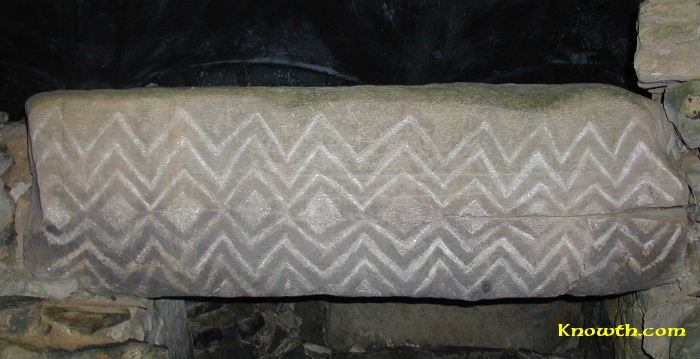
What was the relationship of the craftsmen and artists who worked and labored at monuments to the people, times, or events that played out inside them? Were they one and the same person as these 'leaders'? If they were not, then how could the artist and the stonemason be denied the knowledge of the actions within the inner recesses, when they themselves were responsible for its execution? Were they sacrificed? Unlikely. Were they from a separate community? Possibly. Were they thereafter forbidden to enter the recesses and forever confined to the exterior? Such a scenario, on the present evidence we possess for the Neolithic, seems improbable.
The placement of megalithic art on tombs is of considerable importance in analyzing access. Differences exist between internal and external placement, and high and low placement. Bradley believes that the preponderance of angular art within the interior of the Boyne passage-graves of Newgrange and Knowth represent the private, inaccessible sphere and the preponderance (though not exclusivity in either case) of curvilinear art represents a public sphere (1997:108). There is a differential placement of art styles in the Knowth passage grave, there is a higher placement of the angular art and lower placement of the rectilinear art. Eogan sees the angular art as a "system of communication between the tomb's exterior and interior", and the rectilinear art as "a vehicle for two-way communication which could have benefited the living" (1986:184; cf. Lynch 1973 ). Neither accords with limits on access to the tombs themselves. Nor does the fact that "the creative process is an inclusive one which by its very nature implies dialogue, the symbolism is created by one individual to be read by others" (Davison, pers. comm. 2001). Megalithic art, and the visual appearance of the stones is an important element in the accessibility of monuments (O'Sullivan 1998).
5) Simultaneous Access
Accessibility to monumental sites, and to the ceremonies and rituals that are supposed to be constantly occurring within them, normally implies a contemporaneous admission and simultaneity of action at the moments of deposition or celebration. This is connected to the argument that few people could physically witness these acts at one time. Archaeologists tend to believe that a simultaneous 'broadcast' is required for there to be a shared and equal participation. This is not necessarily the case and we may dispute the 'limited' view with reference to a modern example: tourism at the 5000-year-old passage grave of Newgrange, Co. Meath, Ireland.Analyses of the numbers entering into the chamber suggest that a tour of 14 people who enter the tomb for roughly twenty minutes during a ten-hour 'day' would enable 420 people to view the inner chamber per day. Estimates of the Boyne Valley population – as we saw -leads us to a figure somewhere between 1200-5000 What proportion among this number might be able, physically (if we 'exclude' the aged and the very young), to enter the monument might be somewhere in the region of 750-2500 people. Therefore, in one day, or perhaps two, all of those wishing to enter the tomb could have done so. Such numbers, and reasoning, of prehistoric intentions, time, and population, can naturally be disputed; they remain estimates. Further, the assumption is that the entire population was 'on hand' during any one period. However, the outline of a feasible model for inclusive access emerges, and the result is a plausible picture of community-wide access. One could also envision the idea of prehistoric mass pilgrimages to Newgrange, as the notion of paying one's last respects is a common anthropological phenomenon that often includes whole communities.
Conclusion
Boyne Valley Private Day Tour
 Immerse yourself in the rich heritage and culture of the Boyne Valley with our full-day private tours.
Visit Newgrange World Heritage site, explore the Hill of Slane, where Saint Patrick famously lit the Paschal fire.
Discover the Hill of Tara, the ancient seat of power for the High Kings of Ireland.
Book Now
Immerse yourself in the rich heritage and culture of the Boyne Valley with our full-day private tours.
Visit Newgrange World Heritage site, explore the Hill of Slane, where Saint Patrick famously lit the Paschal fire.
Discover the Hill of Tara, the ancient seat of power for the High Kings of Ireland.
Book Now
Home
| Newgrange
| Knowth
| Dowth
| Hill of Tara
| Fourknocks
| Loughcrew
| More Places
| Labyrinths
| Local Info
| Art Works
| Articles
| Images
| Books
| Links
| Boyne Valley Tours
| Contact