Monuments & Access
The interpretation of Neolithic Monuments by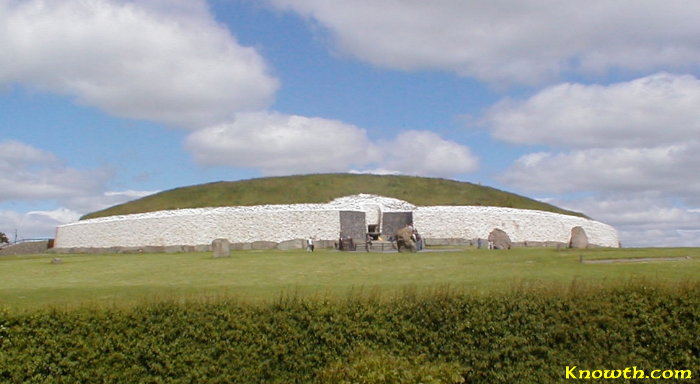
Monuments are one of the defining features of the Neolithic of Western Europe. Tens of thousands of megaliths, henges, stone circles, menhirs, court cairns, passage graves, and other types, remain a rich source of information for archaeologists studying the Neolithic. Their scale and duration are unparalleled; nothing like them existed in the Mesolithic. For over two thousand years these collective architectural projects were the leitmotiv of the Neolithic itself.
However, as this paper will demonstrate, archaeologists have painted a strict vision of controlled access to many of these monuments. Some argue that it is “likely that many Neolithic actors may never have entered a monument” (Kirk 1993:190). Shanks and Tilley see monuments that ‘speak of division’ (1992:201). Thomas suggests that the most potent form of power in the Neolithic was drawn from the idea of separation itself (1998). Thus in the course of their analysis monuments are commonly interpreted as either being entirely inaccessible or containing areas that were either off-limits to others, or invoked a separation of movement through certain defined areas. Such areas are usually the entrances to henges and causewayed-enclosures, and, in particular, the recesses in passage-graves and other chambered tombs. These are described as marking off access for specific purposes, or for specific sets of people.
The Importance of Access
Why the issue of access is so important lies in its influence upon the many segmentary interpretations of Neolithic communities (as deduced through monumental sites). Monuments, such as Avebury, have “done much to create our image of what constitutes the British Neolithic” (Thomas 1990:162). Therefore when archaeologists discuss control mechanisms based on movement restrictions (Thomas 1991:31), they enact a specific social view of the Neolithic. Further, as physical access relates to bodily movement of human beings through space it is directly implicated in the interpretation of the world and the formation of subjectivity. This is of fundamental importance to the social and political images we create of Neolithic people. The 165,000 tons of work that went into Avebury is rarely seen to speak of communality and co-operation. Likewise Newgrange, part of a massive monumental passage-grave complex, is frequently characterized in terms of isolation and closure. Recent phenomenological accounts of ‘embodied’ Neolithic landscapes have contributed significantly to an understanding of monuments (Thomas 1993; Fraser 1998; Bender 1998), yet the subjects that they create are often deprived of their agency. For example, Thomas claims that a recognition of the culturally constructed nature of space will enable archaeologists to “investigate the architecture of Irish megalithic tombs, not necessarily to evoke the same specific meanings which their internal spaces held […] so much as to consider their role in constraining movement and staging or framing particular ritual practices” (1990:170). Despite the progress of realizing the constructed nature of space and its importance, the language of division is evident in the presupposed “constraining” nature of monuments. This is an (common) evocation of a specific meaning, one based on assumption.The Limited Access argument
The over-emphasis on spatial exclusivity at Neolithic monuments, and the suggestion of a dominant power base to control admittance to these spaces has created the perception of an elite group. Some interpretations explicitly espouse the presence of a priestly class who are envisioned as administering in some manner from within the limited areas, to those who gathered outside (Makie 1977). This ‘power’ directed the flow of human bodies at monuments, barred the majority from entering and banished others to the sidelines. In some cases the existence of these elites is reasoned from the need to oversee construction of monuments - i.e. an elite deduced from assumed social conditions - and then read into the material record. In other cases elites emerge from the conditions of use - i.e. an elite assumed from the material record - and then their social role deduced from that.The form of monuments, it is argued, was used to restrict potentially dangerous rival ideas, ideas that were contained in a system of conceptual and physical boundaries (Edmonds 1993:124). Moreover, the spatial divisions evident at some monuments are seen to reflect wider divisions within society. These arguments suggest that restrictive access was used to validate knowledge’s and authorities, which were articulated, at least partially, through the denial of access to others. This may be part of a wider concern to situate “aggrandizers” in societies with perceived resource surpluses (Schiffer 2000:7).
The relationship of monuments to social structures may be seen in the example of Silbury Hill where, Whittle states, “If there was social differentiation, it is as likely to have emerged from the conditions of construction and subsequent use, as to have preceded the decision to build” (1996:276). This link between form, access and power is common. Barrett claims that the increased social differentiation between the Neolithic and the Mesolithic was itself formed out of practices of restriction and exclusion at some monuments. These practices “required increasingly elaborate architectural settings to render them effective” (1990:183). There is little doubt about the effectiveness of the settings, it is how certain people were kept away that is of particular interest here.
Bradley’s interpretation of the French passage grave of Le Petit Mont (Arzon, France) raises several interesting issues. Chief amongst these is the suggestion that such “buildings provided a focus for later mortuary rites, but only those structures which allowed access to the ancestral remains expressed a clear continuity between the past and the present” (Bradley 1998:63). This is a prime example of not only access limitations but also of a link between access and continuity, to which we will return. In another example, Thomas claims that the blocking of tombs “interrupted any flow of reciprocity between the living and the dead”, separating the past from the present (1999:151). He sees the dead as increasingly located in an ‘unassailable’ past (ibid:150), one in which Barrett opines the remote ancestors became ‘giants’ (pers. comm. 1998). Whittle points out that the wider landscape may have offered a tougher prospect for spatial coercion (1996), but in the ‘arenas of value’ that many monuments have come to represent, this coercion is rampant. The greater part of all analyses of monuments support some form of exclusion and division, resulting in the perception that as the Neolithic wore on, monuments became increasingly employed in enacting social barriers.
But how was this actual limitation and barring of access achieved? What have archaeologists attributed this authority to? There are understandable limitations in answering this question. Often, reference is made to social conventions as the source for limiting access (Bradley 1997:12; Makie 1977; Thomas 1997). Harding states that many of the Neolithic henges of North Yorkshire represent “an ‘authoritative’ form of such social constraint” (1997:288). But this sidesteps the issue of physically disbarring people from tombs and monuments. Yet quite often no other form of explanation is offered. The Neolithic is not seen as representing a dynastic culture similar in some regard to the Maya (Adams 1991). There is little or no evidence of human sacrifice at Neolithic monuments, nor of prisoners or of corvee labor with which to explain the construction of Neolithic monuments. Therefore, it is social conventions and religious observances that usually serve as primary explanations offered for the power to disbar and the ‘absence’ of the power in the general populace to enter freely into monuments.
Some initial criticisms
The claim that only those structures that facilitated access to the ancestral remains expressed a clear continuity between the past and the present casts the issue of access in the role of defining what is significant and what constitutes continuity. Bradley’s suggestion, mentioned above, that monuments, which do not allow access to the dead do not signal continuity, deserves further consideration. Specifically, the questions raised are: what constitutes continuity, and what exactly constitutes access itself. The sequence at the aforementioned Le Petit Mont passage grave suggests a period of around 1000 years of activity (Bradley 1998:58; Lecornec 1994). The original passage grave was first constructed ca. 4500 BC, with access available for approximately 500 years. Around 4000 BC a massive pentagonal cairn enclosed the original structure and a sequence of 5 revetment walls was constructed. The volume of work and the collective nature of it testify to sustained communal activity.Does this monument lose its significance because the dead are no longer being placed inside the original chamber? Would this not imply also that Stonehenge no longer signaled continuity because the Aubrey Holes no longer received cremations (Chippendale 1979; Cleal et al 1995)? What of monuments with no burials such as the empty chambers in many of the Michelsberg monuments (Midgley 1992:446)? There are also monuments with one or two burials, for instance Woodhenge, where the only burial was that of a child (Bender 1993:251). Archaeological thinking seems to imply that unless access was possible to the inner, original deposits, then there was no continuity signaled. Such accounts are perhaps placing the inner, inaccessible remains in the same bracket as hoards, which became things remembered by their absence (Bradley 1987). Yet, in a way things that are remembered in their absence do have an inherent continuity.
The ongoing visibility of the passage grave of Le Petit Mont, and the continued alterations and additions by means of which, over the long history of activity, “each successive structure seems to have respected the remains of its predecessor” (Bradley 1998:58), signal a strong, visible continuity. Indeed, the ‘afterlife’ of monuments has been recognised more and more by archaeologists (Holtorf 1998). Yet, many archaeologists have needlessly limited this continuity by focusing unduly upon access as a barometer for longevity. The ability of a community to acknowledge or respect earlier phases of activity at monuments, and to plan for future projects and actions, suggests that it was the monument itself that was the prime focus of activity, rather than access to the normally sparse remains present there. The continuance of activity at these monuments and their significance does not rely, I would suggest, upon either the placement of burials within them or the ability to walk or crawl into their particular recesses. This is clearly witnessed in the fact that at the Severn-Cotswold chambered tomb of Hazleton. Here, a structural collapse had closed off access through the northern passage, but deposition continued in the passage itself (Saville 1990; Whittle 1996:259; cf. Saville 1987).
A further example of limitations on access is taken from monuments which are not necessarily restrictive in themselves but have a sharp bend or curve in their approach ‘path’. These are often interpreted as constructed so as to orient the movement of people as they approach the monuments in question. Similar examples have been interpreted as expressions of the blocking of direct access, such as visual access to Stonehenge from the cursus (Bender 1993) or posts set near the entrances to wooden monuments such as Woodhenge or Ballynahatty (Hartwell 1998). Another example is seen in the way that the monoliths at the end of the Kennett Avenue ‘turn’ those heading for the monument entrance away. But this marks an impressive orientation of view (Burl 1979:198), and was probably built long after the main monument (ibid:190).
It appears that the elaboration of approach routes to monuments has also resulted in images of exclusion rather than of dramatization and celebration. Even though the height of the Avebury ditches would block a great deal of the view, either inside or outside, it has been estimated that Avebury could ‘accommodate’ tens of thousands of people within its banks (Burl 1979:178). Avebury’s two largest stones, located just inside the southern entrance, are also supposed to block access visually. In the words of Gibson they “preserve the mystery until its ultimate but inevitable revelation” (1998:90). Yet this is a monument that expresses the communal like few others, and contains Britain’s three largest stone circles (Wason 1998). Further, the ditches are of such a magnitude that unless generations of corvee labour or slavery were involved (neither of which any archaeologist working on the monument lends any credence to) then they are, ultimately, communal monuments. To insist that the positioning of two monoliths and a 100 meter ‘wobble’ could preserve a mysterious interior, or actions within such massive monuments, is quite difficult to sustain.
It might be argued that ‘Wobbles’ in the entrances to places of liminality and reverence may have blocked things other than people entering, or leaving. Whittle discusses the possibility that the passages may have permitted spirits to come and go (1996:248, 256). And as David argues with regard to similar entrance ‘wobbles’ in the temples on Java:
The temples of the gods have a screen-wall immediately inside the entrance, blocking both the view and a straight path into the sanctuary, as it is believed that demons can only travel in straight lines and are thereby excluded from temples other than their own (David 1999:26).
Whether this example can by applied to data from the European Neolithic is questionable, yet perhaps it may offer some food for thought before we conclude that similar design structures in European Megaliths were constructed to bar access to some members of the immediate community. There are many grounds upon which to question a dominant imagery of division and exclusion at Neolithic Monuments. Next, we examine 5 particular issues.
Five specific criticisms of limited access models
1. Material culture and human remains.2. The assumed primacy of the interior of monuments;
3. The communal construction process;
4. Megalithic Art;
5. The simultaneous nature of the ‘act’ of access;
Conclusion
Rejecting many of the assumptions upon which limited access is based does not necessitate an equally broad acceptance of open access. There is little doubt that at some times, in some places, access may have been restricted to entire monuments, or portions of them. Whether this was based upon age, lineage, gender, or some other form of division is open to debate. We must, therefore, remain equally wary of an idealistic egalitarian ‘access-for-all’ counter-argument. Rules of access would have been defined according to complex sets of social variables that would have existed at the time (and probably changed on a regular basis). For example, a "ritual" space may be perceived as a private core from which a communal identity could be broadcast, or, conversely, it may have been the epicenter of a public space which drew people together and served as a focus for their shared beliefs. Whichever perception was predominant matters because the point of access to a particular site might have carried a sense of being outwardly facing rather than inwardly facing.It is probable that spatial divisions may have mirrored social divisions in a particular society at a particular time. Access to monuments may have been based upon other rules governing a variety of ‘statuses’, such as elites, equals, gender separation, locals and visitors, etc. There are also some plausible arguments which accord with a limiting of access in the Later Neolithic, such as is witnessed at the West Kennett chambered tomb. Here, the intentional blocking off of the entrance area signals the limiting of movement within (but not necessarily around) this exquisite chambered tomb (Whittle & Thomas 1986). This action, though, had the effect of limiting access to everybody, not just some members of the community.
One could even argue that monuments were open for most of the year to everyone but on certain occasions there existed a strict code concerning which members of the community were allowed inside. However, such access could well have been part of a meritocracy, we do not know. Yet we have enacted many times the picture of rigid mournful structures of limited access, ceremonies where danger, darkness and the dead are all that is reflected. It is also quite possible that open monuments such as stone circles had social restrictions placed upon them, even of the most rigid type. Simply because the Neolithic contained many wide ranging and open ceremonial landscapes, it does not necessarily follow that they were somehow more accessible. A ritual space that was "open-plan" might just as easily have been restricted in terms of who was "allowed" to enter it. Similarly, closed monuments, such as the passage-graves we have mentioned, may have had a ‘hajj’ ruling similar to Mecca for Muslims. This would require ‘every’ person or group to visit the monument.
The point about access is important to discuss further because almost surreptitiously Neolithic monuments are being used to divide society into those with power and those without power with relation to access. It is as if the very concepts of division and exclusion, even of private property, are being entrenched without strict examination of the grounds they are based upon. Shades of Foucault’s “panopticon” (1984) are given form all over the Neolithic. The issue of access may prove intractable to any interpretive scheme, but the labors of the community of builders, and the sheer emotional and cultural significance of the monuments to the group, must warn us against accepting broad limitations on who was ‘allowed’ inside.
What type of society does this create? Is it simply a matter of a priestly caste given (willingly) by the population of the area a leading role in ritual? Or are there deeper implications, for instance in the rest of society? We must ask clearer questions of the data and of our theoretical approaches. If access was not given away freely, then what were, and where are, the mechanisms by which the position of those on the inside maintained their authority? Certainly on the grounds of material culture finds alone, as we have seen, there is little evidence to suggest a power to withhold access from the makers. On the contrary, most of the remains of Neolithic society have taught us to date to speak of cooperation and of community, both among the living and the dead.
Visits to tombs may never have been just about a direct physical encounter, and the continuation of events around tombs for years or even centuries after that contact ceased may have been a continuity in the varied uses of these places rather than the dramatic change that archaeologists have to date implied. Many accounts have placed the wrong emphasis on encounters at monuments - missing the fact that monuments may have been less explicitly concerned with the reproduction of authority and more broadly linked to the construction of a sense of community that stretched between several scattered groups who sometimes came together (Edmonds pers.comm. Nov. 2001).
Some of the evidence that can be marshaled against ‘limited access’ to monuments has been reviewed and the persuasiveness of such arguments has been challenged. The existence of limited spaces in Neolithic monuments appears to be the backbone upon which ‘limited access’ arguments rest. Such arguments have been refuted on the basis of material culture, the assumed primacy of interiors, communal construction requirements, megalithic art, and simultaneous access. The spatial patterns of megaliths should be analyzed with various social structures in mind as possibilities, and an understanding that these would have varied across different cultures and different times. The people whose labors constructed the passage-graves of the Boyne Valley or the enclosures of southern Britain must not be locked out of their own constructions simply because there exist spatial divisions within the form of the monument.
Bibliography
Boyne Valley Private Day Tour
 Immerse yourself in the rich heritage and culture of the Boyne Valley with our full-day private tours.
Visit Newgrange World Heritage site, explore the Hill of Slane, where Saint Patrick famously lit the Paschal fire.
Discover the Hill of Tara, the ancient seat of power for the High Kings of Ireland.
Book Now
Immerse yourself in the rich heritage and culture of the Boyne Valley with our full-day private tours.
Visit Newgrange World Heritage site, explore the Hill of Slane, where Saint Patrick famously lit the Paschal fire.
Discover the Hill of Tara, the ancient seat of power for the High Kings of Ireland.
Book Now
Home
| Newgrange
| Knowth
| Dowth
| Hill of Tara
| Fourknocks
| Loughcrew
| More Places
| Labyrinths
| Local Info
| Art Works
| Articles
| Images
| Books
| Links
| Boyne Valley Tours
| Contact