We Have Never Been Material
Andrew Cochrane 2007 - Page 1
Abstract
I propose that objects are not merely the passive receptacles and representations of social relations, set within dualist paradigms. Building on this position, this paper uses as a case-study the varied objects that accompany the images and structures in some Irish passage tombs (such as Fourknocks I and the Mound of the Hostages, Co. Meath). By bringing together both the content and context of the passage tombs discussed, I will attempt to further understand some of the intimate ways in which the sites were seen, considered, and engaged with. Although specific amalgamations of materials regularly occur, there appear to be no universal imperatives that govern precise combinations or placements.
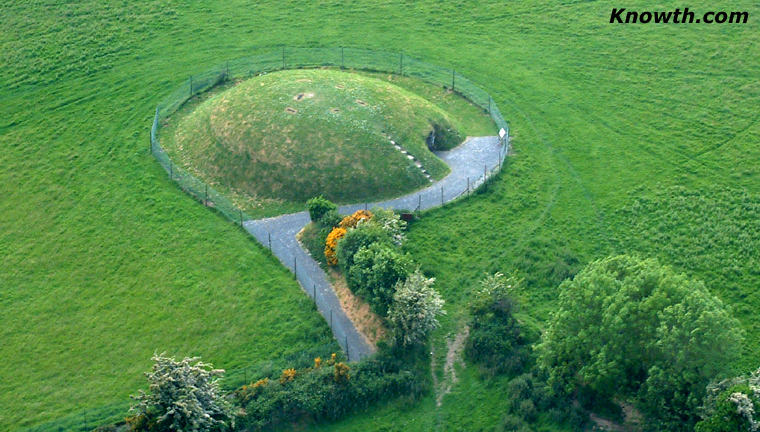 Fourknocks aerial view
This might suggest that although general principles were at play, particular assemblages were mostly created, contrasted and juxtaposed in more fluid, improvised and performative ways. I consider how these notions are amplified when one removes a 'dialectical' perspective that perpetuates modern dichotomies. The possible effects of these passage tomb mixtures or performances will be discussed from a visual cultural perspective that seeks to both illuminate the environmental aspects of the evidence, and ask how it acts or acted. In doing so, I consider that there has never truly been a material world distinct from people.
When I was six years old and was given my first lesson by my mother, I was expected
to believe that we were all made of earth and must therefore return to earth.
This did not suit me and I expressed doubts of the doctrine. My mother
thereupon rubbed the palms of her hands together – just as she did in making
dumplings, except there was no dough between them – and showed me the
blackish scales of epidermis produced by the friction as a proof that we were
made of earth.
Sigmund Freud.
Introduction
In this paper I discuss the relationships between the varied elements that were present in some Irish passage tombs. I argue that these 'things' or assemblages are not the passive receptacles and representations of social relations, set within dualist paradigms, but rather mixtures and performances of essences that interrelate with each other. Modern Western understandings of the world are generally based upon the dichotomy of object:subject. These divisions can take on many forms, for instance, nature:social or animate:inanimate.
In an attempt to overcome these divides, some recent writers have employed dialectical approaches (e.g. DeMarrais, 2004, 12; Malafouris, 2004, 59; Meskell, 2004, 249; Robb, 2004, 135; see discussions in Witmore, 2006), which seek to bring these polarisations closer together and enmesh them in complex flows and networks. Yet in attempting to bring these positions or oppositions closer together, these scholars are inadvertently reinforcing an a priori assumption that the elements are indeed separate and pure forms in their own right. Dialectical approaches have also allowed some to argue for hybrids, sublations, fragmentations, montages and networks (see critiques in Shanks 1992; Witmore 2006; Ingold forthcoming).
The weaknesses of these approaches, however, are that they assume that the webs of connections between elements in the world are formed by pure forms (Latour 1993, 55; 1999, 193). Such an understanding allows one to construct the oxymoronic catch-phrase 'object agency' (Webmoor and Witmore forthcoming) which is as Russell (2007, 73) rightly suggests is a 'non-statement'. Instead, I suggest that after Latour (1993), we think of the essences in the world as being mixtures of mixtures. This means that there have never been any pure forms; I propose that we should begin with mixtures, rather than end with them (see also Witmore forthcoming).
To demonstrate how this approach might work I will now consider the mixtures of things that were deposited in some Irish passage tombs. The passage tombs discussed here were constructed from fourth millennium BC through to the third millennium BC, which is broadly the early Neolithic through to the late Neolithic. The ones that I focus on are Newgrange Site 1, Knowth Site 1, Fourknocks I, the Mound of the Hostages, Co. Meath, Sess Kilgreen, Co. Tyrone and Knockroe, Co. Kilkenny (see Figure 1). I look at the mixtures of assemblages deposited via a mixture of passage tombs in an attempt to move along the threads of Ingold's crisscrossed networks rather than remaining looking at his re-tied 'Gordian Knot' (see note)
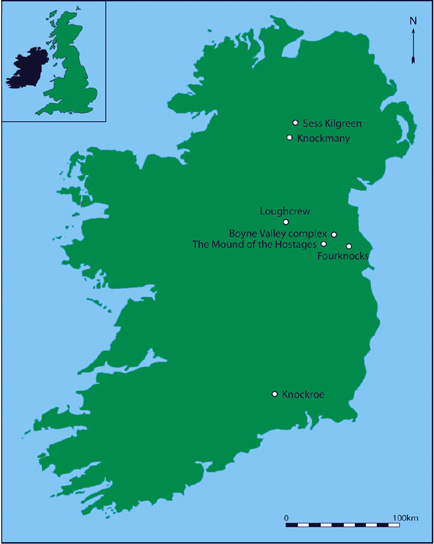 Figure 1. Map of Ireland demonstrating the location of the main sites discussed in this paper (adapted from M. O'Sullivan 1993, 6).
So How Were Things?
Destiny enjoys repetitions, variants, symmetries. Jorge Luis Borges
Standard passage tomb finds include mushroom-headed bone or antler pins, small stone, clay or chalk balls, pendants, beads, stone axeheads and Carrowkeel pottery. Although these specific amalgamations of materials regularly occur, there appear to be no universal imperatives that govern precise combinations or placements. For instance, in the eastern passage tomb at Knowth Site 1, material objects may not have existed in the separate deposits, while at Fourknocks I pottery was absent from some closed contexts, at the Mound of the Hostages one pot contained cremated remains while another smaller one did not, and at Newgrange Site 1 there was no pottery evident (O'Kelly 1982, 122-3; Eogan 1986, 139-40).
This might suggest that although general principles were at play, particular assemblages were mostly created, contrasted and juxtaposed in more fluid, improvised and performative ways (Thomas 1999, 78-9). Such expressions, interactions and interpretations with particular material objects may have facilitated further processes of movement, understanding, transformation and intention. These notions are amplified when one removes an animate:inanimate dichotomy and acknowledges that these objects may not have been regarded as 'dead' or static (Hallowell 1975, 146; Cochrane forthcoming). The possible effects of these passage tomb collections or performances will be discussed further below.
The pendant and bead finds are invariably burnt, suggesting that they were possibly burnt with the bodies (Herity 1974, 124). Previously the occurrence of these smaller assemblages has been interpreted as 'personal' objects that were 'worn by the dead clothed and accoutred as in life' (Herity 1974, 126). Yet, instead of being just personal goods for a particular person, these objects or technologies might have performed in alternative fashions.
This is not, however, to suggest that some people did not adorn themselves in daily life, but rather that in the context of a passage tomb and associated with cremated remains and engraved structural stones, these objects may have operated in more complex ways. Very few of these objects were left in passage tombs by chance, arriving instead through acts of deliberate placement. What we therefore might be witnessing are episodes of deposition that may have related to the construction or disruption of identities of place and the delineation of personhood or being in the world (Pollard 2001, 316).
Note:
This depictive image was created by Tim Ingold in his address to the 'Overcoming the Modern Invention of Material Culture' TAG 2006 session. <Back>