A taste of the unexpected: subverting mentalités through the motifs and settings of Irish passage tombs.
Andrew Cochrane 2005 - Page 2Scaling these slopes might also have impacted upon notions of time and space. The act of climbing might have incorporated different senses of time than were generally used within the daily round. Bloch (1977) has commented that more than one sense of time can often exist in the same society. It is suggested that routine activities may be influenced by the seasons, such as knowing the right times of year to conduct certain events, whereas 'special' activities may involve notions of time that are distinct from or distort the seasons (Bloch 1977). For instance, the summit tops at Loughcrew are generally cooler in temperature than the surrounding lowland areas and can be covered in snow when low-lying areas are not.
This climatic feature might deliver the impression that the passing of seasons is respectively progressed or delayed as one rises up the slopes, with the developmental stages and annual cycles of fauna and flora being different to the lowland ones (Watson 2004, 60). Experiencing the Loughcrew Hills with differing climatic conditions and visibility distorted by atmospherics (Watson 2004, 60), may have lead to concrete testaments to the specialness of the summits.
Such features may confirm a worldview, at some level, in which the Loughcrew Hills are regarded as part of a cosmological axis mundi, a 'Sacred Mountain', 'Cosmic Mountain' or 'navel of the earth', where heaven and earth meet (Eliade 1964, 268). Hill and mountain tops are often regarded by some Tewa people from the American South-west, as an 'earth navel' an inverted hole into the worlds below that allow spirits access from one realm to another (see discussions in Tilley 1994, 65-66), exposing themselves as 'hierophanies', that is something that reveals itself to be special (Eliade 1964, 32). Foucault (2002, 231-33) describes these sites as 'heterotopias', that is a counter-site which can simultaneously juxtapose in a single place several places.
These zones also contest and invert a place while being outside all places, even though one can locate them in a physical reality. These summit tops or island settings may have subverted daily life (see also Bradley 2000, 27). At the Loughcrew summits, at particular times, some members of society may therefore have inverted their normal networks of relations and disrupted how they thought about themselves, others and the world in general. How these themes interact with the passage tombs and associated visual imagery will be discussed in more detail below.
Appetites for construction and disruption
There is currently a lack of direct datable evidence for the Loughcrew complex and estimated dates generally range from c. 4000 - 2800 BC (McMann 1994, 526). Lithic evidence from the area does, however, demonstrate Mesolithic (some time after 7000 cal BC) and extensive Neolithic activity (Cooney 1987; Dillon 1990, cited in Cooney and Grogan 1994, 13; Kimball 2000, 31). This situation has led Cooney (2000a, 158-163) to propose a speculative three phase sequential model for the Loughcrew complex, based on Sheridan's (1985/6) developmental scheme. Cooney (2000a, 159) believes that such an approach allows one to further appreciate how the complex evolved through the actions of some Neolithic people (see also Thomas 1990; 1992; Fraser 1998).What this scheme highlights is that as with the Boyne Valley passage tombs, the larger Loughcrew passage tombs seem to be built after most of the smaller ones (contra Herity 1974, 84-7), with the smaller passage being built in the first two phases. The passage tombs were not all built at the same time, rather there were repetitions, episodes and punctuated performances over time. The settings of the tombs in the final stages draw the spectator's attention to the more level areas at Loughcrew, creating 'stage' settings. It is noteworthy that as soon as one creates a stage, there is gaze and distance, performance and otherness, although particular interactions can subvert or abolish these dimensions (Baudrillard 2003, 27).
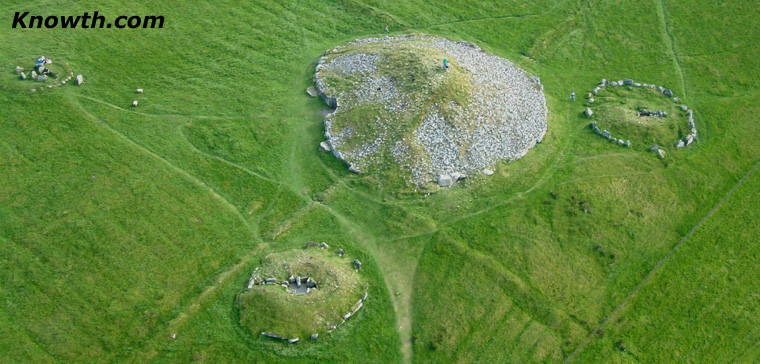
Of the 31 cairns now visible at Loughcrew today (Cooney 1990, 743), seven have intact ground features, while 21 have remaining interior fragments and 17 have partial or complete kerbs (McMann 1994, 526). Many of the visual motifs are deteriorating (15 cairns still have motifs today) and many more have been lost in the last hundred years as a result of weather conditions, erosion, modern afforestation and even by flourishing nettles (Conwell 1866, 365).
The surviving images on do not present the same 'mature' plastic style that was observed at the Boyne Valley passage tombs, and appear more as a collection of random images that are 'crowded onto surfaces in a busy and seemingly unfocused manner' (O'Sullivan 1993, 30). Following O'Sullivan's (1996, 87) typological sequence, none of the motifs progress beyond the Step 1 standard Irish image designs, with the plastic aspects of the stones rarely explored. Due to restrictions of space here and these preservation issues, I will focus on select cairns and their visual motifs to further understand some of the contradictions, past actions and dramas that may have been played out at these sites. Before engaging in the specifics of the archaeological data, I will briefly introduce the concept of the carnivalesque.
Strange lusts and terrifying actions
In attempting to appreciate the Loughcrew summits, I have recently been drawn to the notion of the carnivalesque and its pervasive and influential visual imagery. The word 'carnival' often evokes an image of an amusement park, Disney theme park, or state fair. Historically, however, carnivals in Europe were quite different affairs. For instance, although they share the same ideas of merriment with their modern counterparts, European medieval carnivals were much more all-encompassing. Contemporary carnivals are diminished examples of the physical lusting, mutating and mutilating activities that were played out during some previous carnival environments whilst consuming excessive psychoactive substances (Note 1).Mikhail Bakhtin was one of the first authors to coin the term 'carnivalesque' (1968). He describes the carnivalesque as something that is created when the themes of the carnival subvert, distort and invert habitual or established society. In carnival, all that is marginalised and excluded, such as the mad, the scandalous and the uncertain, takes centre stage and liberates in an explosion of otherness (Stam 1989, 86). In this environment, 'negative' bodily expressions such as hunger, thirst, defecation and copulation become a 'positive' corrosive force; life enjoys a symbolic victory over death. Bakhtin (1968) argued that folk-humour based societies in early modern Europe created manifestations of the carnivalesque that laughed at and mimicked those in authority, who believed that social mentalités, history, destiny and fate were static and unalterable. The carnival is not 'irrational'; it is the bodily immersion into false façades, monstrous creations, feasts, comic rites and protocols, games and dramas, parodies, processions and visual imagery.
It is the 'overlay' of many things and worldviews at once, it is the world turned upside-down, razing and generation coupled with comic, sensuous and abusive performances. It incorporates unbridled juxtapositions, grotesque ruptures and impugnation between binary oppositions and their parodies; it is the mundane routine with fantastical images. Thus it creates an environment where 'everything is pregnant with its opposite, within an alternative logic of permanent contradiction' (Shohat and Stam 2001, 35). Within carnival, all barriers, norms and prohibitions are temporally suspended (Bakhtin 1968, 15). The carnival incorporates a different kind of communication, based on free and familiar contact (Bakhtin 1968, 17; Stam 1989, 86). The term 'carnivalesque' therefore refers to the carnivalising of normal daily life fluctuating within fleeting permanence. It incorporates a number of themes and these can be summarised as follows:
- The activation of life and love and the actualisation of myths, with communal and cosmic reunions.
- Emphasis on sacrifice through the concatenation of life and death.
- The idea of bisexuality and the practice of transvestitism as a release from socially imposed sex or gender roles. This can also incorporate same-sex orientated practices.
- A celebration of the grotesque, excessive bodies, orifices and protuberances, with a rejection of social decorum and polite speech.
- Subversion through the world being turned upside-down, emphasising the permanence of change.
- Anti-aesthetics that illuminate asymmetry, heterogeneity and the oxymoron, while erasing boundaries between spectators and objects or performers (Stam 1989, 93-94).
For the Navajos of Utah, clowns 'open' people up with a mixture of laughter and panic, and when they approach certain spectators 'the smiles of the women and children quickly change to expressions of surprise, tempered with fear' (Tedlock 1975, 107). The children may have cause for alarm as they are often told that the clowns will carry them off and eat them. Certainly the 'Fool Dancers' of the Kwakiut native Americans occasionally kill spectators by throwing stones or stabbing them with sticks (Tedlock 1975, 107). In these examples not everyone has to invert or participate, they can watch if they like (sometimes at some personal risk) (Note 2), while the marginal is briefly brought to the centre. Through these performances the carnivalesque creates more than alternative realities and worldviews, it is life itself, but formed via certain patterns of play (Bakhtin 1968, 7).
Next Page (3)
Previous Page (1)
Note 1:
See Gilmore's (1998) description of Andalusian street carnivals in southern Spain for modern European examples. <Back>Note 2:
In a sense there are no 'real' spectators within carnivalesque environments as all near are immersed within it; they live in it with 'normal' life ceasing to exist during its time-span (Bakhtin 1968, 7). <Back>Boyne Valley Private Day Tour
 Immerse yourself in the rich heritage and culture of the Boyne Valley with our full-day private tours.
Visit Newgrange World Heritage site, explore the Hill of Slane, where Saint Patrick famously lit the Paschal fire.
Discover the Hill of Tara, the ancient seat of power for the High Kings of Ireland.
Book Now
Immerse yourself in the rich heritage and culture of the Boyne Valley with our full-day private tours.
Visit Newgrange World Heritage site, explore the Hill of Slane, where Saint Patrick famously lit the Paschal fire.
Discover the Hill of Tara, the ancient seat of power for the High Kings of Ireland.
Book Now
Home
| Newgrange
| Knowth
| Dowth
| Hill of Tara
| Fourknocks
| Loughcrew
| More Places
| Labyrinths
| Local Info
| Art Works
| Articles
| Images
| Books
| Links
| Boyne Valley Tours
| Contact