Spirals within Spirals, Stones have Stories to Tell
A personal essay by James Nemec (1953-2011) - Page 6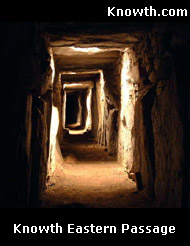 It
was surprisingly cool inside, dank. I had arrived in Ireland during one of those rare
times of year when it was sunny, clear out. It's usually foggy and damp in this part of
the world. My good luck!
It
was surprisingly cool inside, dank. I had arrived in Ireland during one of those rare
times of year when it was sunny, clear out. It's usually foggy and damp in this part of
the world. My good luck!
We came to an opening, a sort of first chamber that had been converted into a small display room. I moved through the crowd to look at the diagrams on the wall of the overhead floor plan of Knowth. I asked our guide, "Excuse me. Does light travel through the Eastern Passage to light up the inner chamber? Like at Newgrange?"
Our tour guide was a sweetie, despite her accent. She said, "No, no one knows." Why did I expect her to say that? Then she corrected herself. "It's possible that light did travel through the passageway, like at Newgrange, however, it could be the ground has settled here over time, knocking the stones out of place."
I wondered, what else was out of place here?
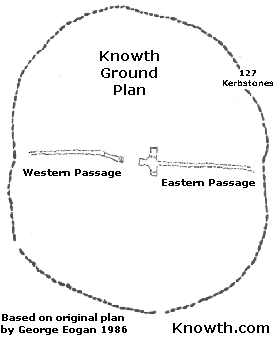 She
pointed out that there were two passageways, unlike at Newgrange, where there
was only one passageway, the passageway to let the light enter the inner chamber
at the Winter Solstice. Two passageways, interesting. Each passageway begins at
opposite ends of the mound that is Knowth. One passageway is shaped very much like
the passageway at Newgrange to end in a small chamber which flares out on either
side, almost in the shape of a cross, however, the other passageway travels most
of the distance of the interior of the mound and then diverges away.
She
pointed out that there were two passageways, unlike at Newgrange, where there
was only one passageway, the passageway to let the light enter the inner chamber
at the Winter Solstice. Two passageways, interesting. Each passageway begins at
opposite ends of the mound that is Knowth. One passageway is shaped very much like
the passageway at Newgrange to end in a small chamber which flares out on either
side, almost in the shape of a cross, however, the other passageway travels most
of the distance of the interior of the mound and then diverges away."Why didn't they connect the passageways?" I asked, not caring what the other tourists thought of me. "Nobody knows that either," she answered. I knew she'd say something like that. Then I said, "It seems you can only get why they don't connect if you see the floor plan." She gave me a sharp look. I wasn't sure what I was talking about myself. "I mean, the overhead view," I said.
"No, no, no. They don't connect because the rocks are so heavy."
"You mean, they could not connect the passageways?"
"Nobody knows why," she said again.
"You mean, they could not connect the passageways?"
"Nobody knows why," she said again.
I kept my mouth shut. All that our very tired guide needed at the end of her day was some wild-eyed American dude pestering her with silly questions. Meanwhile, to connect the passageways together seemed a simple enough task for these ancient builders. If the interior of Newgrange was a symbol of something within, next to everything else that Newgrange seemed to be, then perhaps here inside Knowth was hidden a symbol too. What could it be? Newgrange was about inner light. As my imagination went to work on this, she launched into another description about the second passageway, called the Undifferentiated Passage. This was not the same passageway that ends in a cruciform shape. That day, I'd thought of this passage as the divergent passage because it diverges away, but technically, it's called the "Undifferentiated Passage" because it's hard to differentiate between the passage and the burial chamber at the far end of it. It was one of those archeological terms, I guessed.
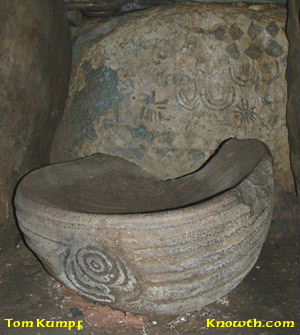 She
then told us a story about a burial stone, or basin stone, at the far end of
the Undifferentiated Passage. She said that someone, no one knows who, really,
after the time of Saint Patrick, had lifted the basin stone from the chamber to
take it completely out of the Undifferentiated Passage, but it was so heavy they
lost their grip and dropped it. It became stuck, for the passageway had become
thinner along the way than the basin itself. The basin stone now blocks part of
that passageway. But if the ancient builders could place that stone, or build a
chamber around it, couldn't they have connected the passageways with relative ease?
She
then told us a story about a burial stone, or basin stone, at the far end of
the Undifferentiated Passage. She said that someone, no one knows who, really,
after the time of Saint Patrick, had lifted the basin stone from the chamber to
take it completely out of the Undifferentiated Passage, but it was so heavy they
lost their grip and dropped it. It became stuck, for the passageway had become
thinner along the way than the basin itself. The basin stone now blocks part of
that passageway. But if the ancient builders could place that stone, or build a
chamber around it, couldn't they have connected the passageways with relative ease?
Was this a choice?
I thought of a phrase current now in popular culture, Only Connect. This site is about connection, I thought. Then it became very clear. For me, it was a symbol about our remembering to connect. It was as much about the lack of sunlight under the ground, the broken cosmic umbilical cord, as it was about sharpness of death. It wasn't about the two passageways so much but about the space in between. The space, the gap, reveals our lack of connection. "What about the gap?" I ventured to ask again. "What gap?" she said. "You know, that huge space between the two passageways." She said, "Nobody knows." Was this another symbol then? Symbol of what? The gap that is filled with longing, the longing to connect, the longing the great mystic poets speak of, Rumi and Hafiz. This gap, I thought, speaks of the soul's separation from our Source that the great Saints speak of, from St. Augustine to St Theresa, the separation from Union, from Spirit, Infinite Intelligence, God, Love, call it what one will, the Fall of Man.
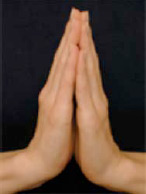
 In
therapeutic bodywork sessions, a client, just by being aware of a "gap,"
aware of a distance, a separation from his or her own body, from family, loved
ones, can be inspired to remember to connect. The recalibration to this
connection can occur by itself, without force, when the ingredient of our
awareness shines within the hidden chamber. To discover this from the layout of
an ancient Earth structure was major for me. Even here, there was love, even
here, the symbol of one's Union with Source. And the lack of one's connection.
The separation. Even here, there was consideration, kindness, longing. Just to
look at the floor plan, as a tourist, the end of the Undifferentiated passageway
was shaped almost like a hand reaching out to something more, something greater.
It was the elegant shape of an outstretched and open palm. It was an image of
caress and of longing through the darkness. Was there more to these primitive
peoples than could possibly be imagined, or was it just me? My friend was
nowhere to be seen. Who could I share this with? When we can remember to
remember, then the dry, thankless task of observing the self, moment by moment,
opens to the Real. When we can remember, we can open even the Cosmos. And by
"Cosmos," I don't mean just this Universe! Again, I recalled the teaching long
known in Western Christendom, although seldom understood: "If thine eye be
single, thy whole body will fill with light."
In
therapeutic bodywork sessions, a client, just by being aware of a "gap,"
aware of a distance, a separation from his or her own body, from family, loved
ones, can be inspired to remember to connect. The recalibration to this
connection can occur by itself, without force, when the ingredient of our
awareness shines within the hidden chamber. To discover this from the layout of
an ancient Earth structure was major for me. Even here, there was love, even
here, the symbol of one's Union with Source. And the lack of one's connection.
The separation. Even here, there was consideration, kindness, longing. Just to
look at the floor plan, as a tourist, the end of the Undifferentiated passageway
was shaped almost like a hand reaching out to something more, something greater.
It was the elegant shape of an outstretched and open palm. It was an image of
caress and of longing through the darkness. Was there more to these primitive
peoples than could possibly be imagined, or was it just me? My friend was
nowhere to be seen. Who could I share this with? When we can remember to
remember, then the dry, thankless task of observing the self, moment by moment,
opens to the Real. When we can remember, we can open even the Cosmos. And by
"Cosmos," I don't mean just this Universe! Again, I recalled the teaching long
known in Western Christendom, although seldom understood: "If thine eye be
single, thy whole body will fill with light."
Could even a child get this?
It's enormously difficult to describe this in plain English. Perhaps, like James Joyce, I would be better off creating a language of my own to evoke that LIFE which is with us, and that which we ignore. Whether the light traveled through the one passageway at Knowth, the passageway that ends in the shape of a cross, like at Newgrange, wasn't important now. For the lesson of Knowth, the lesson that was created by the wisdom in the body—and by the communal body of many working together in a mutually felt necessity—was mainly to remember. And for my tourist's euro, this seemed a teaching that at the time of its making by those ancient builders, wasn't "esoteric" at all. It was made from the wisdom in the body.
Was I onto something?
What else could I learn today?
We began to spill out of the miniature museum, and at this point, I felt compelled to depart the tour. I went up to the top of the mound and looked at the surrounding countryside. Eileen had told me that the Hill of Tara, which was once the seat of the High Kings of Celtic Ireland, was not far in the distance. I knew that the Newgrange mound was somewhere in the other direction but it did not concern me somehow. I tried to focus on opening myself energetically to the top of the Knowth mound. I'd had a tiny sense of the history from the tour guide and of those who had settled here, but the overall feeling of the top was that it was a rather ordinary place. Just another hill in Ireland. I started to think and think of the pictures in the museum, of the timelines there, the historical data. I knew I could become swept away with the details gathered by archeologists, geologists, and mystic seekers. I could obsess on getting everything right. But after all the data, what did anyone know? It seemed the best way for me was to not know. It then became very clear to me, in that moment, to learn about this place not by what I might think about it, but by what I might feel about it. "What am I feeling now?" I asked myself. My answer was, I wasn't really feeling anything here at all. Another hill, another mound, ordinary.
There was a quality of stillness. Well, the ordinary has a lot to recommend it, I thought. I again looked at the view and surrounding smaller mounds of Knowth. I wished I could stay longer and explore. On some level, I knew this was not to be experienced by the mind, or by the thinking, it was to be experienced with something more, but what? The body. Why not? I picked up a rock. I feared I would be discovered and corrected by the authorities if I tried to cart a rock away. I dropped it. It was nothing special, anyway, just another rock at a tourist place. I then turned full around and found myself walking down the steps of the mound with an increasing urgency. I knew that the tour was about to end, but there was something more, something deeper. I took a sharp right off of the mound and slipped over to one of the first supporting rocks there. I wasn't sure what I was doing. It was something my body was doing. What is it to let the body do what it does? It's kind of going along with the flow. It's more feeling than just thinking. For some, it may feel like the movement of a dance, when you just let go and let your body move in ways your body knows best. Or the movement of a finely attuned actor onstage in the moment of performance.
I went to the first rock that drew my attention. It wasn't one of the most spectacular. I went down to my knees. This disturbed me. Why kneeling down? I had already had a sense of the destruction that can occur when a place such as this is worshipped as an external object. In my mind, to kneel and worship this place didn't work for the later generation Celts. Or whomever it was that screwed up. And it would not work for me now. This was not a place to worship, this was a place to BE. I stood back up. I looked around to either side of me. No one was around.
Why not just stop?
Boyne Valley Private Day Tour
 Immerse yourself in the rich heritage and culture of the Boyne Valley with our full-day private tours.
Visit Newgrange World Heritage site, explore the Hill of Slane, where Saint Patrick famously lit the Paschal fire.
Discover the Hill of Tara, the ancient seat of power for the High Kings of Ireland.
Book Now
Immerse yourself in the rich heritage and culture of the Boyne Valley with our full-day private tours.
Visit Newgrange World Heritage site, explore the Hill of Slane, where Saint Patrick famously lit the Paschal fire.
Discover the Hill of Tara, the ancient seat of power for the High Kings of Ireland.
Book Now
Home
| Newgrange
| Knowth
| Dowth
| Hill of Tara
| Fourknocks
| Loughcrew
| More Places
| Labyrinths
| Local Info
| Art Works
| Articles
| Images
| Books
| Links
| Boyne Valley Tours
| Contact