David Sweetman (1938-2023) | Irish Archaeologist
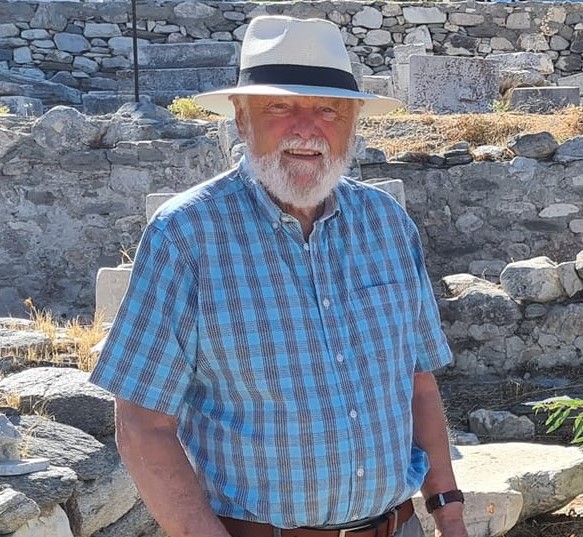
David Sweetman - former Chief Archaeologist of Ireland
David Sweetman held the position of Chief Archaeologist with the Office of Public Works from 1994 until his retirement in 2003. A native of Johnsbrook House, Girley, Co. Meath, David was educated at Glenstall Abbey before spending a period working and playing rugby in Canada after his Leaving Certificate. He returned to education in 1963 and began a degree in economics, history and English, before dropping English and economics and transferred into early Irish history, where he studied under Professor Ruaidhri de Valera at the Department of Archaeology, as well as George Eogan and Michael Herity.
He received his BA in 1966 and, after a year's research in Calgary, Canada, where he went to Bloody Falls with Robert McGhee to study the height of sea level in prehistory, he received his MA in 1969. He joined the National Monuments Service of the Office of Public Works the following year. One of his most significant publications was in 1978, when he published Archaeological Excavations at Trim Castle Co. Meath, 1971-74, the Republic of Ireland's first major medieval excavation report. He also undertook ground-breaking excavations of early Bronze Age enclosures at the Bend of the Boyne, Monknewtown and at the Newgrange passage tomb.
The Archaeological Survey of Ireland is regarded as his greatest contribution to Irish archaeology. These are large, attractive, uniform volumes that provide a brief summery of every known archaeological monument in each county. During Sweetman's period as Chief Archaeologist, the 'Record of Monuments and Places' became the primary planning guide in terms of archaeology.
In retirement, Mr. Sweetman continued to work as a consultant archaeologist for development projects and advised those seeking to restore tower houses as private residences. Patrick David Sweetman died on October 29th 2023 at the age of 85.
David Sweetman - Irish Archaeologist
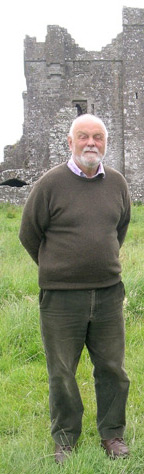 David
Sweetman, MA, FSA, MRIA is the former Chief Archaeologist of Ireland.
The photograph is from the Irish Archaeological Field School excavation
at Bective Abbey in 2009.
David
Sweetman, MA, FSA, MRIA is the former Chief Archaeologist of Ireland.
The photograph is from the Irish Archaeological Field School excavation
at Bective Abbey in 2009.
When David was with the Office of Public Works in 1982, there was a significant discovery at Newgrange. A Beaker House alongside a crematorium and burial ground were discovered about 100 yards from the passage grave.
David is author of The Medieval Castles of Ireland. Blarney Castle, Bunratty Castle and Dublin Castle are three of the most recognisable and well-known castles in Ireland but how many of us really know why and how they were built and who lived in them? There are many castles dotted throughout Ireland and each one has its own story to tell, its own history to reveal.
The conquest of Ireland by the Anglo-Normans brought dramatic changes to the Irish landscape. Prior to 1169 castles were not a common architectural feature. The Irish relied on their natural surroundings bogs and woods for protection from marauding forces unlike the conquering Normans who developed strongholds as a means of defence. Annals from that time indicate that the country was full of foreigners and castles.
Initial fortifications were made of earth and timber and later of stone. However, not all castles were built for military purposes. Many were constructed for long-term occupation. David Sweetman looks at the six main fortification types built in Ireland from 1169 onwards: Timber and earthwork castles, large stone fortresses, hall-houses, later medieval fortresses, tower and fortified houses, and stronghouses.
Books by David Sweetman
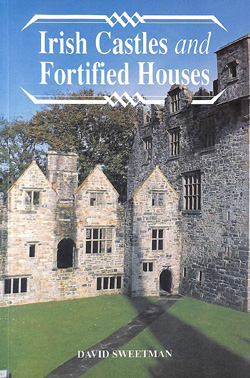 Irish Castles and Fortified Houses -
The arrival of the Anglo-Normans in Ireland in 1169 marked the beginning of castle building in Ireland.
The earliest castles, known as mottes, were built of wood and clay, and the speed of their erection coupled with the Normans
fighting skills meant that land quickly conquered could be securely held. By 1200 these fairly simple yet effective structures
were already being replaced by large stone fortresses.
Irish Castles and Fortified Houses -
The arrival of the Anglo-Normans in Ireland in 1169 marked the beginning of castle building in Ireland.
The earliest castles, known as mottes, were built of wood and clay, and the speed of their erection coupled with the Normans
fighting skills meant that land quickly conquered could be securely held. By 1200 these fairly simple yet effective structures
were already being replaced by large stone fortresses.
These first stone castles were built to dominate and intimidate and, in the beginning, were seldom used as permanent residences. The size and layout of the castles varied considerably depending on the suitability of the site and the availability of finance, skilled labour and materials such as stone. To a great extent the building of castles ceased after 1300, but recommenced in the fifteenth century with the introduction of the tower house. This concise exploration of the origins, features and functions of Ireland's castles and fortified houses will provide a useful, easy-to-read guide for the interested layperson.
Purchase at Amazon.com or Amazon.co.uk
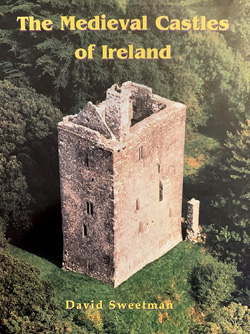 The Medieval Castles of Ireland is a definitive study of the archaeology of Irish castles, from the middle ages to the seventeenth century,
covering well over four hundred castles and earthworks. The great age of Irish castle-building began with the arrival
of the Anglo-Normans, traditionally dated to 1169, and continued right up to the seventeenth century.
The Medieval Castles of Ireland is a definitive study of the archaeology of Irish castles, from the middle ages to the seventeenth century,
covering well over four hundred castles and earthworks. The great age of Irish castle-building began with the arrival
of the Anglo-Normans, traditionally dated to 1169, and continued right up to the seventeenth century.
This account of the development of Irish castles proceeds chronologically from the large earthwork and stone castles introduced by the Anglo-Normans, through the later medieval hall housesand tower houses, to the strong houses and fortified houses which marked the end of the medieval period. Blarney Castle and Bunratty Castle are famous surviving examples of medieval castle-building, but as this book shows, they are in good company, and there are many others to be found in whole or in part throughout the country. The volume is lavishly illustrated with 200 original drawings and photographs.
Purchase at Amazon.com or Amazon.co.uk
Danestown Ringfort (Ringwork Castle)
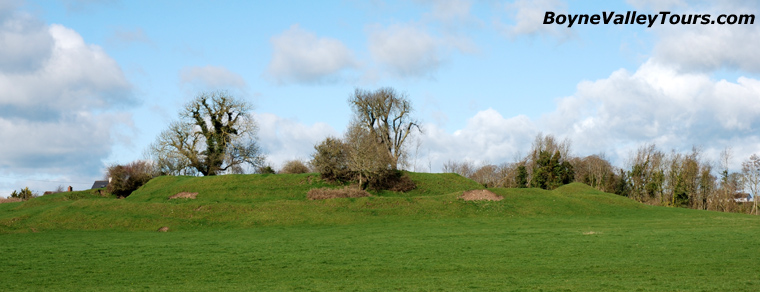
Danestown Ringwork Castle
The earthwork at Danestown in the Boyne Valley has traditionally been classified as a Ringfort however the Archaeologist David Sweetman has re-classified Danestown as a Ringwork Castle. Ringforts are farmstead dwelling places of the native Irish, Ringwork Castles are Anglo-Norman fortifications dating from the late 12th century. Medieval churches are often located close to Ringwork Castles, at Danestown the ruins of a medieval church are located in a cemetery 100 metres from the earthwork.
Boyne Valley Private Day Tour
 Immerse yourself in the rich heritage and culture of the Boyne Valley with our full-day private tours.
Visit Newgrange World Heritage site, explore the Hill of Slane, where Saint Patrick famously lit the Paschal fire.
Discover the Hill of Tara, the ancient seat of power for the High Kings of Ireland.
Book Now
Immerse yourself in the rich heritage and culture of the Boyne Valley with our full-day private tours.
Visit Newgrange World Heritage site, explore the Hill of Slane, where Saint Patrick famously lit the Paschal fire.
Discover the Hill of Tara, the ancient seat of power for the High Kings of Ireland.
Book Now
Home
| Newgrange
| Knowth
| Dowth
| Hill of Tara
| Fourknocks
| Loughcrew
| More Places
| Labyrinths
| Local Info
| Art Works
| Articles
| Images
| Books
| Links
| Boyne Valley Tours
| Contact